From Cyriacus Nnaji, Lagos
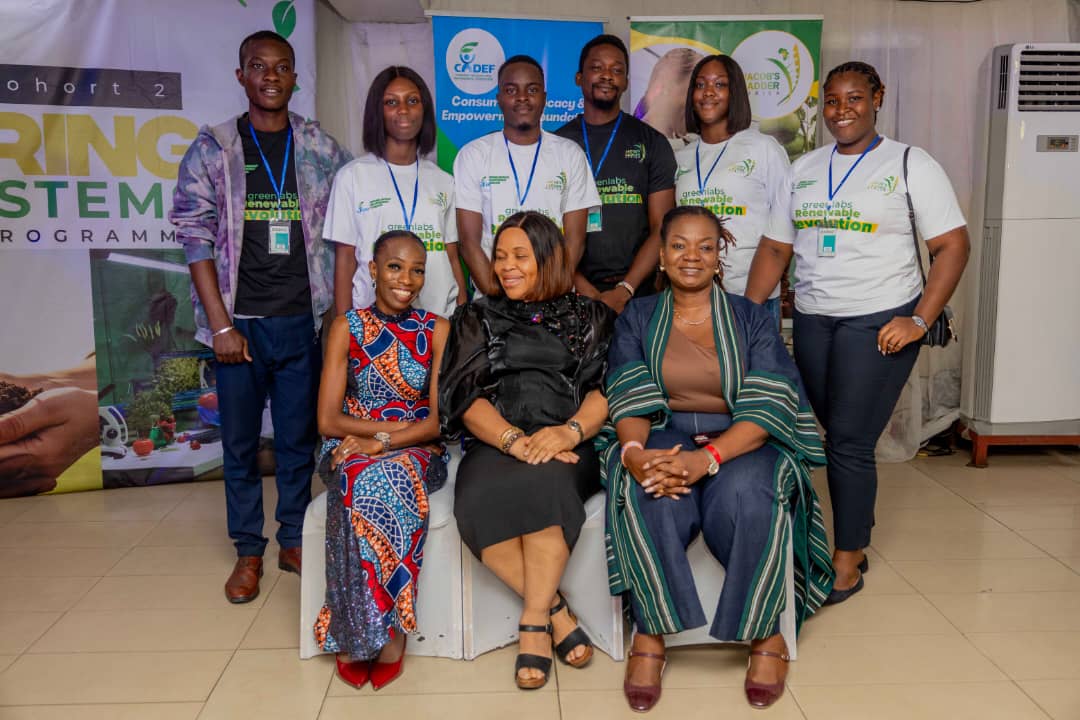
Youth-driven innovation aimed at confronting Nigeria’s deepening food insecurity and climate pressures took centre stage on Friday as the Greenlabs Incubation Programme unveiled breakthrough solutions at its Cohort 2 “Powering Food Systems” Demo Day.

Powered by the Consumer Advocacy and Empowerment Foundation (CADEF) in partnership with Jacobs Ladder Africa (JLA), the initiative is positioning young innovators at the forefront of efforts to rebuild fragile food value chains, reduce post-harvest losses and deploy renewable energy across agricultural systems nationwide.
Launched on January 22, 2026, the Greenlabs Powering Food Systems Innovation Challenge attracted applications from across the country.
Following an intensive mentor-guided innovation sprint and multi-stage screening process, 16 innovators presented solutions, with Geocycle, Leovia Farms and Ecobag Mart emerging as finalists.
In an outcome underscoring the programme’s emphasis on scalability and real-world impact, Geocycle, Ecobag Mart and Leovia Farms secured top honours and pre-seed funding to accelerate prototype development, formal business registration, market validation and early entry into the marketplace.
All finalists will proceed into a structured nine-month incubation programme designed to transform early-stage ideas into sustainable green enterprises through expert mentorship, enterprise training and access to growth resources.
Delivering the keynote on behalf of the Permanent Secretary, Ministry of Agriculture and Food Systems, Emmanuel Audu Fatai, declared that innovation is no longer optional to Africa’s food future.
“Today’s innovators are rewriting tomorrow’s food economy. This initiative moves beyond sustainability rhetoric to equipping young Africans with the tools to build it,” he said.
He highlighted the continent’s enduring contradiction of vast agricultural potential coexisting with food shortages, climate stress and weak value chains, stressing that modern food security now lies at the intersection of energy, technology, finance, climate policy and innovation.
Government backing for sustainable agriculture was further reinforced by Lagos State’s ongoing programmes, including the Lagos Agrithon, Agri-Innovation Summit, Food for Lagos Programme, Agri-Premiership Programme and the Lagos Agricultural Scholars Programme, all targeted at boosting production, youth participation and climate-smart farming.
Environmental authorities also signalled support for circular-economy approaches such as waste-to-energy solutions, pointing to growing institutional alignment around green transformation.
Executive Director of CADEF, Prof. Chiso Ndukwe-Okafor, described the Demo Day as a critical bridge between invention and enterprise.
“This is where ideas become businesses. Beyond pitching, we are building founders who can create jobs, scale responsibly and sustain impact,” she said, noting that the incubation framework embeds financial discipline, integrity, business lifecycle knowledge and entrepreneurial mindset development.
Chief Innovation Officer at Jacobs Ladder Africa, Karen Chelang’at, said the challenge deliberately pushed innovators to confront practical food-system failures with renewable-energy solutions capable of reducing losses, improving yields and strengthening value chains in sectors such as poultry and aquaculture.
“Funding is only the beginning. The real success will be market-ready businesses that create jobs and deliver measurable community impact,” she said.
Organisers maintained that government action alone cannot resolve Nigeria’s food and climate challenges, stressing that cross-sector partnerships and youth-led enterprise will be decisive in building resilient and sustainable food systems.
With scalable solutions advancing toward incubation and market entry, the Greenlabs Cohort 2 Demo Day signals a shift from policy dialogue to youth-powered execution in Nigeria’s pursuit of food security and a green economy.