By Kayode Aberdeen
Victor-Marie Hugo, a French poet, novelist, and essayist died more than two centuries ago but there still stands some immortal and memorial thoughts he blessed the world with before his demise in 1885. Hugo said that: “There is one thing stronger than all the armies in the world, and that is an idea whose time has come”.
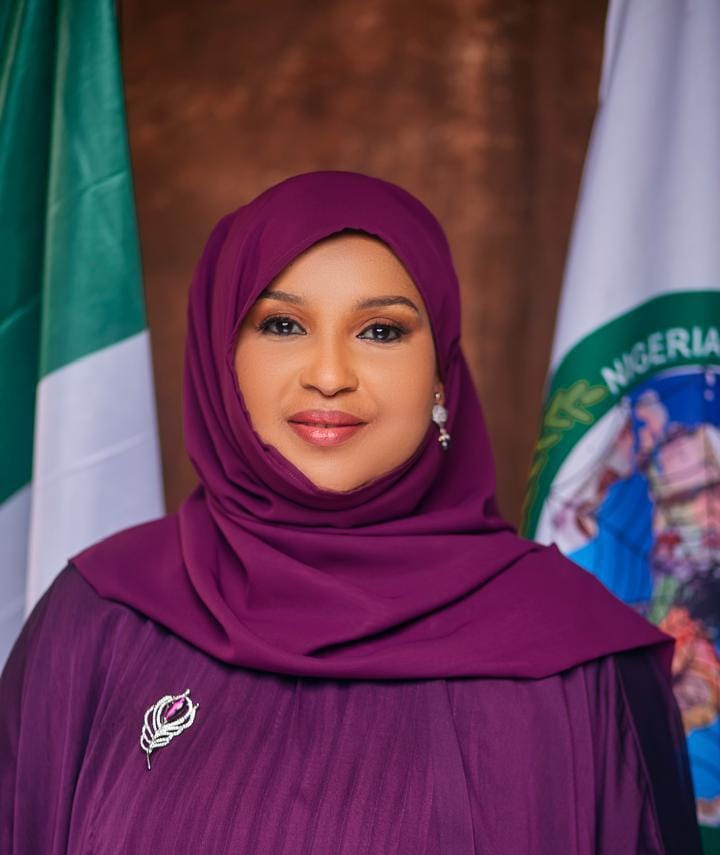
These thoughts bear striking parallelism to the fecundity of fresh ideas, vision, and drives which Hafsat Bakari, Director and CEO, Nigerian Financial Intelligence Unit (NFIU) has brought to refashion and redefine the anti- Money Laundering and Terrorist Financing in Nigeria. In just two years, by dint of hard work, courage, and clear-minded focus, Hafsat has brought to the NFIU, and indeed, the entire nation what an average leader may not be able to accomplish in 5 years.
Whoever advised President Bola Ahmed Tinubu to appoint Hafsat Bakari as the Director/CEO of Nigerian Financial Intelligence Unit NFIU, has offered one of the most patriotic and generational services to our nation.
Her appointment by president Bola Ahmed Tinubu on the 20th of February,2024 and her subsequent confirmation by the senate on the 27th, Febuary,2024, did not come as a surprise to many Nigerians, owing to her sterling career while in EFCC.
When Nigeria was placed on the Financial Action Task Force (FATF) grey list in 2023, few believed the country could swiftly reverse its fortunes. The designation, a diplomatic rebuke signalling strategic deficiencies in anti-money laundering and counter-terrorism financing controls, sent ripples through the global financial community. Banks became wary, foreign investors grew hesitant, and Nigeria’s reputation took a blow.
But in a little over two years, the story has changed. On 24 October 2025, Nigeria officially exited the FATF grey list, reclaiming its place among compliant nations and reigniting investor confidence.
Her leadership, is marked by methodical precision and institutional discipline, that has been instrumental in restoring global faith in Nigeria’s financial system. Since assuming office, Bakari has focused less on speeches and more on systems strengthening the NFIU’s operational architecture, deepening inter-agency collaboration, and ensuring Nigeria’s compliance framework meets international standards. “Our removal from the FATF grey list reflects Nigeria’s commitment to transparency, accountability, and the rule of law in financial transactions. It is a collective victory for the country’s financial system and for all agencies that worked tirelessly to achieve it,” she said after the announcement.
According to her, Nigeria’s exit from the grey list followed rigorous evaluations and sustained reforms led by the NFIU in partnership with key institutions such as the Central Bank of Nigeria (CBN), Securities and Exchange Commission (SEC), Corporate Affairs Commission (CAC), the Economic and Financial Crimes Commission (EFCC), and the Independent Corrupt Practices and Other Related Offences Commission (ICPC).
Together, these agencies addressed FATF’s 30-item action plan, closing regulatory gaps, enhancing risk assessments, and improving financial intelligence sharing. Bakari’s leadership has also been defined by her insistence on professional competence.
For those who have been following the strides of operational works of the NFIU in the last two years, conscious and determined efforts have been going on against money laundering and terrorism financing.
In the area of organisational restructuring, Bakari has introduced sweeping reforms to align with global best practices, by creating Eight thematic sectors that address core operational and administrative efficiency.
Under her watch, the NFIU, in collaboration with the Deutsche Gesellschaft für Internationale Zusammenarbeit (GIZ), recently organised a two-day capacity-building workshop for Anti-Money Laundering and Counter-Financing of Terrorism (AML/CFT) officers working in Nigeria’s Free Trade Zones. The training focused on strengthening technical skills, improving compliance tools, and reinforcing trade transparency. This hands-on approach to reform reflects Bakari’s broader vision: building durable systems rather than temporary fixes. Her background at the EFCC, where she once led the strategy and reorientation unit, equipped her with the discipline to turn institutional challenges into measurable progress. Colleagues describe her as deliberate, organised, and quietly relentless the kind of leader who prefers results to rhetoric.
Her efforts have not gone unnoticed internationally. At the FATF plenary in Paris, the organisation’s President, Elisa de Anda Madrazo, commended Nigeria for demonstrating “strong political commitment and visible improvements in transparency, enforcement, and beneficial ownership reporting.” She credited the country’s inter-agency coordination and government-wide reforms as key factors behind the delisting. Bakari, in turn, credited President Bola Ahmed Tinubu’s administration for providing the political backing that made reform possible. “The Presidency’s support was instrumental in completing the FATF Action Plan and aligning Nigeria with international standards,” she said. The presence of three Nigerian ministers, Justice Minister Lateef Fagbemi, Finance Minister Wale Edun, and
Interior Minister Olubunmi Ojo at the FATF plenary underscored that commitment.
Nigeria’s return to the FATF white list carries economic significance beyond regulatory compliance. It boosts investor confidence, lowers the country’s financial risk profile, and opens the door to renewed foreign partnerships.
International banks and investors can now engage Nigerian institutions with fewer compliance barriers, reducing transaction costs and improving cross-border flows. For President Tinubu’s economic team, the timing could not be better.
The FATF endorsement supports ongoing fiscal and monetary reforms from the unification of exchange rates to efforts at stabilising the naira and attracting foreign investment. It signals to the world that Nigeria’s financial environment is becoming more transparent and less risky. The benefits also extend to Nigeria’s digital economy. With stronger AML/CFT compliance, fintech firms and digital payment operators can now access global markets with fewer restrictions. Venture capital inflows and cross-border partnerships are expected to grow, reinforcing Nigeria’s status as Africa’s fintech hub.
Yet for Bakari, the work is far from over. She is cautious about celebrating too soon, aware that maintaining credibility demands constant vigilance. “Our focus now is on sustainability, ensuring that the systems we have built remain effective and that Nigeria never returns to the grey list,” she said. To that end, the NFIU is investing in advanced analytics, expanding its data-sharing networks, and fostering stronger ties with global partners such as the Inter-Governmental Action Group against Money Laundering in West Africa (GIABA). These efforts are designed to keep Nigeria ahead of evolving threats in financial crime and ensure long-term compliance.
Hafsat Bakari’s rise from a dedicated EFCC officer to the head of Nigeria’s top financial intelligence agency mirrors the country’s own journey, from vulnerability to credibility.
She does not command attention with grand speeches or political posturing; instead, she works behind the scenes, building systems that endure. In an era where trust and transparency are the ultimate currencies, Bakari stands as a symbol of what steady, principled leadership can achieve.
Nigeria’s removal from the FATF grey list is not just a bureaucratic milestone; it is a restoration of national confidence and a testament to what quiet reformers can accomplish. Through discipline, collaboration, and an unyielding commitment to integrity, Hafsat Bakari has done more than reform an institution, she has helped rebuild Nigeria’s credibility in the eyes of the world.
As Bakari continues to strengthen the country’s financial ecosystem, she is also not loosing sleep of the Non-Profit Organisations, (NPO) who are also playing key roles in the financial civic space. The major key stakeholders recently met to discuss measures to prevent abuse by terrorists using (NPO) as conduit to advance money laundering and terrorism financing, thereby undermining legitimate humanitarian and development work of charity organisations in the country.
This focus shaped discussions at a 2-day high-level multi-stakeholder dialogue on NPO Financial Inclusion, jointly organised by the Nigerian Financial Intelligence Unit (NFIU), the Special Control Unit Against Money Laundering and, International IDEA.
Speaking on behalf of the CEO of the Unit, Hafsat Abubakar Bakari, at the commencement of the dialogue on January 26, 2026, the Head of the Development Partner Coordination Office, Dr. Faisal Dikko, stressed that vigilance against terrorist financing remains non-negotiable.
He noted that Nigeria is moving away from blanket restrictions towards a targeted, risk-based approach aligned with the 2023 update to FATF Recommendation 8, designed to isolate illicit actors while protecting genuine charities, particularly at the grassroots.
Key outcomes of the two-day forum include improved regulatory alignment, tailored KYC protocols for small and community-based NPOs and, the establishment of a joint technical working group to sustain coordination and problem-solving.
In a bold move to sustain the success story of NFIU, the 2027 FATF Mutual Evaluation Summit organised by the Nigerian Financial Intelligence Unit (NFIU), in collaboration with national and international partners, recently held four-day National Risk Assessment (NRA) Training Workshop in Abuja to strengthen Nigeria’s defences against illicit finance.
The workshop was opened by the NFIU CEO, Hafsat Abubakar Bakari, represented by Chief of Staff, Mohammed Ahmed, who described it as a critical phase in Nigeria’s fight against money laundering, terrorist financing and proliferation financing.
The 2026 NRA, covering the 2022–2025 period, will guide national risk prioritisation, resource allocation and policy responses. It involves about 55 public sector agencies and key private sector stakeholders, and applies the World Bank ML/TF Risk Assessment Toolkit alongside the RUSI methodology for proliferation financing, with focus areas including virtual assets, legal persons, and environmental and natural resources.
The Forum was inaugurated by the Attorney-General of the Federation, represented by Mrs. Vivian Oporomo, with contributions from GIABA and RUSI. Overall, the workshop underscores Nigeria’s experience-driven approach to strengthening its AML/CFT/CPF framework ahead of the 2027 evaluation.
All these institutional transformations of NFIU by Bakari is geared towards one-goal, result-oriented NFIU. No wonder An average NFIU staff today is a watered garden and sufficiently motivated to ply his or her job with contentment and renewed strength. It is, therefore, not surprising that their productivity is rising higher every day. The leadership of Hafsat Bakari is a sweet song on the lips of her staff and buoyant blessings for the whole nation.
Kayode Aberdeen, a communications expert, writes from Lagos.