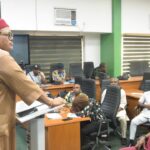
By Chuks Aziken
In the heart of Ika land, a quiet but deliberate transformation is unfolding. At the center of this shift is Dr. Donald Peterson, Special Adviser to the Delta State Governor on Entrepreneurship Development, whose expanding footprint across sectors is steadily redefining development in Agbor and its surrounding communities.
While his name has become synonymous with entrepreneurship and youth empowerment, observers say his most enduring legacy may well lie in education.
Investing in Minds at University of Delta
Education took center stage during the maiden convocation ceremony of the University of Delta (UNIDEL), Agbor, where Dr. Peterson instituted a ₦2 million endowment fund through the D-Peterson Foundation. The initiative was designed not merely as a celebratory gesture, but as a structured incentive for academic excellence.
Under the scheme, ₦1,000,000 was awarded to the Overall Best Graduating Student with a First Class degree, while ₦250,000 each went to outstanding First Class graduates in select departments. The transparency of the process drew commendation from stakeholders, especially when one department had no recipient because the eligibility criteria were not met — a decision widely praised as a reinforcement of merit-based recognition.
Beyond the cash prizes, Dr. Peterson went further by sponsoring the Overall Best Graduating Student from Master’s degree through PhD level. In a move that surprised many, he extended the same Master’s-to-PhD sponsorship to the awardee’s sibling, underscoring his belief that brilliance should never be constrained by financial limitations.
For many in Agbor, the gesture symbolized more than philanthropy; it signaled a long-term investment in intellectual capital and a clear message that excellence will be rewarded.
Bridging Policy and Opportunity
As Special Adviser under the administration of Sheriff Oborevwori, Dr. Peterson’s mandate extends beyond ceremonial roles. His office has aggressively pursued what he describes as “Delta-preneurship” — a strategy blending technology, agriculture and innovation to create wealth from local resources.
Through collaborations with UNIDEL and other institutions, thousands of young people in Agbor have undergone structured training in tech-preneurship and agro-preneurship. Participants receive practical instruction in digital skills, ICT, graphics design, agribusiness management and modern farming techniques.
The impact is visible. Young graduates who once contemplated relocation now speak confidently about startups, digital services and agro-processing ventures. Small tech hubs and agribusiness clusters are gradually emerging within Agbor, creating employment and retaining talent within the community.
Strengthening Primary and Secondary Education Aspirations
Beyond tertiary institutions, Peterson’s advocacy for education resonates strongly among secondary school students. Community sensitization programmes have emphasized the link between education and entrepreneurship, encouraging students to view academic pursuit not just as a path to employment, but as preparation for enterprise creation.
By integrating entrepreneurship awareness into youth outreach initiatives, his office has helped reposition education as both a foundation and a springboard for innovation. Teachers and parents in Agbor communities report renewed enthusiasm among students who now see tangible examples of how academic excellence can translate into opportunity.
Vocational and Skills Development
Recognizing that formal university education is not the only pathway to success, Dr. Peterson has also invested heavily in vocational training. Through foundation-led initiatives, hundreds of youths have been trained in tailoring, shoemaking, hairdressing, barbing and other practical trades.
Crucially, beneficiaries are provided with starter packs and mentorship support, enabling them to transition swiftly from training to enterprise. In neighborhoods across Agbor, newly established micro-businesses stand as evidence of the programme’s ripple effect.
This dual focus — formal education and practical skills — has created a layered development model. While some youths pursue academic distinction at UNIDEL, others thrive through vocational empowerment, ensuring inclusivity across socioeconomic backgrounds.
Agricultural Innovation and Rural Education
In agrarian communities within Ika land, Dr. Peterson’s promotion of modern agro-entrepreneurship has introduced a new learning culture. Workshops on cost-effective livestock feed production, sustainable farming methods and agribusiness planning have transformed agriculture into a knowledge-driven enterprise.
Farmers who once relied solely on traditional methods are now exposed to innovative techniques that improve productivity and profitability. By treating farming as both science and business, these initiatives blend education with economic empowerment.
Women and Community Development
Women in Agbor have also benefited from structured entrepreneurship schemes tied closely to education and training. From catering and fashion to agro-processing, women-led enterprises are expanding, supported by targeted workshops and small grants.
Community leaders note that as women gain skills and financial independence, household stability improves — reinforcing the broader developmental cycle.
Sports, Discipline and Youth Engagement
Understanding that development extends beyond classrooms and workshops, Dr. Peterson has used sports as a complementary tool for youth engagement. The Peterson U-17 Soccer Tournament in Ika land provided a platform for talent discovery, discipline and social cohesion.
While sports may appear distant from education, stakeholders argue that such initiatives cultivate leadership, teamwork and focus — values essential to academic and entrepreneurial success.
A Growing Development Model
Across sectors — education, technology, agriculture, vocational training and sports — a consistent theme emerges: structured empowerment rooted in local realities.
Community leaders in Agbor describe Dr. Peterson as a bridge between state policy and grassroots needs. By leveraging his position to attract resources, build partnerships and personally invest in education, he has carved out a distinctive development model centered on people.
While challenges remain, the visible momentum in Agbor suggests that a culture shift is underway. Academic excellence is being incentivized. Skills acquisition is gaining prestige. Entrepreneurship is replacing dependency.
In the streets of Agbor, in classrooms at UNIDEL, and in emerging business clusters across Ika land, the message is increasingly clear: development is no longer abstract. Through sustained investment in education and human capital, Dr. Donald Peterson is helping to shape a future where opportunity is cultivated at home — and where Agbor stands as a growing example of community-driven progress.
Chuks Aziken wrote in from Abuja