By Felix Khanoba
As political activities gather momentum ahead of the 2027 general elections, the Chairman of the Independent National Electoral Commission (INEC), Prof. Joash Ojo Amupitan, has assured Nigerians of significant improvements in the electoral process, declaring that the next presidential poll would be the best in the nation’s history — even as he conceded that perfection cannot be guaranteed.

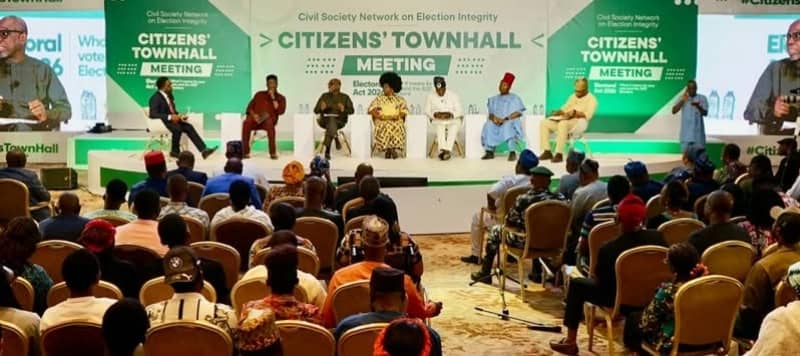
Amupitan spoke on Sunday at a Citizens’ Townhall on the Electoral Act 2026, organised by the Civil Society Network on Election Integrity and broadcast live from Abuja Continental Hotel. The event, themed “Electoral Act 2026: What it means for your vote and the 2027 elections?”, brought together civil society groups, lawmakers, academics, election observers, security agencies and members of the public.
“By the grace of God, the 2027 election will be the best Nigeria has ever had. The electorate of 2027 is more aware and understands the direct correlation between elections and national development,” Amupitan said.
While expressing confidence, the INEC boss tempered expectations.
“Nigerians desire perfect elections, but achieving 100 per cent perfection may not yet be realistic,” he stated, stressing that the commission “cannot guarantee a completely flawless election in 2027, particularly regarding the electronic transmission of results.”
Amupitan identified logistics and result management as central to delivering credible polls.
“So result management and logistics are two basic issues that, from our own end, we’re trying to see how best we’re able to manage them very well, so as to enhance the transparency and credibility of the system,” he explained.
Drawing from recent experience, he cited the FCT Area Council elections where results were promptly released in five councils, while one ward in Kuje recorded delays until the following day.
According to him, the success of any election depends largely on whether it starts on schedule, is conducted peacefully and concludes with transparent collation and declaration of results.
On electronic transmission, Amupitan maintained that INEC has the capacity to transmit results but clarified that the challenge lies in real-time uploads.
Using a banking analogy, he said that just as money may leave an account instantly without the recipient receiving an immediate alert, result transmission may not reflect online instantly despite being successfully sent.
“I don’t see the issue of transmission as a problem; the problem is not the network but the adequacy of the networks we have,” he said.
Addressing concerns arising from the 2023 presidential election, Amupitan insisted that the era of technical glitches was over.
“Regarding the ‘glitch’ that was blamed for issues in 2023, let me be clear: the glitch is eliminated. It will not surface again,” he declared.
He disclosed that his audit of the 2023 polls revealed that while the Bimodal Voter Accreditation System (BVAS) was tested in state elections such as Osun and Ekiti, it was not properly stress-tested for interstate transmission during a nationwide presidential election.
To prevent a recurrence, INEC plans to conduct a nationwide mock presidential election ahead of 2027.
“Moving forward, we will conduct mock presidential elections to ensure that transmission across state lines is seamless before the actual vote,” he said.
“One of the things we are trying to do before the election is to have a mock presidential election so that we are sure that this transmission across the states must not fail.”
He added that the legal proviso permitting alternative collation methods is merely a safeguard.
“It is just a proviso, a safety. If it fails, results must still be transmitted. But our determination is that it will not fail.”
“Election anywhere in the world is now about technology, but before deploying any technology, it is important to test it thoroughly,” he said.
However, civil society leaders faulted aspects of the Electoral Act 2026, particularly the proviso allowing manual transmission when electronic systems fail.
Executive Director of YIAGA Africa, Samson Itodo, urged lawmakers to delete the clause.
“I just wished that the lawmakers eliminated that particular proviso. This is why we made a call to them to commence the process of amending that Act and just delete that particular proviso,” he said.
“That way, as a country we will maximise the utility of electronic transmission of results because it limits human interference, it makes the whole process open and transparent. If politicians are not scared I see no reason why this was not considered in its full breadth.”
Itodo also warned that the compressed election timetable could strain the commission and noted that credibility would be shaped not only by election day performance but by preparation, transparency in resource management, professionalism of officials, the conduct of political actors, and the independence of security agencies and the judiciary.
“And lastly, the vigilance of citizens is what will determine the credibility of the next elections, because democracy is not self-executing. It requires guardians, and the citizens of this great country are the guardians that we need,” he added.
On his part, former INEC National Commissioner, Prof. Okechukwu Ibeanu, said constant tinkering with electoral laws may not solve systemic problems.
“I think there are still gaps and loopholes in the law, and it’s unfortunate that it took us debating about a proviso for the country to come to a consensus that electronic transmission was actually in the 2022 Act.
“But what we have done is actually to take us far back to 2018… We consistently tinker with the electoral legal framework as if that holds all the answers to our electoral problems,” he cautioned.
He urged citizens to take ownership of the process.
“Citizens, this is about you. It is not about politicians; it is not about INEC. Except citizens are in a position to protect their votes and control those who ostensibly represent them, our dream of a truly democratic country will remain an illusion.”
Former INEC Director of ICT, Chidi Nwafor, emphasised the role of security agencies and the judiciary in safeguarding electoral integrity, while urging a review of Sections 50 and 70 of the Act.
Similarly, former Director of Voter Education, Oluwole Osaze-Uzzi, questioned the manual collation fallback.
“Who is the judge when there is a network failure? Is it the electoral officer?” he queried.
For Oluwadara Oluwalana, Head of ICT at the Nigerian Society of Engineers, the country has the technical capacity to make electronic transmission work.
“Yes, I believe telecom operators can come together and make it work. I think we have the capacity now,” he said.
Also speaking, Chairman of the National Assembly’s bipartisan conference committee on the Electoral Act (Amendment) Bill, Adebayo Balogun, maintained that Form EC8A remains the primary source for result collation.
But Senator Victor Umeh, representing Anambra Central, described the INEC Result Viewing Portal (IREV) as a “game-changer,” noting that electronic transmission of Form EC8A was designed to forestall manipulation.
On the political front, the National Chairman of the All Progressives Congress (APC), Nentawe Yilwatda, dismissed claims that the Act favours the ruling party and defended the defection of opposition politicians to the APC.
“Very fair, very fair because you will discover that many of those political parties are already dying,” he said.
“They saw a reason to join us because of how we operate as a party—from party management to organization and mobilization.
“APC seems to be the best party in terms of mobilization, organization, and governance. That provides a leeway for competition. When I go to the market, I have a choice to make: a choice between good governance, good party management, and a transparent system.”
However, ADC chieftain Sam Amadi argued that the INEC chairman’s assurances did not inspire sufficient confidence.
Former Country Director of ActionAid, Ene Obi, also raised concerns over campaign spending limits in the Act, questioning how they would enable less financially endowed Nigerians to contest elections.
“Another thing to look out for is the source of whatever money they are talking about,” she added.
As stakeholders continue to debate the strengths and gaps in the Electoral Act 2026, one consensus emerged at the townhall: the credibility of 2027 will depend not only on technology and legislation but on institutional integrity — and active citizen vigilance.