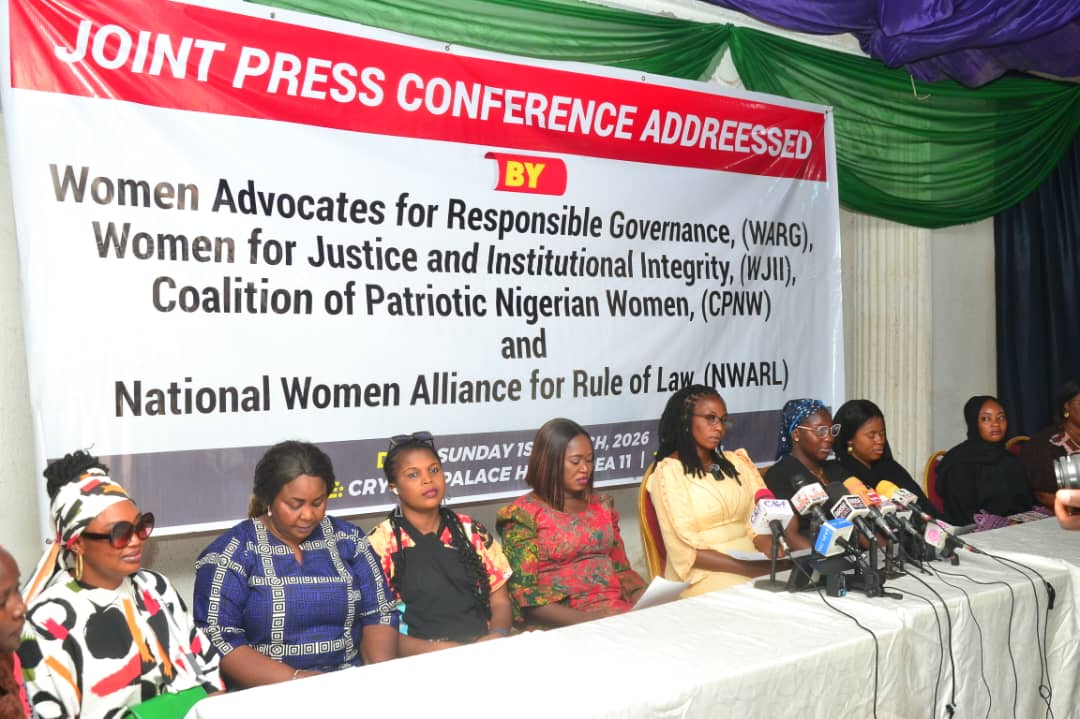
Four women-led advocacy organisations have called for strict adherence to the rule of law in handling allegations against the Minister of Works, David Nweze Umahi, insisting that the matter must be resolved through proper judicial channels rather than social media campaigns.
At a joint press briefing held in Abuja on Sunday, March 1, 2026, Women Advocates for Responsible Governance (WARG), Women for Justice and Institutional Integrity (WJII), Coalition of Patriotic Nigerian Women (CPNW), and National Women Alliance for Rule of Law (NWARL) collectively maintained that accusations attributed to Mrs Tracy Nicholas Ohiri lacked verifiable documentation and should be tested before a competent court.

Addressing journalists, the National President of WARG, Dr Amina Yusuf, expressed concern that unsubstantiated claims were being amplified in a manner capable of undermining governance.
“The issue is not about silencing any individual, but about ensuring that serious allegations are backed by credible evidence,” she said.
Dr Yusuf questioned the basis of a ₦24.5 million transaction allegedly dating back to 2015, noting that such a commercial engagement would ordinarily be supported by contracts, invoices, delivery acknowledgements, and traceable financial records.
“Nearly a decade later, there appears to be no formal demand letter, civil action, or documented effort at recovery if the claim was genuine. Public discourse must not replace legal procedure,” she added.
Similarly, the Executive Director of WJII, Hajia Halimat Bello, emphasised that institutional integrity depends on proof and process.
“Commercial transactions of such magnitude cannot exist without documentation. If the supply truly occurred, let procurement records or evidence of civil recovery steps be presented before a competent court,” she stated.
Speaking for CPNW, Mrs Folake Adeyemi described the allegation as inconsistent with established commercial practice.
“It would be unusual for a multi-million naira supply to remain undocumented and unlitigated for nearly ten years. If this were purely about debt recovery, the appropriate legal remedies would have been pursued long ago,” she argued, warning that emotional narratives should not overshadow legal standards.
On her part, the Chairperson of NWARL, Dr Grace Onuoha, drew attention to what she described as the broader democratic implications of the matter.
“The rule of law is under threat when social media becomes judge and jury. We are supporting the Minister because we defend process, not personalities,” she said.
“Nigeria cannot operate on viral verdicts. Public officials are accountable. But accountability must follow legal channels. File a claim. Submit evidence. Present documentation. Allow judicial determination. Anything outside that framework invites suspicion of ulterior motive.”
She further declared: “We reject trial by ambush. We reject reputational warfare disguised as activism. We reject emotional coercion as a substitute for law. Institutions must be protected. Reputation cannot be destroyed without proof.”
Dr Onuoha stressed that social media must never replace the judiciary.
“When public sympathy becomes the strategy and emotional appeal becomes the evidence, the rule of law is weakened. If documentary evidence exists, it should be tested before competent authorities. If it does not, Nigerians must resist the temptation to become a digital jury in a matter that properly belongs within the justice system,” she said.
In a separate formal statement issued in Abuja on the same day, the National Women Alliance for Rule of Law reiterated its position that “Nigeria deserves maturity. Nigeria deserves discipline. Nigeria deserves justice grounded in evidence.”
The statement was jointly signed by Dr Grace Onuoha, Chairperson, and Dr Maryam Danladi, National Secretary.
Collectively, the four organisations affirmed that their intervention was guided by principle rather than personality.
They reiterated the presumption of innocence and called on Nigerians to refrain from what they termed “trial by ambush,” insisting that allegations, however serious, must ultimately be proven in court and not adjudicated through viral content.