By Cyriacus Nnaji
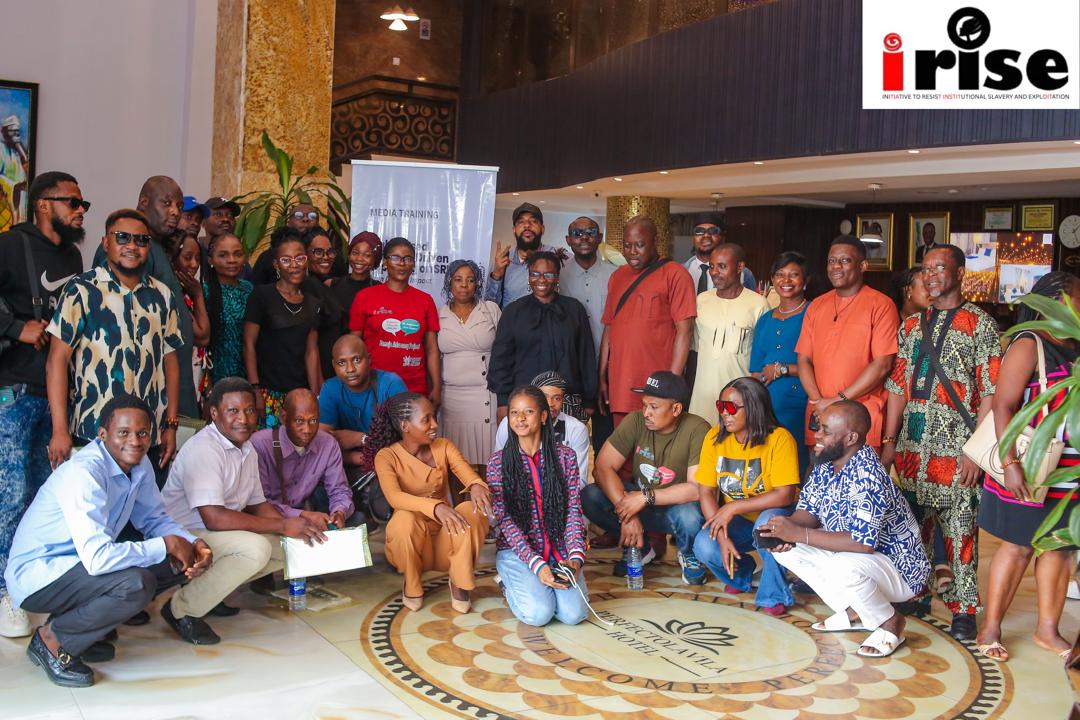
With the vision to ensure a world where gender equality is standard, all forms of violence and exploitation are eradicated, and individuals have a right to make informed decisions about their health; and the Mission to end violence and exploitation, create economic opportunities and champion Health & Reproductive rights, the Initiative to Resist Institutional Slavery and Exploitation, (IRISE) on Thursday, 26 and Friday, 27, February, 2026 gathered journalists at the popular Perfecto La Villa Hotel, Amuwo-Odofin, Lagos, to train them on ethical, rights-based and evidence-driven approaches when reporting sexual and reproductive health and rights (SRHR) issues.

Recalled that in October, 2024, under the PAMOJA Project, IRISE conducted a survey aimed to understand community-specific factors affecting SRHR and the impact of unsafe abortion practices in Oshodi-Isolo of Lagos State.The participants cut across different age groups, educational backgrounds, and occupations.
Key finding showed that currently 50% cite financial barriers to accessing proper care; 70% of community members are aware of
pregnancy terminations, 80% acknowledge health risks of unsafe practices and only 45% know about safe medical options.
The survey also discovered some information gap. From the findings only 40% have received formal health education from qualified professionals, 85% express strong interest in receiving more health information, while limited awareness of available local health services was also discover.
On Community impacts and concerns, the survey identified common unsafe methods including local herb, which was put at 60; unregulated pills 45% and unlicensed providers, 20%. While common risks identified include severe bleeding 55%, infections 50%, long term health complications 45%, and fatal outcomes, 65%. On the whole 50% knew of at least one who died from complications of unsafe abortion.
Social Factors identified include Sigmatisation, religious and cultural considerations, need for male involvement in health decisions, economic barriers affecting access to services, information accessibility challenges, and legal misunderstanding
Notwithstanding, there is need for support systems like Policy makers, women’s support networks, healthcare provider partnerships, community leaders engagement, and economic accessibility solutions.
On the advocacy strategy of IRISE, the group Promotes SRHR education ultimately aimed at ending unsafe abortion in Oshodi Isolo by providing safer options.
IRISE’s Advocacy goals also aimed to improve awareness and understanding of SRHR, Reduce stigma and misconceptions around safe abortion, increase access to safe Abortion and SRHR resources, through local partnership.
Expectedly there are outcomes targeted, to increase health awareness and practices; active community involvement, sustained support system, stronger referral networks, enhanced Community wellbeing, reduced health risks.
According to the Executive Director of IRISE, Omodele Ibitoye Ejeh, while speaking to the Journalists on the PAMOJA Project concluded by saying that the finding showed there was a significant gaps in SRHR knowledge and access, exacerbated by stigma and economic barriers. IRISE’s advocacy plans aims to address these through Community engagement and improved access to services. She said IRISE invites stakeholders to collaborate with IRISE to implement these initiatives and ensuring safer reproductive health practices in Oshodi/ Isolo in Lagos.
Speaking on the training Ejeh said the event was designed to bring media professionals together to examine how sexual and reproductive health issues are being reported and how narratives can influence public perception.
She spoke further that the media plays a critical role in shaping societal understanding of sensitive issues, including abortion and survivors of sexual violence.
She said, “The message is bringing media partners together to look at how sexual and reproductive health and rights are being reported and what picture the media is painting, especially around abortion rights and bodily autonomy,” she said.
Ejeh noted that the programme also aimed to highlight the Safe Termination of Pregnancy guidelines introduced by the Lagos State Government in 2022 to guide service providers in protecting the lives of women and girls.
According to her, the guideline was misunderstood and subsequently suspended shortly after its launch.
“The guideline is not a law promoting abortion. It is meant to guide service providers on how to protect the lives of women and girls from dying due to unsafe practices,” she explained.
She added that IRISE is currently engaging policymakers, community leaders and the media to create awareness about the guideline and advocate for its reinstatement. “Our call to action is that the guideline should be reinstated. Lagos is a pace-setter, and when Lagos leads, others will follow,” Ejeh added.
Ejeh also stressed the need to address stigma and victim-blaming in cases of sexual violence, calling on society to hold perpetrators accountable and support survivors.
Speaking also was the Coordinator of the African Women Lawyers Association of Nigeria, Lagos State Branch, Adesola Bello, who stressed the importance of Ethical Reporting in Cases Involving Survivors of Sexual and Gender-based Violence. She encouraged journalists to avoid judgmental language and ensure that reports do not expose survivors to further trauma.
Defining SRHR from a human right perspective, she said it refers to the right of every person to make decisions about their body free from discrimination, access quality reproductive health services
and enjoy bodily autonomy and dignity.
According to Bello, “Ethical reporting should not be judgmental. Journalists should focus on the perpetrators and the offence committed rather than the survivor’s actions or behaviour,” she added.
Bello further noted that consent must be obtained before sharing survivors’ stories and warned against publishing explicit details that could stigmatise victims.
On challenges affecting prosecution of cases, she explained that stigma often discourages survivors from pursuing justice.
“Sometimes it is not really poverty; it is the stigma survivors are trying to avoid,” she added.
The erudite lawyer also called for continued sensitisation of law enforcement officers to ensure that survivors are treated with dignity and respect.
Bello advised survivors of abuse to seek immediate help at medical centres or report to the gender unit of the police to enable proper investigation and access to justice.
Speaking on ethical practice and reporting she urged journalists to avoid prejudicing court cases for lawyers, “They should make sure they obtain informed consent, protect survivor identity, verify facts, practice trauma-informed engagement, avoid victim-blaming language, maintain confidentiality, and avoid re-traumatization, among other guides.
Esther Udoh, a Data Analyst and Monitoring and Evaluation Officer, IRISE, speaking on the topic, Evidence-driven Reporting: Using Verified Data, Research and Statistics in Stories, Fact-Checking Tips, said that the media has to understand that data is very important. She added that stories without data are just opinions. She said “Data brings credibility, evidence to protect journalists legally, and better strengthen advocacy impact. In chosing data, the data must be very verified, researched and from credible source.
She added that journalists need evidence like Government report, national survey, research studies, policy documents, Court rulings, expert interviews, eyewitness accounts.
Speaking on Multimedia content creation: writing articles, producing short videos, and using social media effectively, Tijani Israel said that data storytelling is the infusion of data, visuals, infographics into narratives used to communicate complex insights effectively and drive action.
On why Rights based reporting matters he said, it reduces stigma and discrimination, informs policies with evidence, empowers communities with information, holds duty bearers accountable, and amplifies marginslised voices.