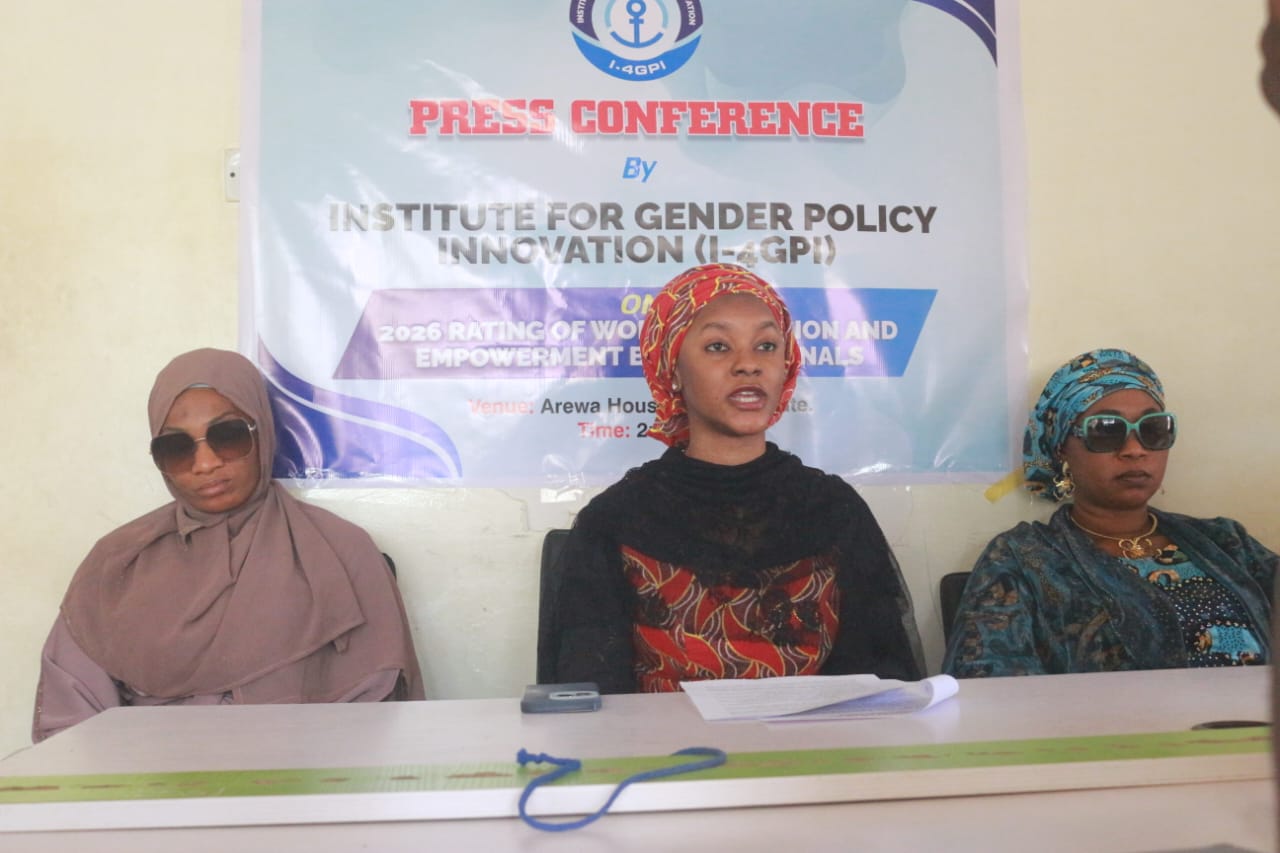
The Institute for Gender Policy Innovation (I-4GPI), an African policy think-tank focused on gender-responsive governance, has identified seven groundbreaking policies introduced by Kaduna State Governor Uba Sani that are reshaping opportunities for women and setting a new national benchmark for gender inclusion in governance.
The policy brief, presented by the Director-General of the Institute, Hajiya Sabrina Wakili, described the Kaduna reforms as “a bold policy shift that is redefining women’s economic access and participation in governance.” It cited a series of deliberate policy frameworks and programmes implemented under the Sani administration.

According to I-4GPI, the most revolutionary among these initiatives is the Gender-Responsive Public Procurement Policy, which has opened government contracting to women on an unprecedented scale.
Under the policy, 20 percent of goods contracts are reserved for women-owned businesses, 10 percent of consulting services are set aside for women, and five percent of works contracts are also allocated to women entrepreneurs. The policy also provides a 100 percent waiver on registration fees for women-owned firms and a 50 percent reduction in tender fees, making it easier for women to compete in public procurement.
The Institute further noted that Kaduna State under Governor Uba Sani became the first subnational government in Nigeria to formally adopt a Gender-Responsive Public Procurement Policy, developed with the support of UN Women and other development partners. The framework also mandates the inclusion of women in procurement committees and requires deliberate measures to expand opportunities for women-owned enterprises.
The Institute described the policy as “a structural intervention capable of shifting economic power towards women in a way no Nigerian state has attempted before.” Analysts have repeatedly cited the procurement reform as a pioneering governance model because it embeds gender inclusion into the legal and institutional architecture of public spending, rather than relying solely on empowerment programmes.
Beyond procurement reforms, the think-tank highlighted the Kaduna State Women Economic Empowerment Fund, which has provided financial support to thousands of women entrepreneurs across the state.
According to the Institute, the initiative has already benefited more than 10,700 women through cooperative financing and small business support, enabling many to start or expand enterprises in agriculture, retail, and food processing.
The report also pointed to the government’s “A Kori Talauchi” poverty reduction programme, which has targeted vulnerable women for economic inclusion. Through the initiative, about 4,900 underserved women have received livelihood support and empowerment packages aimed at lifting families out of poverty.
Another major intervention identified by the Institute is the administration’s HeForShe-style gender advocacy programme, which promotes male leadership support for women’s inclusion in governance, economic activity, and community development.
The policy think-tank also commended the state’s Women Economic Empowerment Policy framework, designed to close gender gaps in employment, finance, and enterprise development.
In rural communities, the Institute noted that the government has invested heavily in skills and agricultural value-chain training for women, with over 5,000 rural and semi-urban women trained in modern rice processing and other agro-processing techniques to boost productivity and incomes.
Another key initiative is Kaduna’s Women Peace and Security Action Plan, which integrates women into peacebuilding and conflict mediation efforts, particularly in communities affected by insecurity.
The Institute also pointed to growing national recognition of Kaduna’s gender reforms. Kaduna State recently won the “Best Government Supporting Women and Their Families” award at the Voice of Women Conference and Awards, a national platform recognising exceptional commitment to women’s empowerment through progressive policies and programmes. Observers said the award highlighted the state’s gender-responsive procurement reforms and other institutional initiatives.
According to I-4GPI, expert commentary from senior officials, including leadership of the Kaduna State Public Procurement Authority, has similarly described Governor Uba Sani’s administration as championing inclusive politics and gender-friendly governance, noting that the procurement policy remains the first of its kind by any subnational government in Nigeria.
The Institute added that while several states—including Akwa Ibom State, Borno State, Cross River State, Edo State, Enugu State, Kano State, Kwara State, Lagos State, Nasarawa State, Plateau State, and Taraba State—have begun exploring gender-responsive policy frameworks, many remain at the planning or early implementation stages.
Some states such as Lagos State and Ekiti State have introduced frameworks encouraging contract opportunities for women-owned businesses. However, analysts say these initiatives are largely still at policy or pilot phases and have yet to match the comprehensive institutional model adopted in Kaduna.
Global policy analysis has also highlighted the broader national gap. Studies by institutions such as the Brookings Institution note that Nigeria does not yet have uniform mandatory gender-responsive procurement requirements nationwide, leaving states to pioneer reforms individually.
At the same time, governance reports indicate that most Nigerian states still struggle with meaningful gender representation and institutional inclusion for women, particularly in political and legislative spaces, even where economic empowerment programmes exist.
Summarising its findings, I-4GPI said the seven initiatives collectively represent “one of the most comprehensive women-focused governance agendas currently being implemented by any state government in Nigeria.”
“The scale, structure and institutional backing of these policies clearly show that Kaduna State is moving beyond rhetoric to practical gender inclusion,” the Institute said.
It added that the reforms demonstrate how subnational governments can use policy innovation to dismantle long-standing barriers limiting women’s participation in economic and public life.
“With these interventions, Governor Uba Sani has positioned Kaduna as a national reference point for gender-responsive governance,” the Institute concluded.