Imagine a world where education goes beyond academics to nurture peace, empathy, and mutual understanding. Education for peace is designed to equip individuals with the knowledge, skills, and values needed to promote harmony, tolerance, and conflict resolution, while also strengthening critical thinking, problem-solving, global citizenship, and socio-emotional learning. By embedding these principles, it seeks to build a more peaceful and cohesive society.
In Nigeria, however, access to education remains a major challenge. A UNICEF report as of 2025 estimates that 10.2 million children are out of school, with the northwest accounting for 45 per cent and the northeast 28 per cent. Persistent insecurity and repeated attacks on schools have worsened the crisis, deepening educational marginalisation—particularly for girls—amid poverty, cultural barriers, and displacement caused by conflict.

Against this backdrop, the Neem Foundation, a non-governmental organisation focused on crisis response and promoting peace and well-being in conflict-affected communities, is taking deliberate steps to address the situation and create opportunities for young girls.
The organisation’s efforts were recently highlighted on the “A Journey of Hope” episode of The Ripple podcast, where its Programme Officer, Ms. Minoe Duamwam, outlined its vision and interventions. She explained that one of the foundation’s core priorities is expanding access to education for girls in the northeast and northwest regions.
Central to this effort is the Lafiya Sarari initiatives, a project funded by the Catena Foundation alongside other partners. The initiative provides quality education and psychosocial support to girls impacted by the Boko Haram insurgency in northern Nigeria. Designed as a safe and nurturing environment, Lafiya Sarari aims to restore a sense of calm and stability disrupted by conflict. Over the past seven years, the programme has enrolled 100 girls who were directly affected by the insurgency.
Ms. Minoe revealed that the Lafiya Sarari initiatives are a project within the education program of the Neem Foundation, created to help address the root cause of violent extremism and prevent further radicalization, empowering young girls to become agents of change in their communities, and the purpose of the program is education for peace.
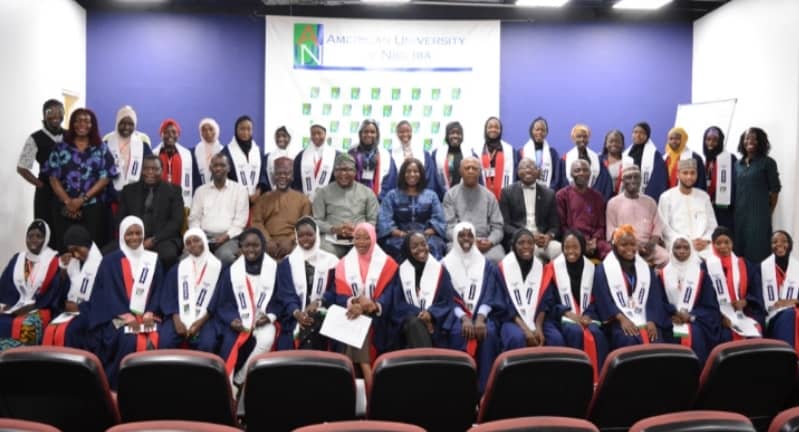
In a move to expand opportunities for beneficiaries, the Neem Foundation partnered with the American University of Nigeria (AUN), a decision anchored on the institution’s reputation for academic excellence. The collaboration enables girls from the Lafiya Sarari programme to access high-quality higher education, improving their prospects and broadening their horizons.
The partnership reflects the shared commitment of both institutions to advancing education and empowering underserved communities. It also demonstrates AUN’s role in fostering impactful collaborations that drive social change. Through this initiative, both organisations are working to equip young girls with the knowledge, skills, and confidence needed to positively influence their communities.
Highlighting the organisation’s broader impact, Ms. Minoe noted that the Neem Foundation has played a critical role in “providing vital psychosocial support to individuals and communities affected by conflict. Through innovative programs like Counselling on Wheels, Deradicalization services, and the Lafiya Sarari initiatives, the foundation demonstrates its commitment to healing and rebuilding communities devastated by conflict,” Ms. Minoe added.
She also commended the American University of Nigeria (AUN) for its high standards and quality of education. “This partnership has enabled the Neem Foundation to empower young girls with top-notch education, aligning with their mission to provide opportunities for marginalized communities.”
According to Ms. Minoe, the decision to collaborate with AUN was influenced by the university’s strong track record. She said “Notably, the Neem Foundation had previously hosted AUN alumni for internships, who consistently demonstrated exceptional skills and work ethic compared to others.” This experience, she explained, strengthened the foundation’s confidence in AUN as a reliable partner in advancing education and sustainable development.
The American University of Nigeria (AUN) continues to earn recognition for its commitment to academic excellence and transformative learning. Its reputation attracts students and partners from across the world, all drawn to its rigorous academic programmes, research opportunities, and dynamic learning environment.
By maintaining high standards, AUN equips students with the knowledge, critical thinking abilities, and skills required to excel in their chosen fields. Its emphasis on intellectual growth, creativity, and personal development has positioned it as a leading institution and a beacon of quality education in Nigeria.