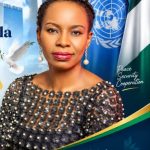
By Chika Ebele Jadesola Orji
What happens after the speeches, resolutions and commitments made in New York?
That question stayed with me as I followed the conversations at the 81st United Nations General Assembly.
Following the conversations and high-level engagements around the 81st United Nations General Assembly, three interconnected issues particularly stood out to me as an international development practitioner and diplomat: peace and security, climate change, and the role of women and local communities in building resilient societies.
In his opening address, UN Secretary-General António Guterres offered a powerful frame for the moment we are in: “These are not separate crises. They are chapters of the same story.”
What struck me most is that, although these issues are often discussed in separate spaces, they are deeply connected at community level. For a smallholder woman farmer, climate change, food security, livelihoods, access to resources and even community stability are not separate conversations.
They are part of everyday life.
- Peace and Security:
One of my strongest observations is that peace and security must be understood beyond the absence of conflict. Sustainable peace requires dialogue, inclusion, trust and the meaningful participation of communities — particularly women, who are often among those most affected by conflict and displacement, while also playing critical roles in keeping families and communities together.
At UNGA81, the African Union’s high-level meeting on Women, Peace and Security reinforced the importance of women’s participation being substantive rather than symbolic. AU Commission Chairperson Mahmoud Ali Youssouf called for women’s knowledge, leadership and mediation capacities to translate into real and sustained influence.
As H.E. Dr. Khalilur Rahman, President of the 81st UN General Assembly, reminded delegates: “Dialogue can be difficult. It can be frustrating. But it is always better than a world in which we stop talking and take up arms.” That distinction matters.
For me, the conversation is no longer simply about whether women are at the table. It is whether they have the influence to shape what happens at that table. Additionally, a reminder that peace is built not only in diplomatic rooms, but within communities, through dialogue, livelihoods, social cohesion and opportunities for people to participate in decisions affecting their lives.
- Climate Change:
Climate change was another area that continued to resonate strongly with me.
President Paul Kagame of Rwanda made a compelling point at the UN Climate Change Summit in New York: “What is urgently required is a shared responsibility for a mitigation and adaptation strategy that leaves no one behind because we are all in this together.”
Those words remain particularly relevant to Africa.
For smallholder women farmers and local communities, climate change is not an abstract global issue. It can mean unpredictable rainfall, drought, flooding, declining yields, disrupted markets, increased post-harvest losses and reduced household income.
And this is where climate change intersects directly with food security.
The question is therefore not simply how we reduce emissions or negotiate climate commitments. It is also how we ensure that women and local communities have access to the resources, knowledge, technologies, finance and infrastructure required to adapt and remain resilient.
- Women, Food Security and the Communities That Sustain Us
Perhaps one of the most important reflections for me is the growing recognition that women farmers are central to the resilience of our food systems.
This is particularly significant in 2026, the International Year of the Woman Farmer. The UN has recognised the important contribution of women across agrifood systems as farmers, producers, processors, traders, entrepreneurs and community leaders and their contribution to food security, nutrition and rural livelihoods.
Yet recognition must translate into opportunity.
Women farmers need more than acknowledgement. They need meaningful access to land, finance, technology, extension services, markets, climate information, infrastructure and decision-making spaces.
This matters because food security does not begin and end at the level of international declarations. It begins in communities with the people who produce, process, preserve, transport and sell food. For a smallholder woman farmer, peace, climate and food security are not separate policy sectors. They are lived realities.
A poor road can mean lost produce.
Inadequate storage can turn a harvest into post-harvest loss.
A climate shock can reduce household income.
Insecurity can restrict access to farms and markets.
And when women are not meaningfully involved in decisions, policies can miss the realities they are designed to address.
Africa as partner, not simply beneficiary
Nigeria’s intervention at UNGA81 also offered an important perspective on Africa’s place in the multilateral system. Speaking on behalf of President Bola Ahmed Tinubu, Vice President Kashim Shettima emphasised that developing countries should be recognised as “indispensable partners” in global solutions and shared prosperity, alongside calls for stronger African representation and reform of global institutions.
That message matters.
Africa has challenges that require international cooperation, but Africa also has knowledge, innovation, resources, markets and solutions to contribute. The relationship must therefore be one of partnership, agency and shared responsibility.
Beyond the Speeches: Where Does Multilateralism Meet the Community?
This is perhaps my biggest reflection from following UNGA81.
The world does not necessarily lack commitments. What remains critical is our collective ability to translate those commitments into action, resources and measurable change.
From peace and security to climate change, food systems and gender equality, the real test of global commitments is what happens when they reach local communities.
For me, the distance between a negotiating table in New York and a woman farmer in a local community should not be measured only in geography. It should be measured by how effectively international commitments translate into policies, resources and opportunities on the ground.
A woman farmer should be able to see the connection between the conversations taking place in global institutions and the realities of her own community; whether that means safer communities, better access to markets, climate-resilient agrifood systems, reduced post-harvest losses, stronger livelihoods or greater influence in decisions that affect her life and future.
This, for me, is the essence of meaningful international development, multilateralism and diplomacy: connecting global commitments with local realities, and ensuring that the people at the heart of our food systems and communities are not only heard, but are able to shape the decisions and outcomes that affect their lives.
Perhaps that is the work before all of us: to keep building the bridge between global commitments and local realities; between the negotiating table and the communities whose lives ultimately give those commitments meaning.
Chika Ebele Jadesola Orji
Policy, Gender, Diplomacy and International Development Practitioner,
Food Systems and Post-Harvest Loss Policy Specialist, and Climate Resilient Food Systems Advocate,
Fellow, African Women in Agricultural Research and Development (AWARD)
Fellow, African Transformer Institute, (ATI)
Chairperson, Peace and Security Committee
Diplomatic Assembly