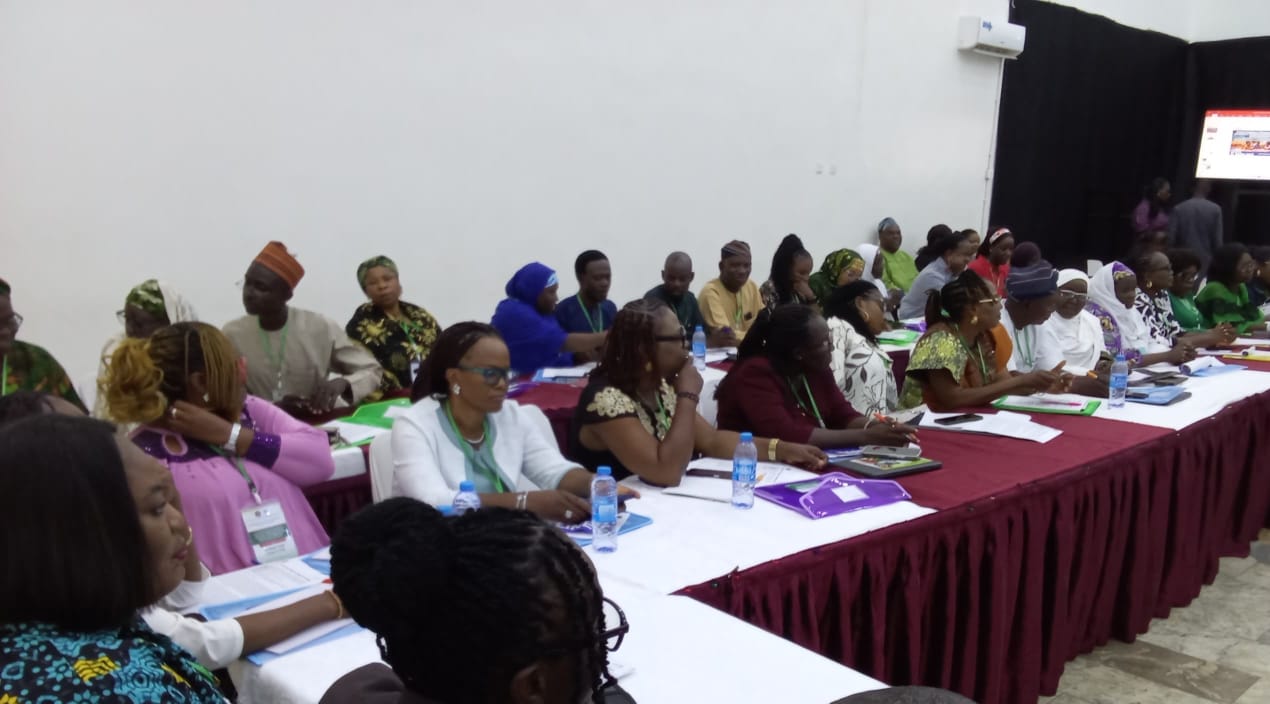
Cross-section of participants at the workshop
About 10 million Nigerian children are currently not captured in early childhood care, development and education, ECCDE, as the Universal Basic Education Commission, UBEC, warned that the situation is contributing to poor learning outcomes among children across the country.
The Executive Secretary of UBEC, Dr Aisha Garba, disclosed this on Monday in Abuja at a three-day capacity-building workshop for state actors on the utilisation of the ECCDE Minimum Standards, Implementation Guidelines and UNICEF Parental and Community Engagement documents.
Garba, who was represented at the event by the Deputy Executive Secretary (Technical) of UBEC, Rasaq Olajuwon Akinyemi, said only 35.6 per cent of Nigerian children aged between 36 and 59 months currently attend any form of early childhood education.
She said the situation was compounded by developmental delays among young children, noting that analysis of the 2021 Multiple Indicator Cluster Survey showed that about 46 per cent of children aged 24 to 59 months were developmentally off track.
According to her, the consequences of inadequate early childhood education become more pronounced as children progress through the school system.
“Only 35.6 per cent of Nigerian children aged 36 to 59 months attend any form of early childhood education. That leaves roughly 10 million of our youngest children outside ECCDE altogether,” she said.
Garba added that about 70 per cent of Nigerian 10-year-olds could not read and understand a simple text, while only about 2.4 million of the 5.9 million children who enter primary school each year remain in the education system at the end of junior secondary school.
She said early childhood development must therefore be treated as an integrated national priority rather than as a stand-alone education programme.
“There is no cheaper place in the education system to buy results,” Garba said, citing Nobel Laureate James Heckman’s estimate of about 13 per cent annual return per child on high-quality birth-to-five programmes.
The UBEC boss urged states to ensure that ECCDE interventions were reflected in their State Matching Grant Action Plans, warning that programmes not included in the plans would not receive funding, procurement or monitoring attention.
“I must be blunt: what is not in the Action Plan will not be funded, will not be procured and will not be monitored,” she said.
Garba also disclosed that the deadline for states to submit their ECCDE Action Plans for the next intervention year had been extended from September 30 to October 5, 2026.
She, however, stressed that the extension was not an opportunity for states to delay, adding that plans submitted after the new deadline would not be considered for the intervention year.
“The extension is not an invitation to be delayed.
“I expect every State to leave Abuja with a costed, integrated and inclusive draft plan, to present it to your Executive Chairman on your return, and to submit the final plan through the digital planning template within the extended period. Plans received after that date will not be considered for this intervention year,” she added.
She further directed states to develop ECCDE programmes around the needs of the whole child by working with the health, nutrition, water and sanitation, women affairs, social welfare and Local Government Education Authorities.
Garba said the 2023-24 Nigeria Demographic and Health Survey put stunting among children under five at 40 per cent nationally, with the figure ranging from 12 per cent in Rivers State to 65 per cent in Katsina State.
She said ECCDE centres must also comply with essential standards covering child safety, supervision, safeguarding, food and water safety, structural safety and emergency exits.
The UBEC boss urged states to ensure that children with disabilities and those living in hard-to-reach, nomadic, riverine and conflict-affected communities were not excluded from ECCDE programmes.
She also called for stronger engagement with parents, caregivers, School-Based Management Committees, traditional institutions and religious bodies, stressing that communities could serve as important delivery platforms for children who could not easily be reached through conventional classrooms.
Earlier, the Acting Director, Department of Special Programmes and Early Childhood, UBEC, Dr Chijioke J. Onwuzurike, said Nigeria currently had more than 45 early childhood development delivery channels spread across the health, nutrition, education, agriculture and social protection sectors.
Shee, however, said the multiplicity of channels had created fragmentation, with platforms sometimes duplicating one another, failing to share data and providing inconsistent services across communities.
Onwuzurike said the Commission expected every state, over the next 18 months, to map and streamline its existing early childhood development platforms, establish functional multi-sectoral coordination mechanisms and strengthen frontline workers’ capacity for screening and follow-up.
Se said the aim was to ensure that children did not fall through the gaps between sectors. said the aim was to ensure that children did not fall through the gaps between sectors.
“School readiness is not something that begins at the primary school gate; by the time a child reaches that gate, it is largely decided,” Onwuzurike said.
She urged state actors to use the National ECCDE Minimum Standard and Implementation Guidelines as working tools, rather than documents to be filed away.
Also speaking, UNICEF Nigeria Education Specialist, Yetunde Oluwatosin, said early childhood development was critical to addressing the country’s out-of-school challenge
She likened early childhood development to laying the foundation of a building, stressing that getting the foundation right would help children enter school at the appropriate age, remain in school and transition through the education system.
“So it’s really important for us to get the foundation right, because it helps the child to continue learning,” she said.
Oluwatosin said UNICEF had supported the Federal Government in developing the ECCD policy, minimum standards and curriculum, adding that the documents were benchmarked against global standards.
The three-day workshop, organised by UBEC’s Department of Special Programmes and Early Childhood in collaboration with UNICEF, attracted state and relevant education actors, including SUBEB Directors of Special Programmes, ECCDE Desk Officers and UBEC officials.
The workshop is aimed at strengthening state-level capacity for ECCDE planning, financing, implementation, monitoring, data management and community engagement, while enabling participating states to develop or strengthen state-specific ECCDE and early childhood development work plans.