By Stella Odueme
The Independent Corrupt Practices and Other Related Offences Commission (ICPC) and the Code of Conduct Tribunal (CCT), have called for stronger ethical standards, accountability and integrity in Nigeria’s public service.
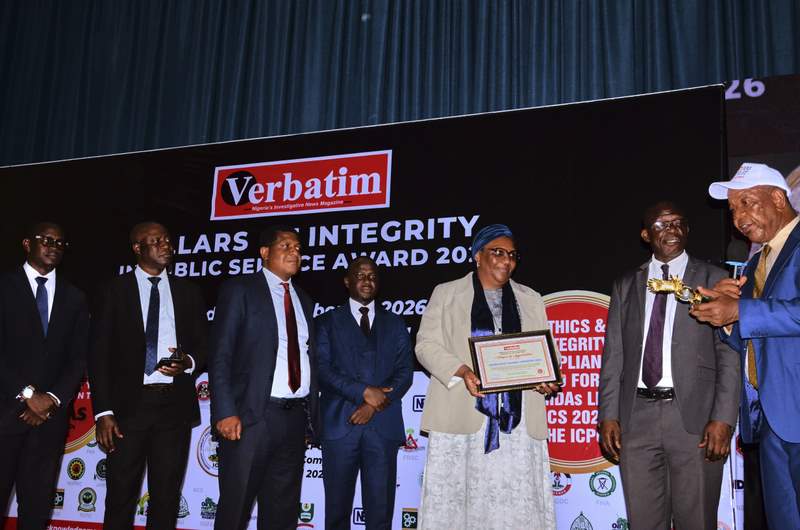
The call was made at the Verbatim Magazine/ICPC presentation of the “100 Pillars of Integrity in Public Service Award”, organised to recognise 100 ministries, departments and agencies (MDAs) and their chief executives for demonstrating commitment to integrity and ethical compliance.
Representing the ICPC chairman, Dr Musa Aliyu at the event, Mr Kupolati Kayode said the fight against corruption must go beyond prosecution, stressing that building a culture of integrity was essential to achieving sustainable national development.
According to the chairman, prosecution remains necessary, but cannot by itself create the kind of society Nigerians desire.
“But if we build a culture of integrity, we’ll have a society of free and prosperous people,” the representative said.
He described the award recipients as examples of public servants and institutional leaders who have remained committed to due process, transparency and ethical conduct.
“You are the evidence that Nigeria is not a hopeless case. You are the proof that honesty is not a weakness but a strength. You are proof that one can succeed in Nigeria without selling their soul,” the representative said.
ICPC further described integrity as a critical pillar of national development, noting that public institutions could only be as strong as the character of the people managing them.
“When we talk about strengthening institutions, we are talking about creating systems that work even when no one is watching,” the speaker said.
Dr Aliyu explained that integrity ensures that rules are followed rather than circumvented, adding that public contracts should be awarded on the basis of competence rather than connections.
According to him, institutions such as the police, judiciary, civil service and customs would become more effective when operated with integrity.
He linked institutional efficiency with economic growth, noting that reducing the cost of doing business could attract investment and improve Nigeria’s access to global markets and credit.
“Prosperity is not magic. It is the reward of a system that works,” the representative said.
The ICPC also called for greater public education on corruption, stressing that the responsibility of promoting integrity should not be left to the anti-corruption agency alone.
The chairman said the ICPC had introduced initiatives, including the National Ethics and Integrity Policy and integrity-related programmes in schools, but urged the media, religious institutions, parents and other stakeholders to play active roles in promoting ethical values.
The media was particularly urged to avoid glamorising questionable wealth without asking questions about its source, while religious institutions were encouraged to promote integrity alongside other teachings.
The speaker also called on parents to teach children the value of honest work and urged Nigerians to recognise corruption as a crime that affects the future of society.
“A nation is not built by country and state; it is built by character,” the representative said.
The representative urged Nigerians to become “pillars” of integrity by refusing to compromise, obeying rules, speaking the truth and demanding accountability from leaders.
On its part, the Code of Conduct Tribunal also commended the organisers for recognising institutions and public servants committed to ethical conduct.
Representing the Chairman of the CCT, Justice Dr. M. A. Danladi, at the event, the representative said the Tribunal appreciated the significance of the gathering as a platform for recognising integrity, accountability and responsible public service.
The representative said Verbatim Magazine, in partnership with the ICPC, deserved commendation for creating a platform to promote a culture of integrity within the Nigerian public service.
The representative stressed that integrity was not merely a personal virtue but a fundamental requirement for effective governance and national development.
“Public office is a position of trust,” the representative said, adding that public officers were expected to exercise their responsibilities with honesty, impartiality, transparency and accountability.
According to the representative, resources and authority entrusted to public institutions are ultimately held in trust for Nigerians.
The CCT representative said the Tribunal’s constitutional mandate underscores the importance of standards of conduct in public life and accountability for the actions of public officers.
Commenting on the recognition of 100 MDAs and their chief executives, the representative said the awards sent a message that integrity in public service required recognition, encouragement and sustained institutional attention.
The recipients were urged to regard the awards not only as an honour but also as a renewed commitment to sustaining the standards that earned them recognition.
The CCT representative further called for stronger systems that promote transparency, prevent misconduct and encourage responsible leadership.
The representative said building an ethical public service required collaboration among government institutions, oversight bodies, the media, civil society organisations, professional bodies and individual public officers.
The media, the representative noted, could strengthen accountability through responsible journalism, investigative reporting and public enlightenment.
“Integrity is measured not only by what we do when we are being watched, but by the principles that guide our decisions when no one is watching,” the representative said.
The CCT therefore urged public institutions to treat integrity as an ongoing institutional culture rather than a one-time achievement.
The representative said professionalism, accountability, fairness and respect for the rule of law should become embedded in the daily operations of public institutions.
In his remarks after being presented with his award, the Managing Director and Chief Executive Officer of the
Nigeria Deposit Insurance Corporation (NDIC), Mr. Thompson Oludare-Sunday, who was honored and was represented said the corporation considered the recognition an honour, noting that the agency plays a critical role in Nigeria’s financial system.
“NDIC, we are a bedrock of the financial system. We provide deposit insurance and reimburse depositors in the event of bank failure,” the representative said.
The representative explained that the NDIC collaborates with the Central Bank of Nigeria to ensure that banks operate in accordance with sound practices and prudential guidelines.
Senior executives from the corporation’s Insurance Surveillance, Research, Audit, and Communication and Public Affairs departments attended the ceremony to demonstrate the importance attached to the award by the NDIC management.
The NDIC representative assured that the corporation would continue to discharge its responsibilities while upholding standards of integrity and transparency.
Also speaking, the Executive Director of the Institute for Agricultural Research (IAR), Ahmadu Bello University, Zaria, Prof. Ado Yusuf, said the institute’s recognition reflected its long-standing contribution to agricultural development in Nigeria.
The Executive Director said the institute had survived several economic and social challenges and remained committed to advancing agricultural research.
He described his responsibility of laying the foundation for the institute’s second century as a major task.
He said the IAR had contributed significantly to the development of crops including cowpea, cotton, groundnut, castor and sorghum.
According to him, a significant proportion of Nigeria’s agricultural production and improved crop varieties had benefited from research conducted by the institute.
He also highlighted the institute’s response to insecurity in parts of northern Nigeria, particularly through the development and deployment of a sorghum variety that grows to less than one metre.
He explained that the shorter variety makes it more difficult for criminal elements to hide within sorghum farms, thereby contributing to both agricultural productivity and security.
He said the innovation had helped the country address food security, national security and livelihood challenges.
The event ended with commendations for the recognised MDAs and their chief executives, with organisers urging the awardees to sustain their commitment to integrity and ethical public service.
While receiving her award, the Rector of Federal Polytechnic, Nekede, Owerri, Dr. Basilia Igbokwe, commended the organisers for the recognition, promising to continue to put in her best to improve on recorded success.
Earlier in his welcome address, the publisher of Verbatim Magazine, Mr Tobs Agbaegbu expressed appreciation to the dignitaries and MDAs that were honoured.
He noted that while the media continues to hold government officials to account, it will nonetheless, recognize integrity in government business and honour such institutions and their chief executive officers.