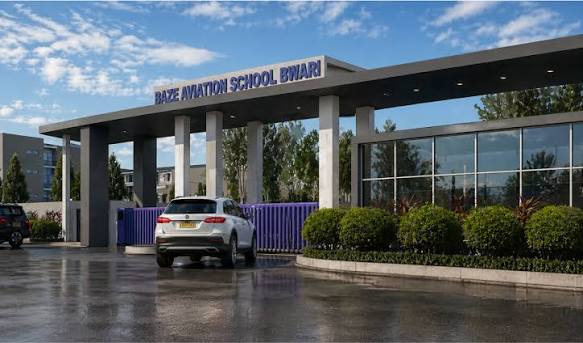
Nigeria could significantly reduce its expenditure on overseas aviation training as the Federal Government throws its weight behind efforts to develop Baze Aviation School in Abuja into a regional centre for aviation education and professional training.
Minister of Aviation and Aerospace Development, Festus Keyamo, disclosed this on Friday during an inspection tour of the aviation training facility in Bwari, Abuja, where he said the project would help retain substantial funds currently spent on training Nigerian pilots and other aviation professionals abroad.
Keyamo described the initiative as an opportunity to strengthen local aviation capacity, reduce foreign training costs and position Nigeria as a destination for specialised aviation education in West and Central Africa.
He expressed optimism that the facility, when fully developed, would attract aviation trainees from neighbouring countries and provide services currently sought by Nigerian professionals in foreign institutions.
“We spend a lot of money every year sending our pilots and other aviation personnel to different parts of the world for training. With this facility, we expect that a significant part of that expenditure will be retained within Nigeria,” he said.
The minister explained that the proposed development would go beyond conventional aviation training, particularly with plans to establish a modern simulator centre equipped with facilities associated with major aircraft manufacturers, including Boeing and Airbus.
He noted that Nigerian airline captains and other aviation personnel regularly travel to countries such as South Africa and the United States to access specialised training and simulator services, resulting in substantial expenditure by airlines and their employers.
According to him, establishing similar facilities locally would not only reduce the financial burden of overseas training but also enable Nigeria to provide specialised services to aviation professionals across the region.
However, Keyamo cautioned government officials against creating administrative obstacles that could delay the project, warning that unnecessary bureaucracy would not be tolerated.
He assured the promoters of the institution that he would intervene whenever necessary to ensure the project was not frustrated by government agencies or individuals.
“Nobody should frustrate this project. No bureaucracy or official should keep your files or hide them somewhere, forcing you to run from one office to another. Don’t go around looking for anybody. Don’t even look for me. Let this project come to fruition,” he said.
The minister described the aviation school as a national development initiative that should receive support irrespective of ethnic, religious or political differences.
He urged the promoters to report any government official attempting to obstruct the development, assuring them of his support within his supervisory and regulatory responsibilities.
Earlier, the founder of Baze University, Datti Baba-Ahmed, presented the project’s development blueprint, explaining that the institution was being planned as an integrated aviation ecosystem comprising a runway, hangars, terminal, academic facilities, accommodation and emergency response infrastructure.
He disclosed that the proposed facilities would include four hangars, a heliport, airside infrastructure, a runway safety area, an air traffic control building, airline management offices, aviation security facilities, a clinic and an emergency response centre.
The development plan also provides for facilities for the National Emergency Management Agency, alongside provisions for original equipment manufacturers and maintenance, repair and overhaul (MRO) operations.
Baba-Ahmed added that the project would incorporate hotels and other hospitality facilities to support its anticipated regional operations.
Giving an update on construction activities, he said work was ongoing on the apron, which is expected to extend 500 metres when completed. So far, 155 metres have been constructed.
On the runway, he disclosed that work on the granular sub-base for the first 1,000 metres had reached approximately 95 per cent completion, while the remaining section of the initial kilometre was expected to be finished before the end of November.
He said the first phase of runway pavement construction was scheduled to begin in December, with asphalt surfacing to follow. The school would subsequently approach the aviation minister for approval to commence flight training.
According to him, the initial 1,000-metre runway is expected to be ready by January and would accommodate virtually all categories of light aircraft.
He also confirmed that the school’s two Grand Caravan aircraft had arrived in Nigeria, adding that the aircraft and ongoing construction activities were already attracting interest from prospective students and parents interested in aviation careers.
Baba-Ahmed said the institution was committed to delivering the project within reasonable timelines and at competitive costs, noting that the school was handling a significant portion of the construction work directly while relying on specialised partners for technical aspects.
Meanwhile, the project has generated optimism among residents of the surrounding communities, who anticipate that the aviation facility will stimulate economic activities, create employment and provide career opportunities for young people.
A retired police officer and representative of Gaba community, Mr Bulus Luka, said the establishment of the school would bring significant economic and social benefits to the host communities.
He said the institution would provide employment opportunities for residents and expose young people to careers in the aviation industry.
Luka expressed hope that the development would eventually produce pilots from Gaba, Nako and Tokolo communities, noting that residents could become active participants in the aviation sector through the opportunities the institution would provide.
He further observed that businesses had already started emerging around the facility, expressing confidence that commercial activities would increase as construction progresses and the school begins operations.
However, he emphasised the importance of cooperation among traditional institutions and community stakeholders to ensure that residents fully benefit from the project.
He specifically called for stronger collaboration among the District Heads of Gaba and Tokolo, as well as other community leaders, to sustain a productive relationship between the institution and its host communities.
With plans for a runway, aircraft, hangars, simulator facilities and MRO operations, the Baze Aviation School project is expected to expand Nigeria’s aviation training capacity, reduce dependence on foreign institutions and create fresh opportunities for investment, employment and regional aviation development.