From Maurice Okafor, Enugu
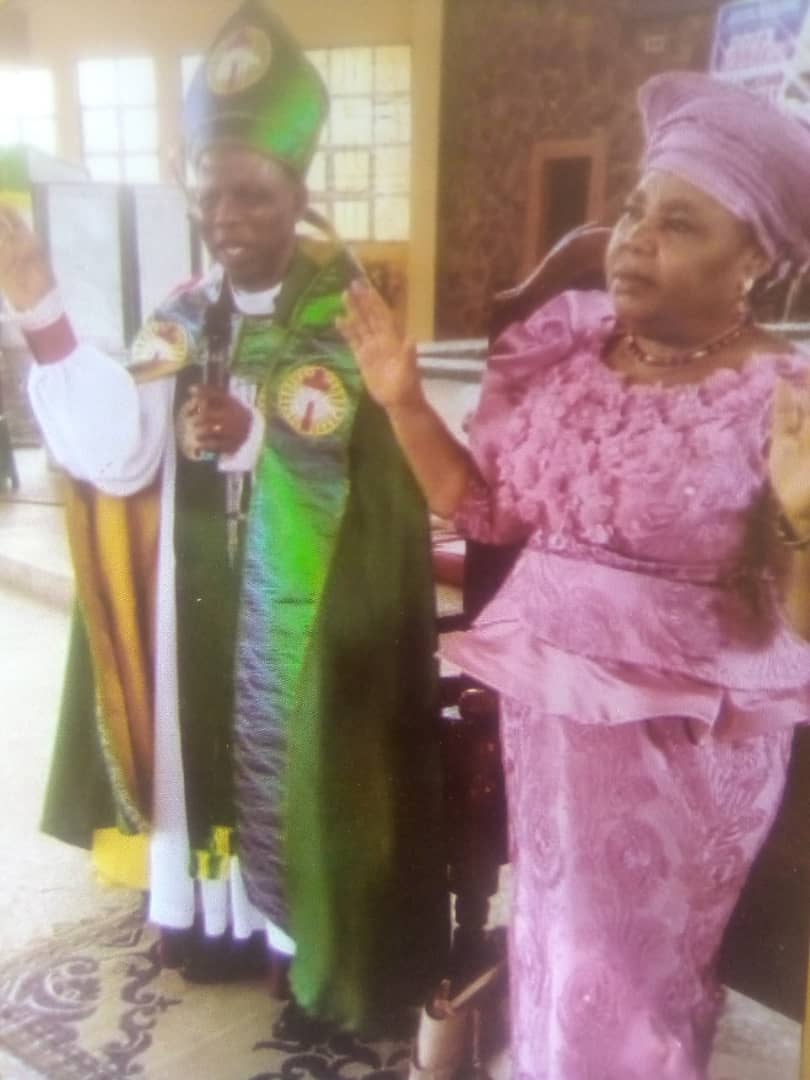
Archbishop Amos Amankechinelo Madu, pioneer Archbishop of the Enugu Ecclesiastical Province and first Bishop of the Oji River Diocese (Anglican Communion), may have formally retired from active church administration, but his commitment to Christian service remains unwavering.

His decades of ministry were celebrated at a historic Homecoming Thanksgiving Service held at the Basilica of Christ Church, Achi, on Saturday, January 3, 2025. The service marked the conclusion of more than 43 years of missionary work as an ordained priest. On the occasion, Archbishop Madu reflected on his extraordinary journey from a military soldier to what he described as a “Soldier of Christ.”
That spiritual transformation also inspired a change in his middle name from Angus to Amos, after the biblical prophet whose works are recorded in the Holy Bible.
As a young man, Master Amos Madu volunteered to join the Biafra Army during the Nigerian Civil War (1967–1970), responding to what he described as a call of duty. He endured the harsh realities of the conflict, witnessing loss, hardship and the struggle for survival that followed, particularly among people of the South-East.
Recalling the experience, he said, “There was escalation of tension and confusion everywhere. Boys were called to join the Biafra Army to defend our people. After watching the film, ‘The longest day’, I went for enlistment and joined the Biafran Army. We fought in different sectors, first was at Nsukka and finally at Inyi.”
The painful memories of the war, he explained, compelled him to reflect deeply on life and faith. According to him, there was an inner pressure to thank God for preserving his life, a conviction reinforced by advice from the then Vicar of Christ Church, Achi, Rev. Stephen Okolo, who encouraged him to find ways of serving in God’s vineyard.
That calling became clearer after he relocated to Zaria in 1971, where he encountered two Christian missionaries — Jeremy Hinds (CMS) from the United Kingdom and Rev. Paul Harris Pooles (SIM) from the United States.
In 1973, Archbishop Madu broke new ground as the first Igbo to be admitted for ministerial training in Northern Nigeria after the war. Two years later, in 1975, he was posted to head St. Paul’s Church, Kakuri, Kaduna, formally beginning his life as a Soldier of Christ.
His priestly formation advanced further in 1980 when he became the only deacon ordained by Bishop Samuel Ebo, the first Bishop of Jos, following his graduation from the Theological College of Northern Nigeria (TCNN), Bukuru.
That same year, he also entered into marriage, wedding Otuomasirichi Gladys Nwakanma. Archbishop Madu has consistently acknowledged her as a devoted partner in ministry, noting that together they laboured across several Northern states, planting churches and expanding Christian outreach.
His quest for deeper theological insight took him to the United States in 1987 on scholarship, where he undertook postgraduate studies at Virginia Seminary. He returned in 1989 and was posted to St. John’s Church, Otukpo, before being transferred in 1992 to St. Francis of Assisi Theological College, Zaria.
Throughout his ministry in the North, Archbishop Madu traversed remote areas, including Mubi near the Cameroon border, establishing churches — many of which initially worshipped in thatched structures and makeshift shelters. He expressed satisfaction that these early foundations have since grown into modern church buildings.
After more than 27 years of missionary work in Northern Nigeria, he was elected and consecrated as the pioneer Bishop of Oji River Diocese on July 11, 1999. His expectation of a less demanding assignment proved unfounded, as the newly created diocese lacked basic structures, including a cathedral and bishop’s court. The challenge, however, only strengthened his resolve to build from the ground up.
By every measure, his tenure as pioneer Bishop of Oji River Diocese was marked by extensive development. He later rose to become Archbishop of the Enugu Ecclesiastical Province, overseeing dioceses including Enugu, Enugu North, Aninri/Awgu, Nike, Udi, Abakaliki and others in parts of Ebonyi State.
Among his most notable achievements was the establishment and completion of St. Paul’s Cathedral, Holy Hill, Oji River — a landmark structure that has significantly enhanced the spiritual, educational and physical landscape of the town. The cathedral’s hilltop location has often been likened to the Church of Transfiguration in Israel, a place of prayer associated with the trials of Jesus Christ, as recorded in the Holy Bible.
Beyond worship, the cathedral complex also serves as the take-off site for the diocese-owned College of Nursing, Oji River. Its commanding presence makes it visible from all major entry points into Oji town, whether from the Enugu–Onitsha road or the Achi–Oji River axis.
Archbishop Madu also spearheaded the construction of the Bishop’s Court in the heart of Oji town, ending years of commuting between Achi and Nachi towns to his administrative office.
Another landmark initiative under his leadership was the establishment of the Oji River Wonderful Table Water, sourced from Oji water springs with over 95 per cent natural purity. The project was the first of its kind in the local government area and significantly eased access to potable water for residents of Oji, Achi, Inyi and surrounding communities, especially before the arrival of other bottling companies.
The project, observers note, became even more critical given the failure of both the Enugu State Government and Oji River Local Government authorities to restore water reticulation from the springs.
Several missionary schools currently run by the Diocese of Oji River were also established during Archbishop Madu’s tenure.
Reflecting on his retirement, Bishop C.O. Okafor, formerly of the Diocese of Ihiala, noted that although Archbishop Madu has retired from active church service, “he continues in active Christian service.”
Delivering the sermon at the thanksgiving service, Bishop Martyn Anagbogu, based in the United States, described Archbishop Madu’s retirement as a blessing, citing his survival through numerous trials that claimed the lives of many contemporaries. He emphasized that Archbishop Madu remains a priest of God for life and would continue to be consulted whenever his counsel and service are required.
Archbishop Madu has documented his journey of faith and leadership in a book titled “My Episcopal Journey: Fulfilling God’s Call,” which is available to the public, clergy and aspiring clerics.