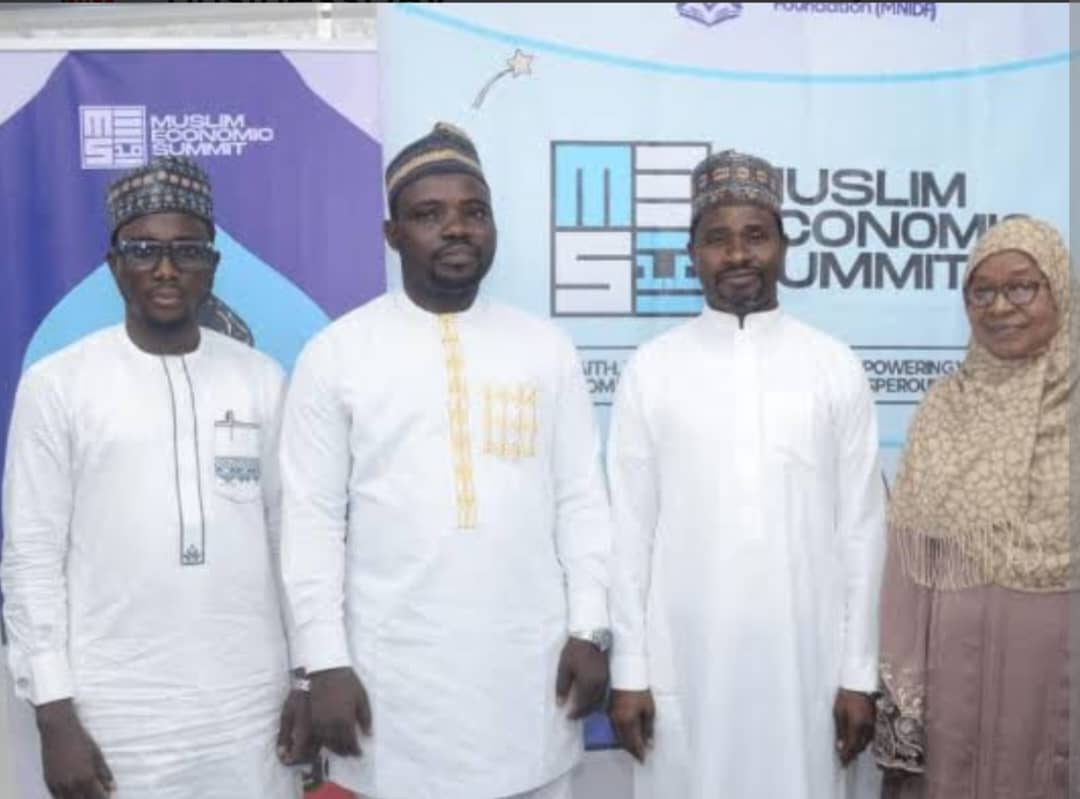
Muassasat Nasrul Ilm Wa Da’wat Foundation has charged Muslims with the responsibility of unlocking practical ways to harness the potentials of the halal economy.
Halal economy refers to an economic system and market that operates in accordance with Islamic principles (Shariah law).
While often associated only with food, it actually covers a wide range of industries and ethical guidelines.
Ibraheem Adigun, National President of the Foundation and Convener of the Muslim Economic Summit (MES 1.0), made this disclosure in Lagos on Saturday during the maiden edition of the economic summit.
Adigun noted that the global halal economy was valued at about N7.7 trillion.
He noted that the Foundation convened the summit to brainstorm on how Muslims could contribute meaningfully to national economic growth, expressing confidence that the Muslim community had significant value to offer the nation.
“The nation is talking about diversifying the economy; today, the government is looking away from non oil sector to grow their GDP.
“So, we believe a lot of energy pushed into HALAL economy will surely help Nigeria in tapping from the resources of this HALAL economy that’s globally trending.
“One of the reasons why this summit is taking place; moreso, as an organisation, we have been interfacing with the society.
“We realised the level of poverty in the society and we deem it fit that we have to contribute to the social economic development of the nation ” he said.
He disclosed that before the summit, the foundation had trained 375 participants including Christians, noting that HALAL economic was inclusive.
Adigun said that the summit was going to be an annual event and prayed that the foundation would be able to sustain it through its MES Waqf Fund (Islamic Endowment).
Speaking, Prof. Ahmad Dogarawa of the Department of Accounting, Ahmadu Bello University, Zaria, Kaduna state, said that Nigeria could tap into this rapidly growing and expanding emerging market by leveraging on a number of things like its large population.
Dogarawa said Nigeria possesses vast arid land and diverse natural resources and is increasingly reaching out to the global community to attract foreign investment into the country.
He noted that with these abundant resources, Nigeria is strategically positioned and enjoys a strong comparative advantage, particularly in the production of halal foods and beverages.
According to him, the country is rich in oil and livestock, stressing that Nigeria’s strategic advantages and economic implications are remarkable, especially within the halal economy value chain.
Dogarawa emphasised that the most critical role of government was to organise stakeholder engagements to educate the public that the halal economy is not about Islamisation or the imposition of Sharia law.
He explained that the halal economy was centered on economic growth, business development, prosperity, and investment.
Speaking at the event, Dr Ahmad Jebe, Special Adviser to Gov. Babajide Sanwo-Olu on Religious Matters, described the halal economy as primarily a religious concern.
Jebe stated that government must remain neutral in religious matters, noting that it could not be one-sided but could collaborate with all religious groups.
He added that government participation was essential at religious events and assured that the state would continue to provide support when necessary.
According to him, the concept of the halal economy emphasises that whatever people consume or engage in economically as a nation must not be prohibited under religious principles.