By Felix Khanoba
Nigeria generated a record $6.1 billion from non-oil exports in 2025, reinforcing the growing importance of the sector to the country’s economic diversification drive, the Nigerian Export Promotion Council (NEPC) has said.
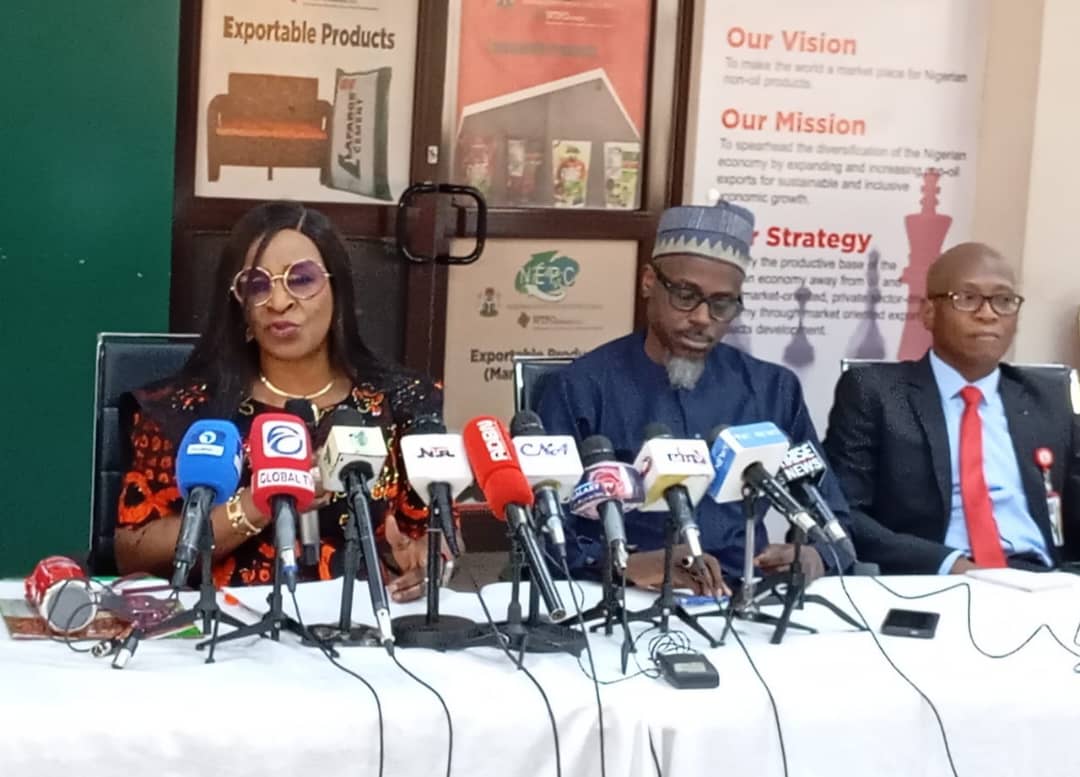
Executive Director/Chief Executive Officer of NEPC, Nonye Ayeni, made this known on Monday in Abuja while presenting the performance of non-oil exports for 2025 and the outlook for 2026.
According to her, the 2025 performance represents an 11.5 per cent increase over the $5.46 billion recorded in 2024, making it the highest value of formal non-oil exports since the establishment of the Council.
“Nigeria’s non-oil export performance in 2025 reached an all-time high, with export value rising to approximately $6.1 billion. This is the highest non-oil export value achieved in the country for formal documented trade since the inception of the Council,” Ayeni said.
The NEPC’s chief executive noted that the achievement underscores the resilience of the non-oil sector and validates the Federal Government’s diversification agenda under President Bola Ahmed Tinubu’s Renewed Hope Agenda.
Ayeni explained that export volume also grew significantly, with total non-oil exports hitting 8.02 million metric tonnes, up from 7.29 million metric tonnes in 2024, representing a 10 per cent increase.
“This growth in both value and volume demonstrates improved export activity across multiple value chains and market destinations,” she added.
Speaking further, the NEPC boss revealed that Nigeria exported 281 non-oil products in 2025, spanning agricultural commodities, processed and semi-processed goods, industrial inputs and solid minerals, signalling gradual progress in value addition.
She disclosed that Nigerian non-oil products were exported to 120 countries, with the Netherlands, Brazil and India emerging as the top three destinations by value, accounting for 17.53 per cent, 10.35 per cent and 7.63 per cent respectively.
“Export to the Netherlands increased by 32.46 per cent, driven by products such as cocoa beans, cocoa butter and sesame seeds, while export to Brazil rose by 19.07 per cent,’’ Ayeni said.
Within Africa, she said Nigeria exported non-oil products worth $271.26 million to 11 ECOWAS countries, although the figure declined compared to 2024 due to the exit of Burkina Faso, Mali and Niger from the regional bloc.
On products, Ayeni identified cocoa beans, urea, cashew nuts, sesame seeds, gold dore, aluminium ingots and rubber as the top-performing exports, with cocoa beans alone accounting for $1.99 billion, representing 32.76 per cent of total non-oil export value.
She attributed the strong performance to improved value addition, reduction in export rejects, better compliance with export documentation, enhanced coordination among regulatory agencies and sustained global demand for Nigerian commodities.
“We are beginning to see a shift where exporters and SMEs are adding value instead of exporting raw products, enabling them to earn premium pricing in the global market,” she said.
Ayeni also disclosed that several commercial banks actively participated in non-oil export transactions in 2025, with 19,975 Nigeria Export Proceeds (NXP) forms processed, while about 94 per cent of non-oil exports were routed through seaports.
Looking ahead, she expressed optimism about 2026, assuring that NEPC would deepen capacity building, expand export clusters, curb rejects, promote value addition and broaden exporter participation.
Ayeni expressed gratitude to President Bola Tinubu for giving her the opportunity to serve the country, even as she lauded the massive support of Minister of Industry, Trade and Investment, Dr. Jumoke Oduwole, and the Minister of State for Industry, Senator John Owan Eno.
“Indeed, 2026 promises to be a great year for non-oil export.
“At NEPC, we remain resolute and committed to driving up the volume and value of non-oil exports and expanding market access for sustainable and inclusive economic growth and to continue to align with the Renewed Hope Agenda of Mr President for job creation and poverty alleviation,” she added.