By Patrick Okigbo III
Xenophobia looks like stupidity, and it is tempting to dismiss it as such. That is a mistake. It has logical explanations, though never justifications. It rarely begins as a simple hatred of foreigners. It grows instead from economic frustration, political manipulation, fear, and a thin grasp of history. Understand those roots and the pattern becomes legible, in Johannesburg as in Essex.
South Africa’s recurring hostility toward fellow Africans is the clearest contemporary example. But the malaise is neither uniquely South African nor uniquely African. It belongs to a long global history in which societies under pressure turn on the foreigner, the biblical scapegoat, and lay their frustrations on its back. The instinct is the same everywhere. What changes is the licence a society gives it.
The first and deepest cause is economic. The end of apartheid was not Uhuru on the jobs front. The structural problems remained and worsened. Expanded unemployment, which counts those who have given up looking, now stands at roughly 42 per cent. On the narrower official measure, the rate has climbed from the low twenties in the early 1990s to about a third today. A generation has come of age knowing nothing but a shrinking economic space. When the formal economy cannot absorb its young, frustration looks for an address. Bereft of ideas, politicians and local agitators supply one. The foreigner, already precarious, becomes the easy target.
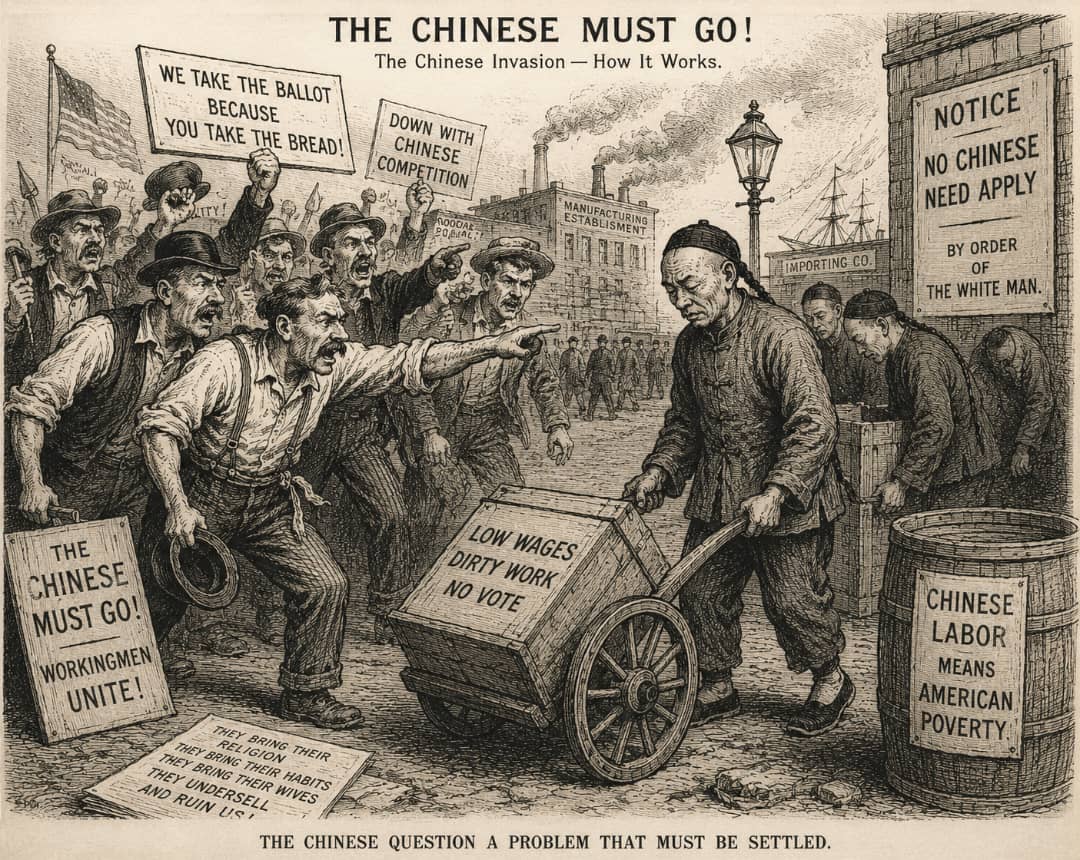
This is an old trick. During the Great Depression, minorities across Europe were blamed for economic collapse and national humiliation. In the United States, Chinese workers were accused of depressing wages, leading to the Chinese Exclusion Act of 1882. The function is always the same. It absolves the political elite of accountability for weak governance and structural failure.
The second cause is political opportunism, and it runs through everything else. Anti-immigrant rhetoric mobilises voters, especially in moments of economic anxiety. Politicians compete to present themselves as defenders of the locals, because it wins votes, from the South African townships to Nigel Farage’s Essex. The same current powers movements in France, Italy and Hungary, and in the United States, a country built on the brains and backs of immigrants. Brexit was, in large part, a response to anxieties about immigration and a loss of control. Xenophobia is therefore both a social pathology and an effective political instrument, which is precisely what makes it so hard to dislodge.
The third cause is identity. South Africa’s liberation struggle forged a powerful identity around the defeat of apartheid. After 1994, the harder question remained: what does it mean to be South African? In moments of uncertainty, nations define belonging negatively. The real citizen, the son of the soil, is set against the outsider. The parallels are global. After the collapse of Yugoslavia and the Soviet Union, new states fought, often violently, over citizenship, language and ethnicity. Nigeria offers a smaller version of the same logic. When a new subnational state is carved out, people who share an ethnic and religious heritage quickly draw fresh dividing lines along the boundary that politics has just introduced, each group seeking advantage. When identity is insecure, people cling to whatever line promises them an edge.
These forces converge most violently at the bottom. Migrants cluster in informal trade, small shops, transport and food, the survival economy. Some work longer hours, accept thinner margins, and draw on tight family networks. Where opportunity is scarce, that creates real friction. The same resentments have surfaced against Chinese traders in nineteenth-century America, against Jews in Nazi Germany, against Asians in Idi Amin’s Uganda, against Igbos in parts of Nigeria. Competition does not justify violence. It only explains why resentment becomes combustible, and why it ignites the moment a political actor decides to leverage it for advantage.
South Africa’s case carries a deep historical irony. Many African states backed the anti-apartheid struggle diplomatically, financially and politically. Nigeria stood at the front of that effort, passing legislation to fund the ANC and offering its leaders a home in exile. Yet many younger South Africans do not know this history. They see African migrants not as the descendants of allies but as competitors. The amnesia corrodes Pan-African solidarity. Weak supranational identity is not unusual. The European Union has never built a European loyalty stronger than the national one, and the United States, now celebrated as a nation of immigrants, once vilified the Irish, Italians, Jews, Chinese, Catholics and Eastern Europeans as threats to jobs, culture and order. The difference is that those societies, eventually, chose to teach a different story.
This is the deeper point the South African case makes, and it travels. Xenophobia is not, at root, about foreigners. It is what a society reaches for when the state stops delivering, and that failure is not confined to poor or collapsing states. France, Hungary, Brexit Britain and the United States are not failed states by any measure a South African would recognise. But each has a large constituency that feels the government has stopped working for it, through stagnant wages, hollowed-out public services, or a political class that no longer delivers. The foreigner is what frustration reaches for when the real source of decline is harder to name and harder to fix. That is why the same pathology appears in Clacton-on-Sea and in Hénin-Beaumont.
If the diagnosis is governance failure, the remedies follow, but in their proper order. Law enforcement can stop an attack. Immigration reform can regulate the border. Economic policy can widen opportunity, which is the only durable cure. Civic education does something none of these can. It shapes how people imagine their society. It teaches citizens the real sources of unemployment and inequality, exposes scapegoating for what it is, restores historical memory, and shows how migrants add to trade, labour, culture and enterprise. Most of all, it builds a national identity confident enough to include others.
But education raises an uncomfortable question that the well-meaning prescription usually skips. If politicians win by scapegoating, who will teach the lesson that disarms them? Not the political class that profits from the fear. The work falls to the institutions with an interest in the truth and some distance from the ballot box: schools, churches, the press, unions, community associations and popular culture. They must do it against the grain of political incentive, and they must do it continuously, because the temptation to blame the stranger never expires.
The lesson extends well beyond South Africa. Wherever poverty, weak governance, political opportunism and identity anxiety meet, xenophobia can take root, in a township or a wealthy democracy. The antidote is neither silence nor moral scolding. It is the patient, repeated work of teaching a society that the foreigner is not the cause of its decline. The real danger is the politics that trains citizens to fear their neighbours while quietly ignoring the failures that keep everyone poor.