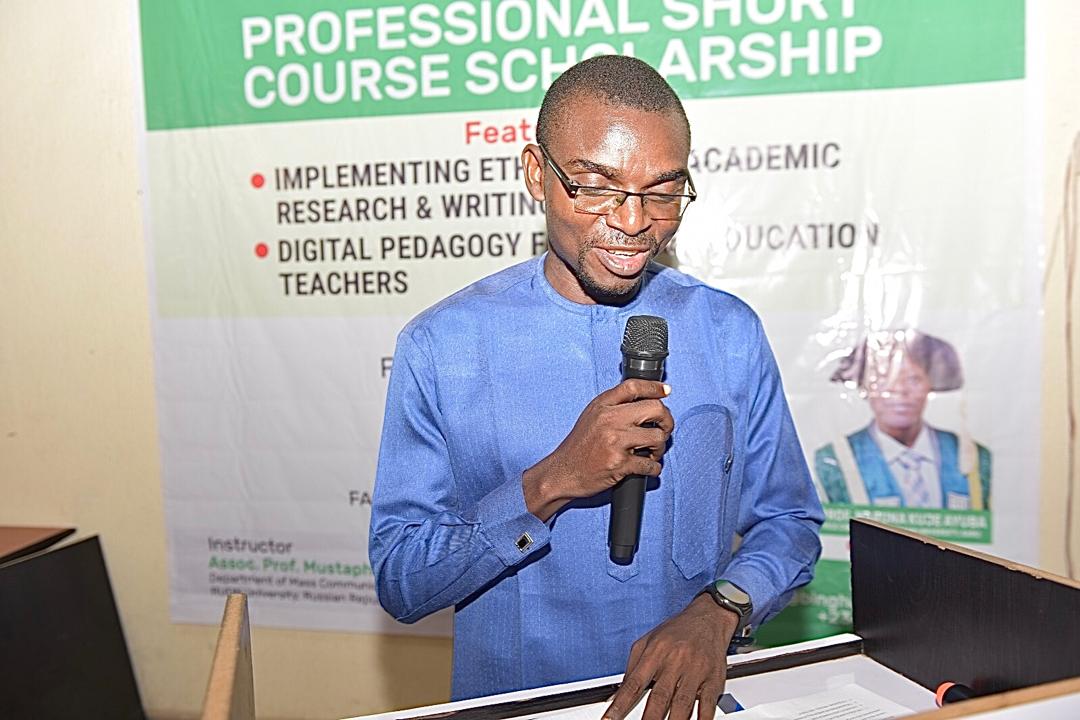
Dean of the Faculty of Communication and Media Studies, Prof. Desmond Okocha, speaking at the event.
By Felix Khanoba

The Vice-Chancellor of Bingham University, Karu, Nasarawa State, Prof. Haruna Ayuba, has called for the responsible and ethical use of artificial intelligence in academic research and writing, saying technology must align with moral principles and human values.
Ayuba spoke at a training programme for postgraduate students organised by the Faculty of Communication and Media Studies, Bingham University, in collaboration with the Centre for Continuing Professional Education, Faculty of Philology, RUDN University, Russia.
He said the joint initiative reflects the spirit of academic excellence and international cooperation, providing a platform for knowledge exchange, capacity building and responsible use of emerging technologies.
“In an era marked by rapid technological advancement, the integration of ethical AI in academic research and writing, along with innovative digital pedagogy, has become essential for shaping the future of higher education,” he said.
According to the Vice-Chancellor, the use of artificial intelligence is becoming the norm in the academic community, stressing the need to ensure its development and deployment are responsible, fair, transparent and respectful of human rights.
“If academicians can minimise harm, prevent bias, protect privacy and promote fairness and accountability in AI applications, we would have won a major battle,” he added.
Earlier, the Dean of the Faculty of Communication and Media Studies, Prof. Desmond Okocha, said artificial intelligence has become a dominant force across sectors, particularly in education, which he described as the foundation of all other sectors.
He noted that discussions on AI often cover less than 10 per cent of the entire ecosystem, urging scholars to understand its structure, tools, advantages and legal implications.
Okocha emphasised that AI is not a monolithic application, as it can be used at different stages of academic work, including idea generation, research, assignments and dissertations.
“AI has come to stay, but it will never replace humans. It will only extend the capacity of humans to function within their environment,” he said.
Also speaking, Associate Professor at RUDN University, Russia, Mustapha Jamiu, said the training is part of a scholarship-based short course designed to upskill staff and students across African universities.
He said the programme, which began in 2023, is being hosted by eight universities across Nigeria within a few weeks.
Jamiu explained that the course at Bingham University focuses on implementing ethical AI in academic research and writing, targeting postgraduate students and scholars.
“The fact is that AI is here to stay. We cannot stop students from using it. The only thing we need to do is to work with it as a tool of this era,” he said.
On his part, the Director, Centre for Digital Divide and Social Informatics, Kaduna State University, Prof. Ayodele Joseph, warned that while AI has benefits, it also risks making scholars lazy if misused.
“There’s nothing bad about using AI, but it should be done ethically. Students should know how to use AI and not allow AI to use them,” he said.
He advised students to verify information generated by AI tools and ensure their academic work remains original and accurate.