By Felix Khanoba
A coalition of civil society organisations (CSOs) on Thursday faulted the newly signed Electoral Act 2026, describing it as a missed opportunity to strengthen Nigeria’s electoral integrity ahead of the 2027 general elections.

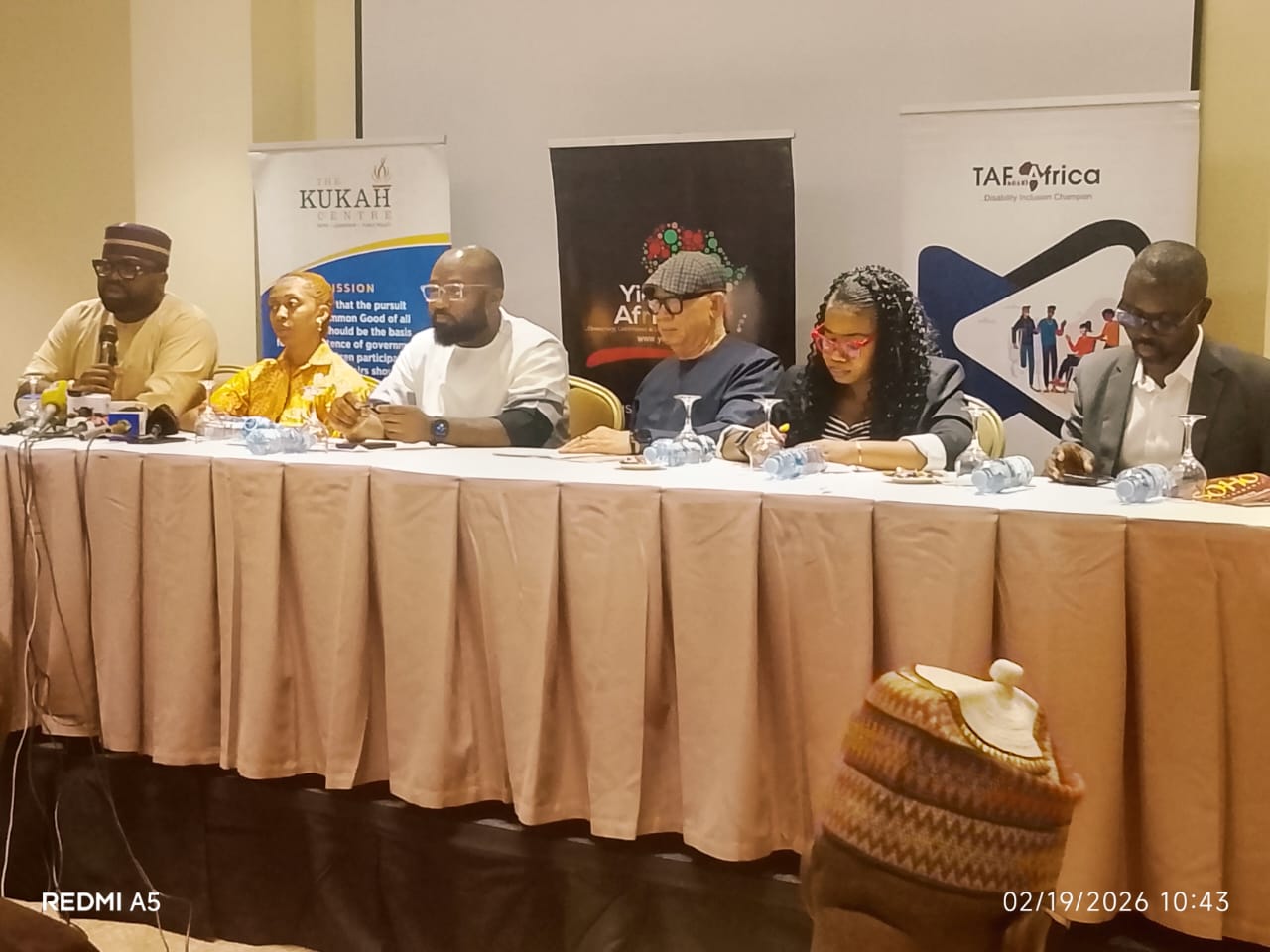
Speaking at a press conference on Thursday in Abuja on behalf of the groups, which include Centre for Media and Society (CEMESO), The Kukah Centre, International Press Centre (IPC), ElectHer, Nigerian Women Trust Fund, TAF Africa and Yiaga Africa, disability rights advocate, Jake Epelle, said the new law failed to close major loopholes that could be exploited in 2027 polls.
“We must therefore state clearly and without equivocation: the Electoral Act 2026 that has now been signed into law is a missed opportunity for the transformative electoral reform that Nigeria requires and that Nigerian citizens deserve,” the groups said.
They warned that instead of deepening transparency and confidence in elections, the new law “creates more vulnerabilities in the electoral process.”
The CSOs expressed “profound concern” over the manner the bill was passed by the National Assembly, alleging lack of transparency and last-minute amendments.
“The final version of the Bill voted upon reportedly contained last-minute amendments that were neither published nor made available to civil society or the broader public prior to adoption,” they said.
They added that some lawmakers admitted voting based on assurances from leadership without personally reviewing the final text.
“This fundamentally violates the principle of informed legislative consent and weakens parliamentary accountability,” the CSOs said.
The groups also criticised the presidential assent, noting that it came despite protests and appeals from civil society.
“The decision of the Presidency to grant assent without addressing the substantive legal, technical, and democratic concerns raised… signals a troubling prioritization of political expediency over electoral integrity,” they said.
Despite their reservations, the organisations acknowledged some positive provisions in the new law, including the introduction of downloadable voter cards and tougher penalties for electoral fraud.
They noted that the provision allowing downloadable voter cards “will increase voter participation and reduce disenfranchisement.”
They also praised the requirement for disability-inclusive voter registration, describing it as “a significant advance in line with Nigeria’s obligations under international conventions.”
However, the CSOs identified several areas of concern, particularly provisions relating to electronic transmission of results.
They warned that the clause allowing manual collation in the event of “communication failure” could be abused.
“‘Communication failure’ is undefined. There is no independent verification mechanism. There are no consequences for deliberate sabotage disguised as technical failure,” the groups said.
They also criticised the ₦50 million administrative fee for registering new political parties, calling it “a financial moat designed to exclude grassroots movements, youth-led parties, and non-elite political formations.”
On the review of election results, they argued that limiting the power to trigger such reviews to reports filed only by Independent National Electoral Commission (INEC) officials could shield wrongdoing.
“Restricting the power of review to reports filed by INEC officials, some of whom may be complicit, is against the spirit behind the power of review,” the groups added.
The organisations said the passage of the law only marked the beginning, not the end, of the reform process, pledging to monitor implementation closely.
“The Electoral Act 2026 is now law. It is imperfect. It is incomplete. It leaves dangerous loopholes open and erects new barriers to participation.
“But it is also the legal framework within which the 2027 elections will be conducted… and it is our responsibility… to ensure that the elections conducted under this law are credible, transparent, inclusive, and reflective of the will of the Nigerian people,” they said.
Meanwhile, the spokesman of the House of Representatives, Hon. Akin Rotimi, who was also present at the press conference, defended the process that produced the law and insisted that electronic transmission of results is mandatory.
“Every single thing was done in keeping with the Constitution, in keeping with the House rules, the Senate rules and all of that,” he said.
He described electoral reform as a continuous process, noting that the law could still be amended if necessary.
“What we have might be an imperfect law, but it is nonetheless done in the best interest of Nigerians… and it is also civil society and Nigerians to work with it to ensure that the outcomes will be free, fair and credible elections,” Rotimi added.
He also welcomed suggestions for a nationwide simulation of the electronic transmission system to identify and fix gaps before the 2027 polls.