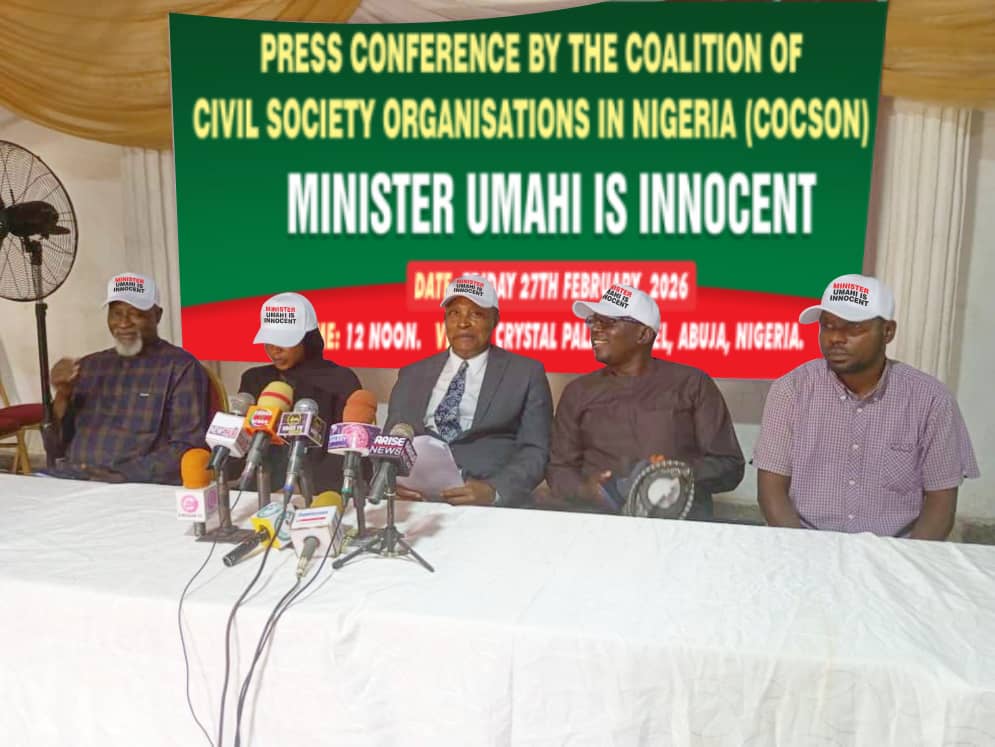
A non-governmental group, Coalition of Civil Society Organisations in Nigeria (COCSON) on Friday rose in strong defence of the Minister of Works, David Nweze Umahi, describing the recent confrontation involving activist Omoyele Sowore as a “dangerous substitution of social media outrage for due process.”

Addressing journalists in Abuja, National Spokesperson of COCSON, Olawale Oladimeji, said while the coalition recognises citizens’ constitutional right to freedom of expression, such rights “must operate within the framework of evidence, legality, and institutional process.”
The press conference followed a February 25, 2026 incident at the Federal Capital Territory Police Command, where a video surfaced showing Sowore publicly accusing the minister of misusing police authority over an alleged private dispute involving Mrs Tracy Nicholas Ohiri.
Central to the controversy is a claim that Umahi owes ₦24.5 million for campaign materials allegedly supplied during the 2015 Ebonyi State governorship election.
COCSON noted that “in separate narratives circulating online, a ₦250 million claim has also been referenced, further deepening inconsistencies in the story.”
After what it described as an independent internal review, the coalition said it found “serious logical gaps” in the allegation.
“If goods worth ₦24.5 million were genuinely supplied in 2015,” the group queried, “Where is the written contract? Where are the delivery notes? Where is acknowledgement of receipt? Where is documented demand immediately after the election? Why wait nearly a decade before going public?”
The coalition stressed that “transactions of that magnitude do not rest on verbal understanding alone. They are supported by documentation. The absence of such documentation naturally weakens the credibility of the allegation.”
COCSON also faulted the timeline of the claim, asking why a transaction allegedly dating back to 2015 would only escalate to social media in 2026.
“Nigeria’s judicial system provides avenues for civil debt recovery. Legitimate claims are pursued through demand letters, arbitration, and court filings, not viral recordings,” the group stated.
It added pointedly: “Timing in public life is rarely accidental.”
According to the coalition, public agitation and “digital outrage cannot replace structured inquiry,” urging all parties to allow investigative authorities to conclude their work without politicisation.
Warning against what it described as a growing national trend, COCSON said: “Social media is weaponized as a substitute for legal institutions. Emotional appeal becomes evidence. Public sympathy becomes strategy. This is dangerous.”
While affirming that “accountability is essential,” the coalition maintained that “accountability must be evidence driven, not sentiment driven.”
It further cautioned against exploiting sensitive narratives, noting that “serious societal causes lose credibility when sensitive claims are deployed without substantiation.”
Highlighting Umahi’s record from his tenure as Ebonyi State governor to his current role overseeing federal road networks, the coalition said his public service trajectory reflects “infrastructure driven leadership and execution focused governance.
“A leader tasked with supervising multi billion naira infrastructure projects is unlikely to be entangled in undocumented financial disputes dating back nearly a decade,” the group asserted.
The coalition insisted that if there is credible evidence, it should be tested in court: “If there is documentation, let it be tested legally. If there is proof, let competent authorities adjudicate.”
COCSON announced that it will organise a solidarity rally in support of the minister on Tuesday, March 3, 2026, to counter a planned protest against him.
“We ask Nigeria to join us to shame Sowore and his cohorts and not to join the proposed rally against the Minister,” the coalition declared.
Reaffirming its stance, the group concluded: “We reaffirm that no citizen is above the law. Equally, no citizen should be publicly condemned without proof. Justice must be evidence driven. Governance must not be derailed by distraction.”