Civil Society Organisations (CSOs) have insisted that the federal government must address demands contained in the Ogoni Bill of Rights, before resuming oil production in the area.
The CSOs also insisted holistic implementation of the United Nations Environmental Program (UNEP), recommendations, and as well quashing the murder charge on late Rights activist, Ken Saro-Wiwa and others.
They also demanded the release of the Ken Saro-Wiwa Memorial Bus seized by the federal government, saying, “it is important that these issues including those touching on environmental degradation, human rights abuses and related issues are addressed first to heal the wounds of the Ogoni people before contemplating oil production resumption in the same area.”
The CSO further called for granting the “Miideekor” demand of the Ogoni people in any oil production resumption deal “such that the Ogoni people should have a stake, a percentage of participation and ownership in the company commissioned to undertake the resumption of oil and gas production in Ogoniland.”
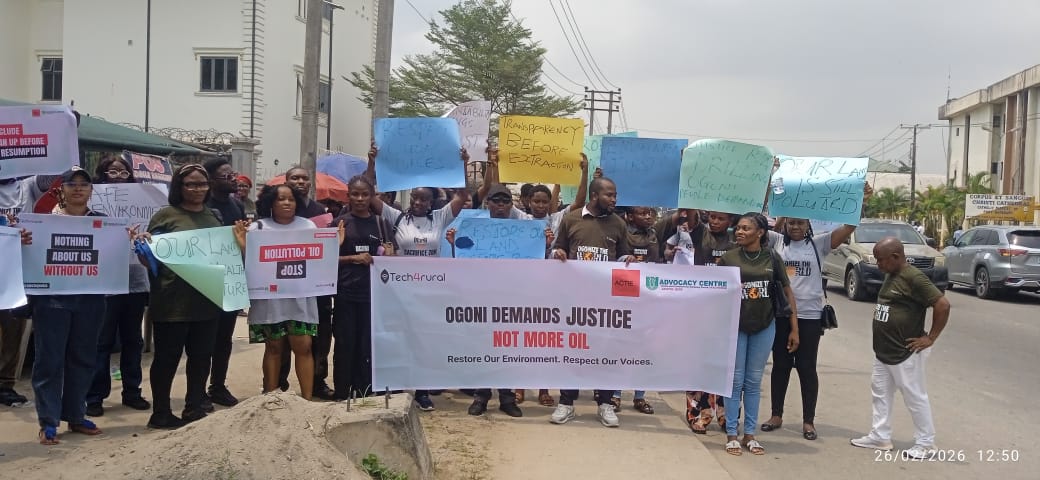
The CSOs made the demands at a one-day community-led workshop and a solidarity peace walk on the planned resumption of oil production in Ogoni tagged: “Project Ogonize”, organised by Tech4Rural in Collaboration with Youths and Environmental Advocacy Centre, YEAC-NIGERIA, in Port Harcourt, Rivers State, yesterday.
Participants at the solidarity peace walk, carried placards with inscriptions: “Restore Ogoni first before oil resumption,” “Stop oil Pollution”, “Pollution is not Development”, “No concent, no Oil,” amongst others.
Speaking, Executive Director of YEAC-NIGERIA, Dr. Fyneface Dumnamene, emphasised that the federal government must address issues that led to the Ogoni crisis and fully restore the environment before resumption of oil production.
He stated “it is important that these issues including those touching on environmental degradation, human rights abuses and related issues are addressed first to heal the wounds of the Ogoni people before contemplating oil production resumption in the same area.
“Demands were made by the Ogoni people on Shell, the oil company that operated in Ogoniland as well as the government of Nigeria. These demands were contained in the Ogoni Bill of Rights (OBR) presented to the federal government of Nigeria in 1990.
“It is this important that these issues including those touching on environmental degradation, human rights abuses and related issues are addressed first to heal the wounds of the Ogoni people before contemplating oil production resumption in the same area,” he stated.
Founder of Tech4Rural; Jethro Christopher, said the Startup uses technology to advocate for environmental justice. “The entire idea of Project Ogonize is to launch an advocacy campaign on two different platforms. The one which we are doing basically here, and also launching an advocacy campaign online,” he said.
Christopher who recalled his experience growing up in an oil producing community, stated that pollution has negatively impacted on the livelihood of the Niger Delta communities.
He said: “I am from Bayelsa, and my community is one of the oil producing places. There is gas flaring there. There is also the oil and everything. But when you talk to an average youth from my community, they tell you, okay, Shell, which was there before, they gave us this road, they give us these lights. But they don’t know the environmental impact or the implications of the light they see and the road they see.
“And after conversing with a few people
I realised that this is actually a problem that we actually have to raise our voice beyond lecture halls like this, and take it to the space where these young people are, because at the end of the day it’s left for us the youths to pick up from where they (older advocates) stopped and to amplify it,” he stated.
Also, Executive Director, Lighthope Succour Worldwide Initiative, Evelyn Williams, recalled her experience in Goi community during an advocacy. “I saw women going to their farms through the river. They said that’s the only access, they have to cross the water and and it happens when the tide is low that they can walk in and i noticed that women the water level was above their waist. And I noticed that the water had oil spill on the surface.
So women have to cross the water and that means their body has a way of breathing in that water, and you also understand the health impacts. Women can be talking of cancer, especially cervical cancer.
“We also noticed fishermen and there were no fishes. The advocacy actually yielded because it’s not just us amplifying the issues, there were a lot of other CSOs amplifying this particular issue and the advocacy yielded and the cleanup in that community actually has been done”, she added.