By Stella Odueme
The Minister of State for Regional Development, Uba Maigari Ahmadu, has stated that the Ministry’s priority is addressing the unique challenges facing Nigeria’s diverse regions.
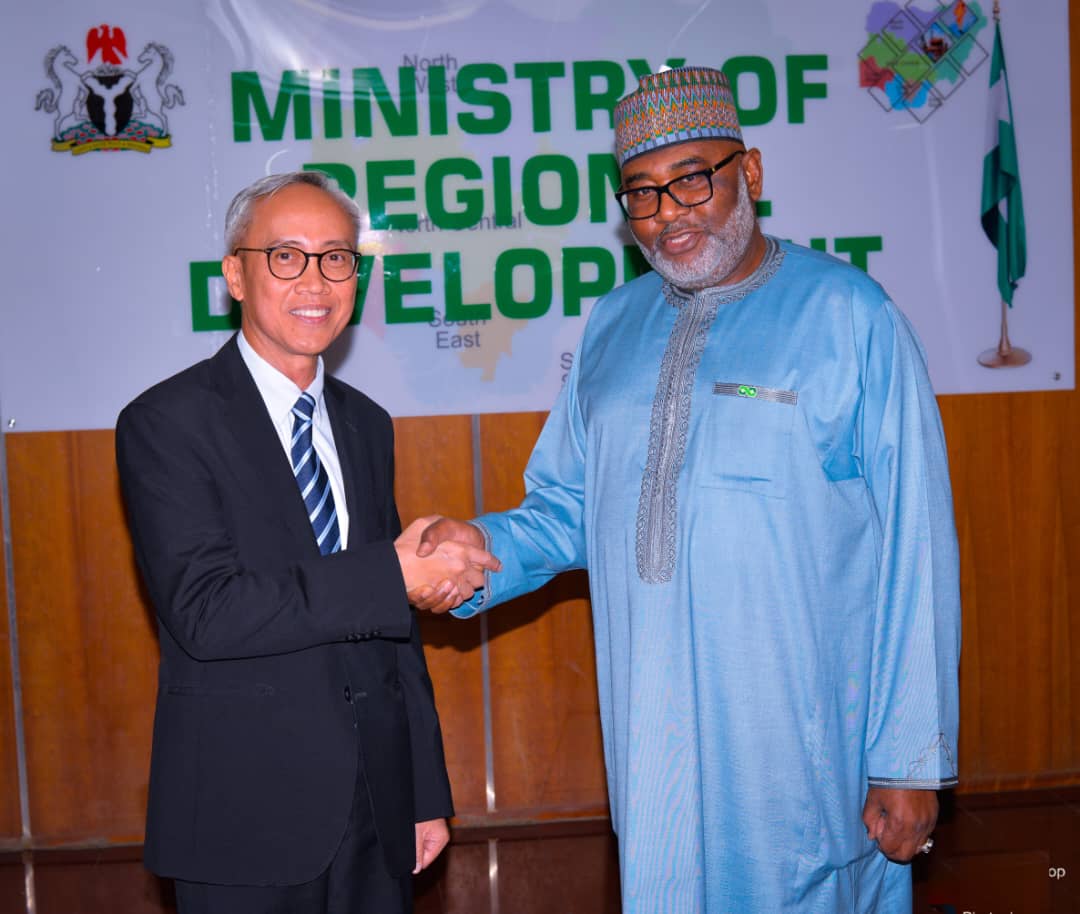
He made this remark while receiving the Indonesian Ambassador to Nigeria, Bambang Suharto, during a courtesy visit on Friday at the Ministry’s headquarters.
According the Head, Information and Public Relations, Sani Datti,in a statement, Minister emphasised that while specialised commissions exist for these regions, the Ministry’s responsibility is to formulate policies and supervise these bodies to ensure they deliver on the mandates assigned by the President.
“The President has directed that resources be prioritised based on immediate regional needs. In the North East, for example, we collaborate closely with security agencies to tackle emerging challenges.
“Our priority remains infrastructure, renewable energy, capacity building, education, health, and agriculture,” he said.
Hon. Uba highlighted a signature pilot initiative involving solar off-grid solutions for local government areas across Nigeria, with emphasis on the North East, North West, and North Central regions, which have been severely affected by insurgency.
He explained that insurgents often target power infrastructure to isolate communities before carrying out attacks and that by providing stable and renewable electricity, the government aims to empower citizens to engage in small-scale manufacturing and other household economic activities, thereby strengthening community resilience.
In his remarks, the Indonesian Ambassador, H.E. Bambang Suharto, noted the striking similarities between the two nations, particularly their population sizes, each estimated at around 230 million, as well as shared geographical challenges.
Indonesia, an archipelago comprising over 17,000 islands, faces development realities similar to those of Nigeria, which require extensive infrastructure expansion.
The Ambassador expressed Indonesia’s eagerness to invest in Nigeria’s agricultural and infrastructure sectors. He highlighted ongoing initiatives in livestock and husbandry for dairy and beef production, as well as a recent successful infrastructure project in Sokoto, where Indonesian-backed efforts recorded a 70 per cent success rate.
The Ambassador also introduced the Danantara Indonesia Project, a government-owned sovereign wealth fund. He revealed that the Nigeria-Indonesia partnership under the initiative intends to invest a minimum of $100 million.
He added that the fund, supported by partners including France, Qatar, the United States, and Saudi Arabia, will prioritise development across eight strategic sectors to drive economic growth. These areas include Renewable Energy, Minerals, Digital Infrastructure, Infrastructure and Utilities, Real Estate, Financial Services, Food and Agriculture, and Healthcare.
Speaking, the Permanent Secretary, Dr. Mary A. Ogbe, expressed deep appreciation for the proposed interventions. She stressed that infrastructure and energy remain the backbone of development and highlighted the need for collaboration in addressing critical health and social challenges, particularly Vesicovaginal Fistula (VVF) and malnutrition-related conditions affecting underserved communities.
The visit centred on strengthening bilateral relations, with particular emphasis on infrastructure development, renewable energy expansion, and human capital advancement, especially in regions impacted by insurgency.