By Ada Ukpabia
In the political heartland of the “Mbaise Nation,” where history, identity, and ambition often collide, a quiet but powerful conversation is gathering momentum. It is not yet a campaign. It is not even a structured movement. But there is an unmistakable chater.

Across village squares, youth meetings, town unions, and political gatherings, one question is beginning to echo with increasing intensity: Can a Regent rise to become a Governor?
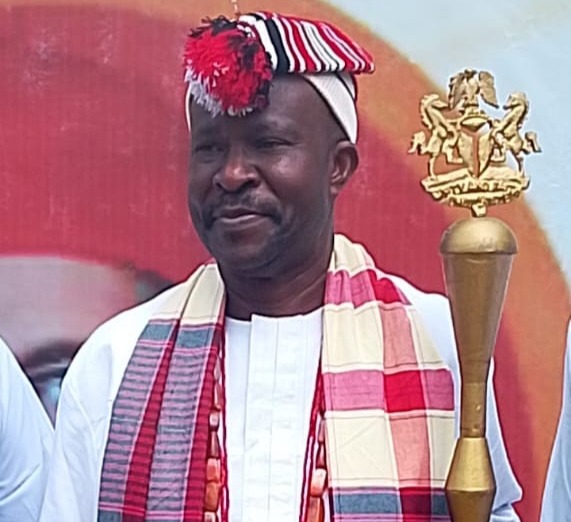
At the center of this speculation is Dr. Ugorji Okechukwu Ugorji — a man whose journey from traditional authority to state-level governance has become one of the most intriguing political stories shaping Imo State’s approach towards 2027.
THE RENAISSANCE MAN
Long before his name began to circulate in Governorship conversations, Dr. Ugorji had already been installed by the traditional rulers in Aboh Mbaise to a position of deep cultural and political significance — as Regent in his Lorji Nwekeukwu Autonomous Community. This is beyond his recognition by the same Council of Traditional Rulers in Aboh Mbaise with the Chieftaincy title of “Nwaejiamatu 1 of Aboh Mbaise.”
In Igbo traditional systems, a regent is not merely a placeholder. He is a custodian of continuity, a stabilizer in moments of transition, and a decision-maker entrusted with preserving both authority and harmony. It is a role that demands diplomacy, restraint, and a profound understanding of people, for in him the “Ofo” of the community resides, even if on an interim basis.
Those who have observed Dr. Ugorji during this period often describe a leadership style marked by calm negotiation, consensus-building, strategic patience, and firm resolve. According to the Palace Secretary of Lorji Nwekeukwu, Nze Emeka Njoku, “Dr. Ugorji has brought modern governance procedures, accountability and transparency to the affairs of Eze-in-Council.”
Mr. Victor “Chi-Chi” Njoku from Umugama Village states that “our Regent has instilled discipline and order in a traditional process that can often be manipulated, bringing clarity where there was confusion.” “Chi-Chi” went on to add that the Regent has mobilized the community to donate funds, which has been used to bring the salaries of Vigilante Officers and Community School Teachers up to date. Ugorji, he says, just hates to see any worker owed arreas in salary or stipend.
In an online commentary shared with this journalist, one Mr. Chinwe Njoku, a former Secretary of the Lorji Nwekeukwu Association for Progress (the Town Union), said on February 1, 2026 “…the recent suspension of a frontline cabinet member has restored my hope. It shows that the Council is serious about integrity and will no longer tolerate actions that bring shame to our community.”
According to Honourable Magnus Emenogu, the current Youth Leader of the community and former Counselor at Lorji, Dr. Ugorji introduced “a sitting allowance” for members of the Eze-in-Council who attend meetings on time. “He has brought the youth to a reckoning and respect higher than before, bringing in the youth leaders as members of the Eze-in-Council,” he added.
His Royal Highness, Eze Azunna Onwubiko, who is the traditional ruler (Uzu 11) of the neighboring Amuzu Autonomous Community, said that Dr. Ugorji “has honoured and extended his father’s legacy. He is truly Omekannaya. Dr. Ugorji has said he would not succeed his father, otherwise he would have been an excellent, refined and enlightened addition to the Council of traditional rulers in Aboh Mbaise. But I respect his sense of honouring the agreement of the rotation of the crown,” the royal father said.
According to Honourable Prince Alexander Elugwaraonu, a former Councilor representing Uvuru Ward 1, the youth in Mbaise is excited about the possibility of Ugorji as Governor. “Dr. Ugorji has promised the youngest cabinet in the history of Imo State, as well as the most gender-balanced. We believe him because as Commissioner, he set up the Youth Advocates Initiative and Hope’s Angels (both of which are support groups for security and peace).”
These are testaments to the qualities that now form the backbone of the argument being made quietly across Mbaise: that Governance at the State level may not be far removed from the principles of traditional stewardship.
If his Regency established his cultural and traditional credibility, Dr. Ugorji’s appointment as the pioneer Commissioner for Homeland Security and Vigilante Affairs by Governor Hope Uzodimma added a state-level gravitas to his profile. He knows the state, and the state knows him – he is even better known to the traditional rulers who are the chief security officers of their respective communities.
At a time when security concerns were redefining political priorities across Nigeria, the creation of the Ministry of Homeland Security and Vigilante Affairsi signaled urgency. That Dr. Ugorji was chosen by Governor Uzodimma to conceptualize and lead it, was a knod to both technocracy and strategy.
With experience drawn from the United States in the international security sphere, he was tasked with helping shape a community-based security architecture —bridging the gap between formal institutions and local vigilante systems. Equiped with kinetic resources for protection, the ministry nonetheless had “peace” in the state as its ultimate goal, with regard for the citizens’ human rights and civil liberties.
For political analysts, this local, state, national and international exposure – traditional authority and modern governance skills and experience — place Dr. Ugorji in a unique category of aspirants: those who understand both the cultural psychology of communities and the technical demands of State administration and statecraft.
Mbaise is not new to political consciousness and aspirants. The region has long been known for its strong civic engagement, intellectual vibrancy, and deep-rooted sense of identity.
So when imaginations begin to “run wild” in Mbaise, it is rarely without reason.
Several factors are driving the current wave of speculation:
THE EQUITY CONVERSATION
With 2027 approaching, discussions around the rotation of power to Owerri Zone have gained prominence. Mbaise, as a critical bloc within that zone, is naturally central to this conversation.

THE SEARCH FOR CAPACITY
The narrative is gradually shifting from where the governor should come from to who can effectively govern. In that context, figures with both administrative experience and grassroots legitimacy are gaining attention. It is not about just money any longer – how much money would any aspirant offer Uzodimma that would impress him?
UGORJI VERSUS OTHERS IN THE MARKET PLACE OF IDEAS
Dr. Ugorji’s ward-level declaration of interest —a move many consider audacious — has added fuel to the conversation. By choosing to engage openly at the grassroots level, he has effectively moved from speculation into structured political relevance. In essence, within the ruling All Progressive Congress party, it is now Ugorji versus others.
Perhaps one of the most delicate aspects of Dr. Ugorji’s rising profile is how he has managed the intersection of loyalty to the current administration and personal political ethos. In many political settings, ambition is often perceived as opposition. But in this case, observers note a more nuanced dynamic.
Dr. Ugorji has remained aligned with party structures while simultaneously signaling readiness for higher responsibility. This balancing act has contributed to a perception of disciplined posturing — an aspiration seeking transparent democratic competition in the market place of ideas, instead ofj expecting a coronation. This ethos resonates within both political elites and grassroots supporters, especially among the youth.
Within Imo’s political landscape, seasoned observers often speak of timing and sequencing. There is a growing belief that political relevance in the State is rarely accidental. Figures who eventually rise often do so after periods of seeming quietness, repositioning, and strategic patience, as well as the grace of God.
In that light, Dr. Ugorji’s current trajectory —visible enough to be discussed, yet measured enough to avoid overexposure — fits into a pattern that many analysts are beginning to watch closely. The buzz is that Nwaejiamatu is reconfiguring the succession game in Imo State.
Still, the question remains: Are these just imaginations and fantasies, or the early signs of a real political upstart?
For now, much of the energy remains conversational, paired with consultations — driven by community sentiment, political curiosity, and regional expectations. But history has shown that in Nigerian politics, today’s “imagination” often becomes tomorrow’s reality, especially when it is sustained by credibility, consistency, and authentic connection to the grassroots. Dr. Ugorji appears to be gradually building all three.
As 2027 inches closer, more aspirants will step forward, alliances will shift, and the political landscape will become much more active. Yet, in this early phase of the conversation, one thing is evident:
In Mbaise, the idea of Ugorji stepping up from Regent to Governor is no longer a distant thought. It is a growing cerebral narrative, steeped in history, fueled by hope, and sustained by the very possibility that thunder might just usher in justice to Mbaise, to Owerri Zone, and to Imo State.