By Jane Okeke
Women leaders and advocates for increased political inclusion have renewed calls for affirmative action and structural reforms to enhance women’s representation in Nigeria’s governance architecture, stressing that the struggle for gender equity in leadership has spanned more than three decades.
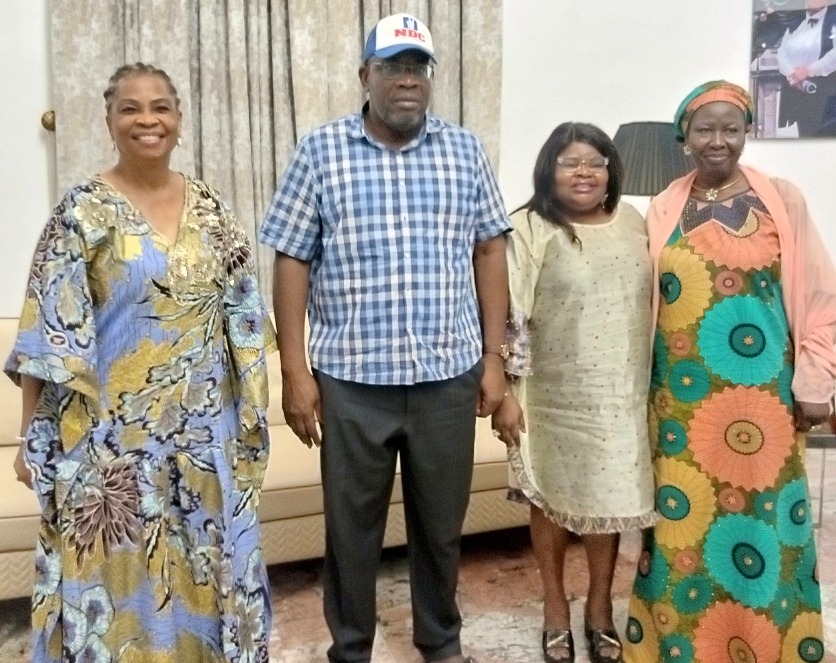
The renewed push came during a courtesy visit by members of the Women Collective Hub, led by Nkoyo Toyo, to Seriake Dickson, where stakeholders deliberated on strategies to expand women’s participation in politics and decision-making processes.
Speaking during the engagement, Toyo emphasised that the agitation for women’s political inclusion is longstanding, rooted in decades of sustained advocacy, policy engagement, and constitutional reform efforts.
“For over 30 years, Nigerian women have fought for inclusion; this struggle is not new,” she said. “Advocacy for women’s political participation has been ongoing since the 1990s. We have been part of constitutional engagements, political reforms, and several national conversations aimed at ensuring women have access to leadership positions.”
She recalled that women’s rights groups had participated in multiple constitutional review processes aimed at securing guaranteed access to positions in government, noting, however, that many of the outcomes fell short of expectations.
According to her, the push for gender inclusion has consistently encountered setbacks despite years of advocacy, institutional engagement, and political negotiations.
“We have engaged in constitutional processes, interacted with political leaders, and driven civil society advocacy, yet the outcomes have not reflected the expectations of Nigerian women,” she said. “While the ideology may exist in party documents, actual political practice often lags far behind.”
Toyo explained that women’s organisations have repeatedly advocated for mechanisms such as affirmative action and reserved seats in legislative bodies to correct what she described as a deeply entrenched imbalance in political representation.
She also expressed concern over Nigeria’s low level of female representation in public office compared to other countries, describing the situation as both disappointing and embarrassing.
“When we travel across the world, we see countries with far higher female representation in parliament. Yet Nigeria, with so many accomplished and capable women, still struggles with less than four percent representation in the National Assembly,” she said. “It raises a fundamental question: how can a country that produces brilliant women leaders fail to translate that capacity into political power?”
Toyo therefore urged political leaders and institutions to support ongoing advocacy for special legislative seats for women and to strengthen commitments by political parties to open their structures to female leadership.
Also speaking during the meeting, the National Women Leader of the Nigeria Democratic Congress (NDC), Dudu Manuga, reaffirmed the party’s commitment to affirmative action and inclusive leadership, noting that the party had already adopted policies aimed at expanding opportunities for women.
According to her, the party is working to dismantle structural barriers that discourage women from contesting elections, while also promoting training, empowerment, and political mentoring initiatives.
“Our party believes Nigerian women should have the opportunity to become everything they were born to be,” she said. “We are removing barriers that discourage women from aspiring to political office and ensuring that our internal processes are transparent and inclusive.”
She explained that the NDC is committed to creating a political environment where women can contest and emerge as candidates at all levels of governance—from councillorship and local government leadership to governorship and presidential positions.
“In this party, we want to see women contest for every office. We want to see women emerge as candidates for governorship, legislative seats, and even the presidency,” she added.
Responding to the delegation, Senator Dickson welcomed the advocacy group and commended Toyo for her decades-long commitment to advancing women’s rights and leadership.
“I have known Madam Nkoyo for several years, and for decades she has been advocating for these issues,” he said. “Women’s inclusion is not just a women’s issue; it is a human issue.”
Dickson acknowledged that Nigeria’s low female representation in governance remains a serious challenge, describing the country’s statistics as unacceptable.
“The level of women’s representation in Nigeria is shameful. In every state and community, you will find capable and qualified women, yet the political system has not created enough opportunities for them,” he said.
The senator expressed support for legislative initiatives aimed at improving women’s political participation, including proposals for reserved seats and other forms of affirmative action.
“There is nothing that will help improve the status of women that comes my way that I will not support,” he said. “Affirmative action and the proposed reserved seats are important steps. They may not solve all the problems immediately, but they are necessary to move us forward.”
Dickson also encouraged women’s organisations to remain actively engaged with lawmakers and political institutions to ensure that gender inclusion reforms receive the necessary legislative backing.
“We must create mechanisms that address economic and social barriers affecting women in politics,” he added. “When the constitutional framework for affirmative action is established, we can then work out the details to ensure women have a strong voice at the table.”
Adding her voice, the Project Coordinator of Women Collective Hub and Director of IRIAD–The Electoral Hub, Princess Hamman-Obels, noted that the visit was driven by the organisation’s commitment to encouraging political parties to integrate women into their leadership structures and electoral processes.
She urged party leadership to convene broader consultations involving civil society organisations and women’s groups to develop practical strategies for advancing female representation.
“We discovered that your party is committed to having women in positions of leadership, and that is why we are here,” she said. “It is important for the party to bring together diverse groups of women—from civil society and other organisations—to strengthen this commitment.”
The engagement forms part of ongoing national advocacy efforts by women’s organisations seeking stronger political commitments, legislative reforms, and institutional mechanisms to expand opportunities for Nigerian women in governance and leadership.