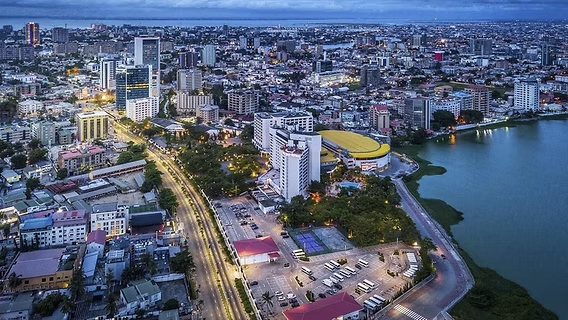
Over the last decade, Lagos has built a lively community of founders, investors, and engineers who build payments, logistics, and other useful tools used every day across Nigeria. In Africa, Lagos is the world’s fastest-growing tech hub that raised more than $6 billion from foreign investors in 2019-2024.
Africa’s Silicon Valley
People call Lagos “Africa’s Silicon Valley” for good reasons. The city draws record amounts of venture capital and, obviously, has several billion-dollar startups. Government policies support new companies, so the Internet and other tech infrastructure keep getting better.
The talent pool is also large and growing. Local hubs and networks help young firms get guidance and funding. Nigeria’s huge, young, online population gives startups a massive home market that plays a similar role to the U.S. consumer base for Silicon Valley giants.
Major global investors trust Lagos. By absolute dollars, it still raises much less than Silicon Valley. However, its growth rate stands out. U.S. startups pulled in nearly $200 billion in venture capital in 2022, according to CBInsights, while across all of Africa, founders raised only about $3.1 billion that year. Even so, Lagos has become the continent’s fastest-growing tech hub.
How it differs from Californian Silicon Valley
When we compare Lagos with Silicon Valley directly, the differences are as important as the similarities. Lagos is still in early development stages and it may take a decade to get as much exposure as Silicon Valley gets. For more information, we asked successful entrepreneurs about comparison. One of the biggest names in entrepreneurship sat with us and talked about the differences. Latoria Williams, the CEO of 1F Cash Advance, says “The Bay Area still dominates in absolute funding, depth of capital markets, and the number of late-stage investors. Yet Lagos is building its own version of that model. Founders combine venture money with revenue-based finance, public funds, and digital credit tools.” In the U.S., small business owners and solopreneurs use SBA loans to cover operating costs or bridge cash gaps when equity funding is delayed; in Nigeria, founders increasingly rely on local fintech lenders and savings platforms to solve the same problem.
How founders use Nigerian government projects
Founders also use revenue‑based finance: government-backed funds, such as the new Nigeria Startup Investment Seed Fund, provide early-stage grants. Lagos State has also launched tech cluster funds under its KITE project to seed local innovation hubs. Together, these tools give Lagos founders a capital stack that looks familiar to anyone watching the U.S. startup ecosystem, just calibrated to Nigeria’s market realities.
Nigeria now treats tech startups as a substantial part of the economy. Three years ago, the country passed the Nigeria Startup Act. The law provides young tech firms with tax breaks, a national seed fund, and a single online portal for registration and compliance. It established a National Digital Innovation Council to coordinate policy and reduce red tape. The goal is to make it easier to start, fund, and protect new tech businesses, much as federal and state-level initiatives have done for founders in the United States over several decades.
Several Unicorns in last few years
As a result, Lagos’s startup ecosystem has produced several unicorns. For now, the city is home to five companies valued at more than $1 billion — global fintech players such as Flutterwave, OPay, Interswitch, Jumia, and Moniepoint. These startups have achieved the kind of billion-dollar valuations once thought mythical in Africa, and while that number is still tiny compared with the hundreds of unicorns created in Silicon Valley, it signals that Lagos can consistently generate global-scale firms.
Beyond the unicorns, Lagos has a deep base of high-growth startups and tech “gazelles”. Over 700 startups in West Africa have raised at least $100,000 in funding, and 13 of the 15 top-funded ventures are Nigerian. Lagos’s leading startups stand out because they fix real African problems and turn daily pain points into useful products for millions. Like many mid-stage companies in the Bay Area, they focus on payments, logistics, and digital services — but they design them around patchy infrastructure, informal commerce, and mobile-first users.
Financial regulators also play a role in this story. The Central Bank runs a sandbox so fintechs can test products under supervision. An open‑banking framework now requires banks to share data, helping startups plug into the system. Authorities also moved from blanket bans on ride‑hailing models to licensing rules that allow safer operations. Difficulties remain, such as crypto-related restrictions and ongoing tax disputes, which create friction, but company registration, online tax filing, and policy have improved. In this respect, Lagos is gradually building the kind of predictable rules that helped Silicon Valley fintechs grow, even if its regulatory journey is still at an earlier stage.
Public bodies and startups work together more often. For example, take universities that host innovation hubs. NITDA runs a national startup accelerator, the Lagos State Employment Trust Fund gives grants to youth-led tech ventures, and officials now explicitly invite the diaspora and private incubators to shape policy. That builds an inclusive digital future. Such an approach is similar to California’s public-private model, which is well known to all of us, where universities like Stanford and UC Berkeley sit at the center of the innovation ecosystem.