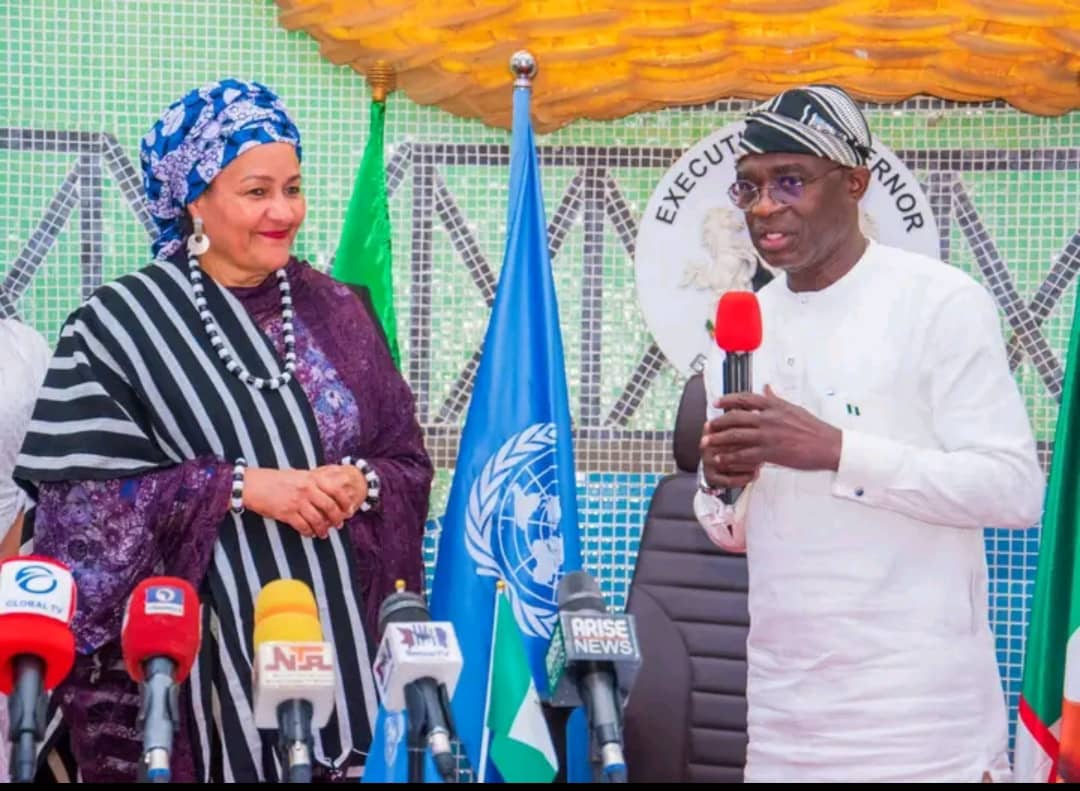
By Chiangi Avese, Makurdi
Benue State Governor, Rev. Fr. Hyacinth Alia has sought a strategic partnership with the United Nations to address the state’s humanitarian, agricultural and climate challenges, declaring that Benue is ready to transform its vulnerabilities into long-term resilience.
The Governor who made the declaration at in Makurdi, during the official visit of the United Nations Deputy Secretary-General, Amina Mohammed, framed his administration’s appeal around a central message, “Benue’s future depends on collaborative global action that links food security, climate resilience and human dignity”.
Alia said, “What we seek is not charity, but collaboration. Not isolated projects, but integrated systems. Not temporary relief, but lasting transformation.”
Appealing for development partnerships anchored on sustainable impact, he described Benue as Nigeria’s “Food Basket of the Nation,” adding that the state occupies a critical position in Nigeria and West Africa’s food systems, but remains under pressure from farmer-herder conflicts, climate-related vulnerabilities and a humanitarian burden of more than 500,000 internally displaced persons.
The Governor noted that since assuming office in 2023, his administration has pursued an integrated development agenda focused on rebuilding institutions, restoring dignity and unlocking economic opportunities across key sectors.
He said, “We are not waiting for change, but building structures that enable change”.
In education, Alia said his government has rehabilitated more than 375 public schools, recruited 9,700 teachers at the basic education level, introduced free education policies and established new technical and higher institutions.
In health, he highlighted the rehabilitation of 104 rural health centres, revitalization of the Benue State University Teaching Hospital, and expanded maternal and child healthcare services.
On infrastructure, the governor said strategic roads and transport projects are being used to connect rural and urban economies and unlock agricultural productivity, while over 10,000 youths have already been trained in digital skills under the state’s ICT empowerment programmes.
He emphasized that humanitarian response remains central to his administration’s priorities, especially in conflict-affected communities.
“These are not just interventions; they are pathways from displacement to dignity,” he said.
Referencing the state’s support for internally displaced persons, including shelter provision, farmland allocation, livelihood restoration and post-crisis rebuilding efforts in Yelewata, the governor also used the occasion to formally seek UN collaboration in five strategic areas. The areas include; climate resilience and River Benue restoration, agro-industrial mechanization, human capital development in education and health, community stabilization and security, and the creation of a Benue SDG Transition and Resilience Financing Facility.
Reaffirming Benue’s ambition to become a model of sub-national transformation, Gov. Alia declared that “Benue is ready to lead, to partner and to deliver results that matter, not just for the Benue people, but as a model for Nigeria and the global community