
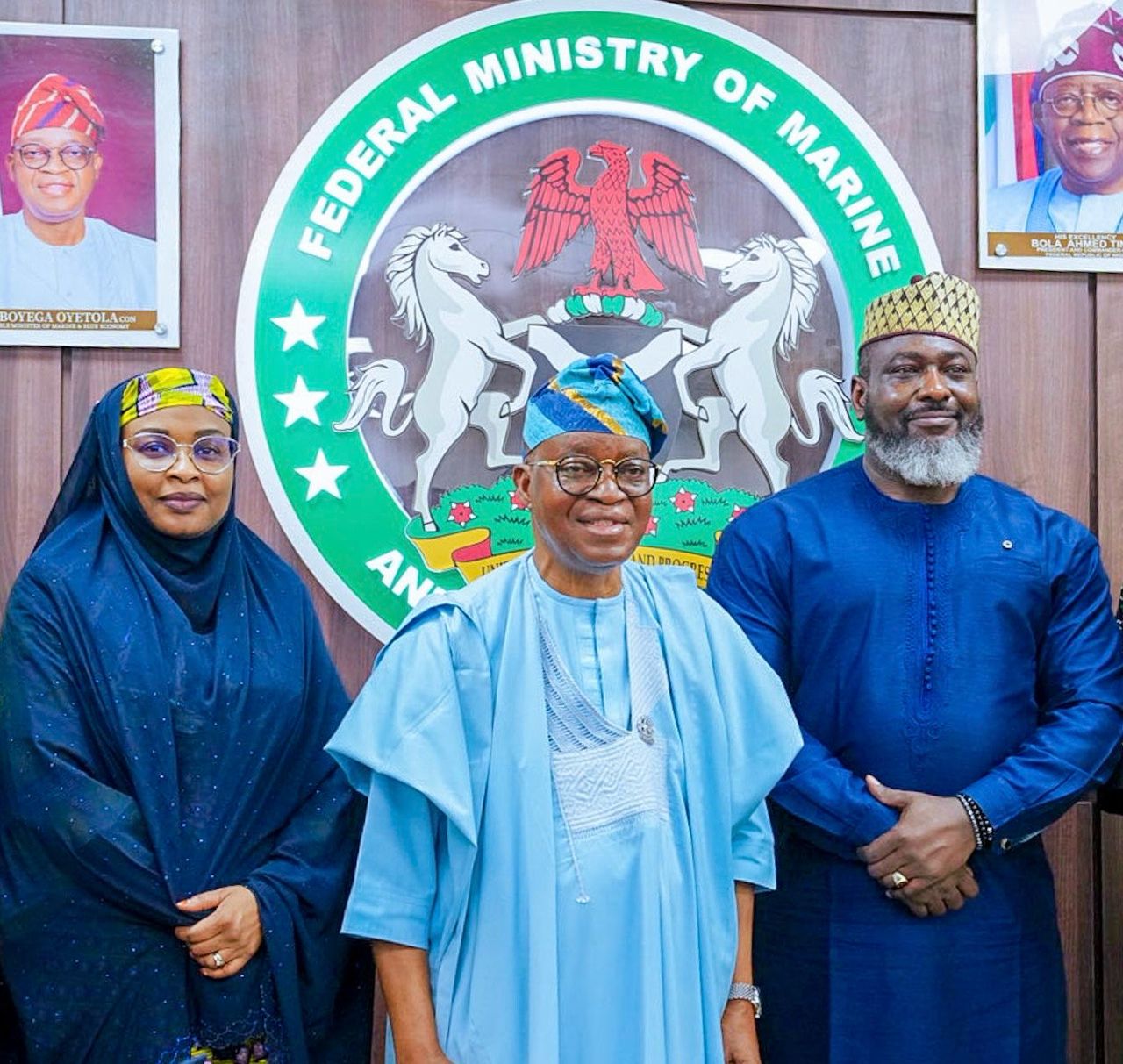
L-R: Permanent Secretary, Federal Ministry of Marine and Blue Economy, Mrs Fatima Mahmood; Minister of Marine and Blue Economy, Dr. Adegboyega Oyetola, CON, and Chief Executive Officer, Nigerian Economic Summit Group (NESG), Dr. Tayo Aduloju, when the NESG leadership visited the Minister in his office in Abuja on Thursday.
By Myke Uzendu, Abuja
The Minister of Marine and Blue Economy, Adegboyega Oyetola, has unveiled plans to end fish importation by expanding Nigeria’s maritime security framework under the Integrated National Security and Waterways Protection Infrastructure.
He revealed that local fish production rose from 1.1 million metric tonnes to 1.4 million metric tonnes in 2025, the first increase recorded in a decade, with plans underway to sustain the momentum through support for artisanal fish farmers and reactivation of fishing terminals nationwide.
Speaking in Abuja while receiving a delegation from the Nigerian Economic Summit Group (NESG), the minister said a proposal had been submitted to the Federal Government to upgrade the initiative in order to consolidate gains in maritime security.
He described the Deep Blue Project as a “game-changer,” noting that its deployment has significantly enhanced surveillance and response capabilities across Nigeria’s territorial waters.
“The project, which integrates air, land and sea assets alongside advanced surveillance systems, has significantly improved maritime domain awareness and response capability, restoring confidence among international shipping lines and investors,” Oyetola said.
According to him, the improved security situation has delivered economic benefits beyond Nigeria, particularly across the Gulf of Guinea, once considered one of the world’s most dangerous maritime corridors.
“Safer waters have led to increased shipping traffic, reduced insurance premiums, enhanced port activity and greater regional trade flows,” he added.
Oyetola said the planned expansion would further position Nigeria as a maritime security leader in West and Central Africa while supporting broader economic growth under the blue economy agenda.
On fisheries, the minister disclosed that the government is intensifying efforts to boost local production and reduce dependence on imports, describing the current level of fish importation as unsustainable.
“It is no longer acceptable that Nigeria continues to spend huge foreign exchange on fish importation,” he said, adding that the government is determined to reverse the trend.
The minister also announced that the United States had approved Nigeria’s Turtle Excluder Device, enabling Nigerian shrimp exports to access both U.S. and European markets.
He said the certification “has unlocked significant foreign exchange earnings, improved competitiveness and created jobs across the value chain.”
Earlier, NESG Chief Executive Officer, Tayo Aduloju, commended the ministry for developing a comprehensive national policy for the sector.
He said the framework provides “a structured pathway for sustainable exploitation of marine resources, improved governance, environmental protection and increased private sector participation.”
Aduloju added that effective implementation would boost economic growth, create jobs and strengthen Nigeria’s position in the global blue economy.
Photo attachment: IMG-20260426-WA0017.jpg
