By Chesa Chesa
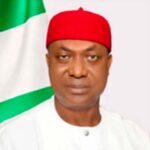
Governor Hope Uzodimma has called on members of the diplomatic corps to align with Nigeria’s ongoing economic and governance reforms, declaring that the country is moving from “foundational repair” to visible recovery under President Bola Ahmed Tinubu.
Addressing diplomats accredited to Nigeria on Monday, the Imo State governor, who also chairs the Progressive Governors’ Forum, said recent policy decisions by the Tinubu administration had begun to restore investor confidence and improve macroeconomic stability.
Uzodimma, who doubles as Tinubu’s Renewed Hope Ambassador, highlighted the removal of fuel subsidy and the floating of the naira as pivotal reforms that reshaped Nigeria’s fiscal and monetary landscape. He described the subsidy regime as a major channel of corruption that drained public finances for decades, adding that its removal had freed up significant resources now being deployed to infrastructure and social investments.
According to him, increased revenues accruing to the Federation Account have strengthened the financial capacity of all tiers of government, enabling states to meet obligations and expand development projects without relying on bailouts or excessive borrowing.
The governor also pointed to major infrastructure projects, including the Lagos-Calabar Coastal Highway and the Sokoto-Badagry Superhighway, as evidence of renewed federal commitment to national development. He said such projects were already improving economic activities and reducing travel time across key corridors.
On monetary reforms, Uzodimma said the unification of the foreign exchange market had improved transparency and predictability, making Nigeria a more attractive destination for investors. He noted gains in foreign reserves, diaspora remittances, and stock market performance as indicators of strengthening economic fundamentals.
He acknowledged that the reforms initially triggered inflationary pressures but maintained that Nigeria had demonstrated resilience amid global shocks, including disruptions linked to tensions in the Middle East. He added that inflation had begun to moderate while economic growth remained steady.
The governor further outlined interventions in education, taxation, digital economy, and security, including the student loan scheme, tax reliefs for low-income earners and small businesses, and ongoing efforts to restructure Nigeria’s security architecture.
Uzodimma urged diplomats to rely on verifiable data and official assessments in evaluating Nigeria’s progress, rather than “excitable narratives” circulating on social media. He stressed that opposition to reforms was expected but should be weighed against measurable outcomes.
He concluded that Nigeria now presents stronger opportunities for international partnerships, investment, and development cooperation, noting that the Renewed Hope agenda provides a coherent framework for engagement.
“The country is not merely surviving its reform period; it is moving through it,” he said, expressing optimism that Nigeria would emerge more competitive and credible in the global arena.
In his remarks m, Minister of Budget and Economic Planning, Atiku Bagudu, said the engagement with diplomats was part of ongoing efforts to deepen collaboration between federal and state governments and the international community, particularly as Nigeria advances the implementation of President Tinubu’s Renewed Hope Agenda.
Bagudu noted that the agenda prioritises economic recovery, inclusive growth, improved governance, security resilience and sustainable development, stressing that Nigeria continues to value the longstanding support of its development partners across sectors such as healthcare, education, agriculture, climate action and institutional capacity building.
He said opportunities for deeper collaboration exist at the subnational level, particularly in areas such as infrastructure financing, investment promotion, skills development, climate-smart agriculture and data-driven planning, adding that stronger engagement with states would help tailor interventions to local realities.
The minister also emphasised Nigeria’s commitment to democratic governance and the rule of law, pointing to the administration’s acceptance of judicial outcomes and continued engagement with state governments as evidence of efforts to sustain reforms and strengthen national development.
The event witnessed messages of goodwill given by representatives of the diplomatic community.