From Cyriacus Nnaji, Lagos
,
Professor of Transport, Mobility and Development at the Lagos State University (LASU), Charles Ojima Asenime, has called for the prioritisation of projects contained in the National Transport Survey Plan (NTS).
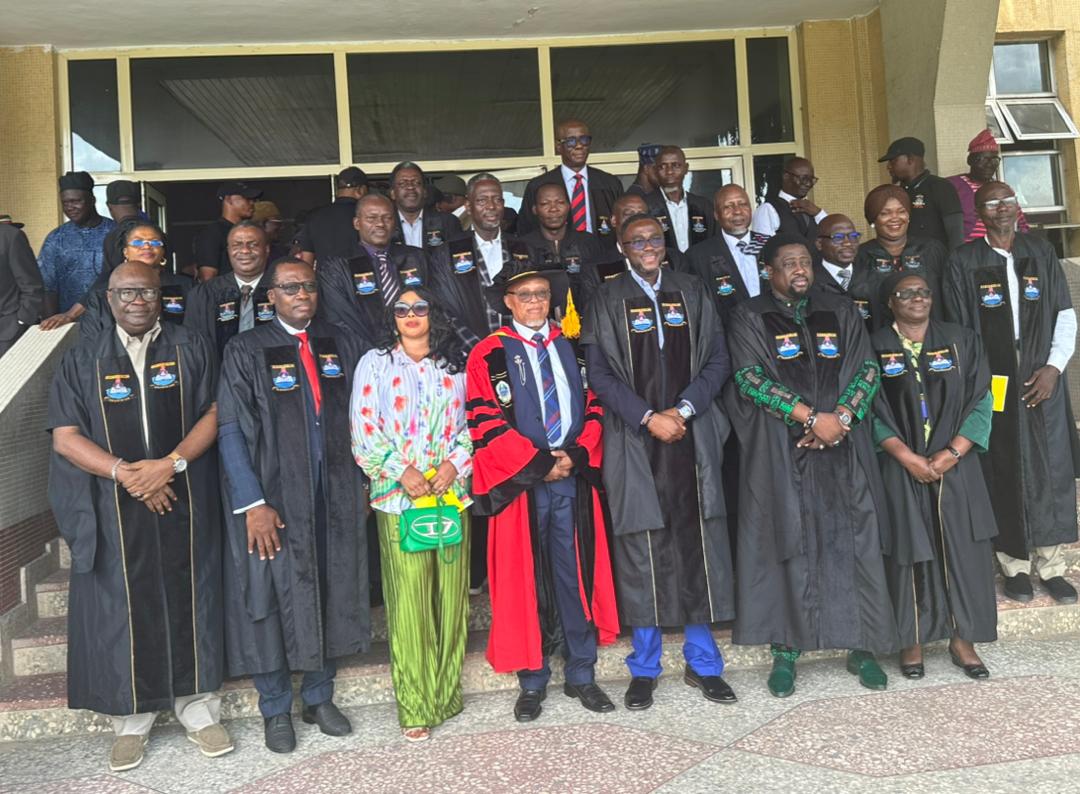
Asenime made the clarion call as part of his recommendations while speaking as the 122nd Inaugural Lecturer of LASU.
The event which took place at the popular Buba Marwa Auditorium of the institution at Ojo on Tuesday, May 12, 2026, has the title “Who is this Agbero? Catechizing the Role of Informality and Non-state Actors in Nigeria’s Transport System and Development.
Asenime said, “I recommend the prioritisation of projects contained in the National Transport Survey (NTS) Plan, Review of the Master Plan for Integrated Transportation Infrastructure (MITI). It is overdue by so many years.”
He went ahead to also recommend that every state should have a Transport Infrastructure Master Plan or a Strategic Transport Master plan like Lagos State.
The erudite Professor, further advocated that all states with littoral communities should establish state Inland Water Transport Authority and collaborate with NIWA to enhance safety and efficiency, improve on active mobility and inclusivity, modernise motor parks, adding “We can reduce informality by integrating informal operators and non-state actors into the transport planning process, prioritise multimodal transport in transport planning across the states of the federation, especially rail and Inland waterways, improve the use of ITS in-transport system (e-call up, Traffic Signals, Port operations, Vehicle Administration, Vehicle maintenance, Traffic enforcement, Traffic Impact assessment projects, Transport safety and security.”
Further, he maintained that the production of an Integrated Multimodal National Transport Policy should be given high priority and government should appoint an interministerial Committee with a supervising minister to operate the policy, saying that to improve safety, the process of issuing drivers’ licence should be closely monitored to avoid issuing licence to undeserving individuals, and lastly, government should establish Road Transport Commission, he stated.
Prof Asenime said that Transport in Nigeria, especially in Lagos, is not just about movement; it is about life itself. “A journey meant to last 30 minutes often stretches into 3 hours, draining productivity and reshaping how we live and work. Transport is the backbone of our existence. If we can move on time, move efficiently, move safely, and move comfortably, then we can be more productive, live a more peaceful and fulfilled life. Without transport, there is no life.”
He captured the vast roles played by transport in what he called the octopian role of transportation in modern society including but not restricted to industrial growth and regional integration.
In Economics/Trade, it enhances movement of goods and services; help Supply chains by enhancing imports and exports. In Education transport enhances students commuting to school, in distribution of books and learning materials; while in Tourism it enhances movement of tourists, access attraction and cultural sites. Transport also plays key role in Communication/connectivity, as it enhances physical movement supports, digital infrastructure, eg laying cables, logistics.
In Health, there is the use of ambulance and emergency response, delivery of medical supplies and vaccines; it facilitates Industry/Manufacturing especially in moving raw materials to factories, finished goods to market; and in Urban development, it enhances city expansion and planning and public transport system.
In conclusion, Prof Asenime averred that the informal transport sector, both on land and inland waterways, has contributed far beyond anyone’s projections.
He stated, “Without it, nearly 80% of Nigerians would struggle to move. Food supplies would dwindle, fish would be scarce, and businesses would grind to a halt. This sector has provided livelihoods to more Nigerians than the formal system ever has. Yet, the shortcomings we experience on our roads and waterways are largely the consequences of informality. Most road traffic crashes stem from human error and weak enforcement. Likewise, boat mishaps along inland waterways are often the result of poor operating capacity, reckless behaviour, and inadequate regulation. Accidents do not simply happen; they give warnings. A man who drives or steers recklessly is a man heading toward disaster.
“Added to this is the neglect of past transport surveys, which has fuelled this rise in informality, compromising both safety and efficiency. By relegating road and inland water transport systems to informal structures, we have reduced mobility—especially for low-income groups—while increasing the cost of doing business and diminishing the quality of life for millions of Nigerians,” he said.
On the way forward, he said, “If we plan transport diligently, implement those plans faithfully, and enforce them consistently, we will build a system that allows us to live sane, healthy, and more productive lives.”
He disclosed that the challenges faced by transport as a discipline are the lack of awareness about the course. He added, “Transport is not a subsidiary discipline—it is a full, independent field that drives economies, secures nations, and shapes the future. From the refuelling midair to hyperloops, from Arctic icebreakers to drones and listics science, transport is the invisible force behind modern civilisation.
“That is why the School of Transport and Logistics in Africa stands proudly as a pioneer that cannot be tucked away under other faculties. Transport is not just about moving people—it is about moving societies forward. And so, as I stand before you today, I embrace the title my colleagues have bestowed upon me: Olori awon Agbero of Lagos. It is not merely a name; it is a recognition that transport—whether formal or informal, state or non-state—defines our daily lives and our collective destiny,” he said.