By Felix Khanoba
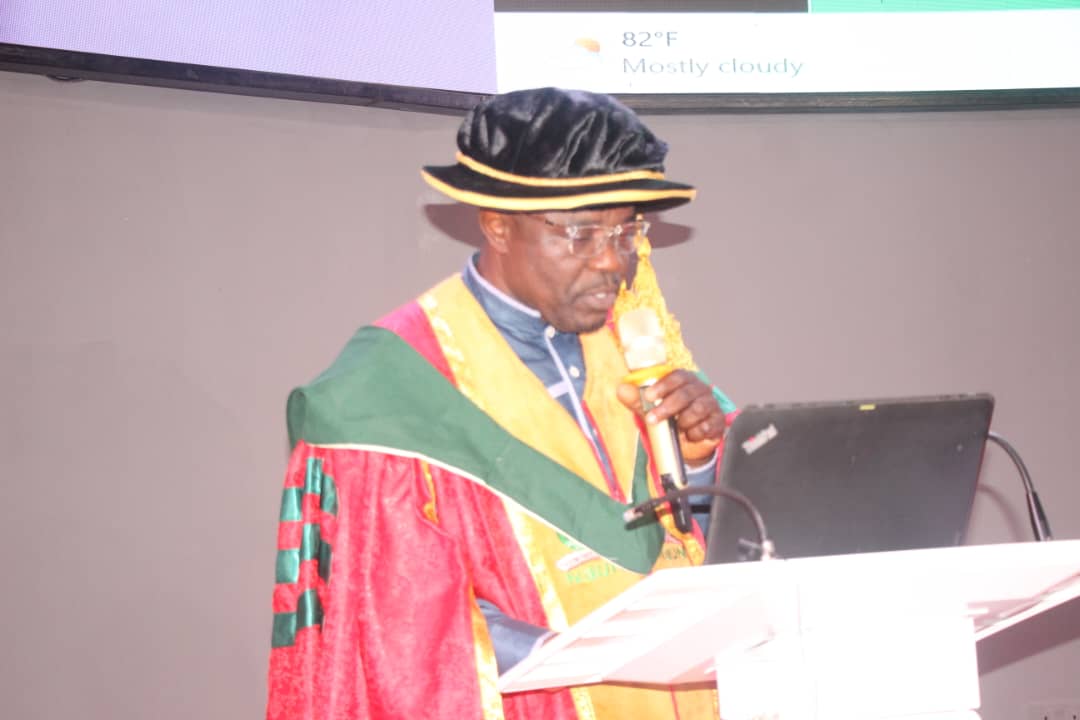
A professor at the National Open University of Nigeria (NOUN), Mustapha Momoh, has cautioned individuals and organisations against relying on the sheer volume of available information without properly assessing its credibility, relevance and usefulness.
Momoh, a Professor of Information Management and Management Information Systems, gave the warning on Thursday, September 24, 2026, while delivering NOUN’s 43rd Inaugural Lecture at the university’s Conference Centre in Abuja.
The lecture, titled “Managing Information Sources, Utilisation and the Need to Know,” focused on the growing challenge of navigating an increasingly crowded information environment and making sound decisions from available data.
Momoh, who is a member of the Department of Business Administration, Faculty of Management Sciences, said society had transitioned from a period of information scarcity to one characterised by information overload.
He said the challenge in the digital age was no longer merely gaining access to information, but determining which sources were trustworthy, understanding the information correctly, deciding when it should be used and ensuring it reached the appropriate people.
According to a statement signed by the Acting Director, Media and Publicity, NOUN, Omotola Ojudu, the professor warned that having access to abundant information should not be confused with having the capacity to use it wisely.
He drew a distinction between being “information-rich” and being “information-wise”, stressing that the availability of vast quantities of information does not automatically translate into better decisions.
“Information is a vital resource,” he said, noting its role in decision-making, goal attainment and organisational performance.
Momoh, however, noted that the expansion of access to information through digital platforms had also created problems, particularly misinformation, disinformation and the difficulty of distinguishing credible sources from unreliable content.
He therefore called for greater capacity among individuals and organisations to separate useful information from irrelevant material, warning that poorly evaluated information could undermine decision-making.
Without proper evaluation and management, he said, information could result in the familiar outcome of “garbage in, garbage out.”
The professor described information as one of humanity’s three major resources, alongside materials and energy, linking the three resources to the Green Revolution, Industrial Revolution and Information Revolution.
He also challenged his audience to reflect on what could emerge as the next major revolution globally.
On the role of information in decision-making, Momoh explained that strategic information was essential for long-term planning and policy formulation, while tactical information supported managerial functions such as resource allocation and control.
Operational information, he added, was necessary for the effective execution of routine and day-to-day activities.
He identified relevance, accuracy, completeness, timeliness and credibility as key characteristics of useful information. Such information, he said, should also be clear, appropriate to the decision being made and directed to the right recipient.
Momoh further differentiated between raw data and information, explaining that data becomes useful only after it has been properly organised, interpreted and understood.
Using optical illusions during the lecture, he demonstrated how human perception could sometimes differ from reality, reinforcing the need for careful interpretation of information.
Earlier, the Vice-Chancellor of NOUN, Professor Uduma Oji Uduma, congratulated Momoh on the achievement and praised his contribution to the intellectual development of the institution.
Uduma encouraged academic staff and doctoral students to make regular attendance at inaugural lectures a priority, describing the events as valuable opportunities to learn from the research experiences and scholarly contributions of established academics.
The Vice-Chancellor said inaugural lectures should not be regarded merely as ceremonial events but as platforms for intellectual engagement and knowledge sharing.
Also speaking, the Deputy Vice-Chancellor, Academics, Professor Chiedu Mafiana, thanked participants and commended Momoh for what he described as an enlightening presentation.
Mafiana said the lecture underscored the responsibility of academics and institutions to generate, preserve, evaluate and disseminate knowledge responsibly.
Momoh, in his closing remarks, expressed appreciation to the Vice-Chancellor, Deputy Vice-Chancellor, Academics, and members of the university community for attending the lecture and supporting the academic milestone.