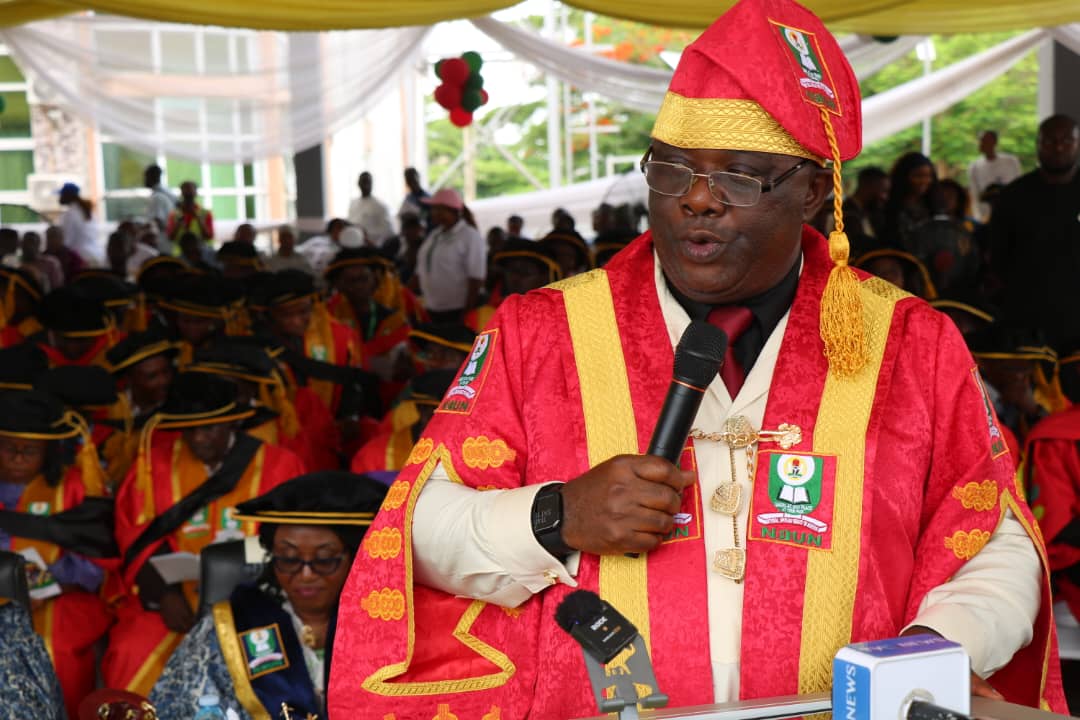
Vice-Chancellor of NOUN, Prof. Uduma Oji Uduma
By Felix Khanoba
The National Universities Commission (NUC) has said it will open discussions with the National Youth Service Corps (NYSC) on the possible mobilisation of graduates of the National Open University of Nigeria (NOUN) for the national service scheme.
Executive Secretary of the NUC, Prof. Abdullahi Ribadu, disclosed this on Saturday in Abuja at the university’s 15th convocation ceremony.
“I want to assure you, at NUC, we will engage with NYSC to see what policy changes can be made in order for NOUN graduates, because the dynamics have changed. Unlike in the past, where graduates of now are 30 years and above, in recent times, you have graduates of a younger age, less than 30, who are likely to participate in the NYSC based on age. We will do our best to see that this thing is effected,” Ribadu said.
President Bola Tinubu, represented at the event by Ribadu, commended NOUN for its expanding role in widening access to higher education through open and distance learning.
“The National Open University of Nigeria occupies a unique and strategic place in the nation’s tertiary education ecosystem. As the foremost institution dedicated to open and distance learning, the university has demonstrated that the frontiers of higher education can be expanded significantly without compromising academic quality.
“Each year, more than 2 million candidates sit for the Unified Tertiary Matriculation Examination, UTME, conducted by JAMB, yet only a fraction gain admission into conventional universities. Institutions such as NOUN therefore play a vital role in democratizing access to higher education by providing flexible learning opportunities for working professionals, young people seeking additional qualifications, women balancing family responsibilities with education, members of the armed forces and security agencies, civil servants, entrepreneurs, and many others across the country.
“Today, National Open University of Nigeria stands not only as Nigeria’s premier open and distance learning institution, but also as one of the largest open universities in Africa, with over 500,000 students enrolled nationwide.
“This remarkable scale demonstrates the enormous potential of open and distance learning to complement conventional universities in addressing Nigeria’s educational access challenges while maintaining comparable academic standards,” Tinubu said.
The President added that his administration is pursuing reforms to expand access, improve quality, strengthen infrastructure, and deepen the integration of technology in teaching and learning, noting that government has increased investment and stakeholder engagement to stabilise tertiary education.
Earlier, the Vice-Chancellor of NOUN, Prof. Uduma Oji Uduma, said the institution’s transformation is being driven by sustained investment in technology, research, and infrastructure.
“NOUN has continued to invest strategically in technology as the backbone of its Open and Distance Learning mandate. With the sustained support of TETFund, the University has recorded major milestones in the development of its digital infrastructure.
“The completion of the first phase of the Fibre Optics Infrastructure Project for Internet Connectivity at the University Headquarters and in twenty- three major Study Centres across State Capitals has significantly enhanced access to online resources while improving staff productivity and institutional efficiency.
“The second phase of this project is already in progress, extending connectivity to twenty-eight Study Centres across sixteen State Capitals and twelve additional communities nationwide. Looking ahead, TETFund has slated the third phase of its ICT intervention for 2026 connectivity but also strengthen critical academic units such as the Centre for an intervention that will not only deepen Entrepreneurship and General Studies and the Career and Counselling Services Centre, while expanding both the number and diversity of institution-based and national research projects,” the VC said.
He further highlighted improvements in the university’s digital capacity, including migration to global cloud infrastructure and expansion of its learning management systems.
“This transition has effectively resolved longstanding challenges relating to scalability, security, and interoperability, while aligning NOUN with global best practices in digital education.
” The establishment of a modern University Data Centre – equipped with dedicated power systems and advanced cooling infrastructure – alongside the centralization of our web ecosystem under nou.edu.ng, and the provision of backup internet connectivity at the Headquarters, have collectively strengthened data governance, improved system uptime, and reinforced a unified digital identity for the University.
“Today, NOUN sustains the largest single-instance Moodle-based Learning Management System in the West African sub-region-supporting over 180,000 active users, delivering more than 2,000 courses per semester, and accommodating up to 10,000 concurrent users. This scale is not merely technical – it is transformational. Continuous pedagogical redesign and the integration of learning analytics are further enhancing student engagement, retention, and learning outcomes,” he said.
The VC added that the university has recorded its first three research patents and continues to gain recognition for innovation.
“These achievements affirm NOUN’s transition from knowledge dissemination to knowledge creation. NOUN’s stature continues to grow across Africa and globally,” he said.
On the convocation, Uduma said 24,575 students graduated, including 17,474 undergraduates, 1,788 postgraduate diploma holders, 5,282 master’s degree recipients, and 31 doctoral graduates.
“This includes 17,474 undergraduate degrees, 1,788 postgraduate diplomas, 5,282 master’s degrees, and 31 doctoral degrees. These numbers are precise in arithmetic, yet expansive in implication. ..
” Among the undergraduate graduands, 57 attained First Class Honours (approximately 0.3%), 2,505 earned Second Class Honours (Upper Division) (about 14.3%), 8,541 graduated with Second Class Honours (Lower Division) (approximately 48.9%), 4,149 obtained Third Class degrees (about 23.7%), while 234 completed their programmes with Pass degrees (approximately 1.3%),” he added.
Also speaking, the Chancellor of the university and Oba of Benin, Oba Ewuare II, urged the Federal Government to address lingering challenges facing the institution, particularly the exclusion of its graduates from the NYSC scheme.
“I call the attention of the Federal Government to the imperative of dedicated and sustained intervention funding for this University. If we are to fully harness its strategic importance, then its physical and technological infrastructure must be commensurate with its national mandate. These Study Centres require continuous development, modernisation, and digital enhancement to function at optimal capacity. Investment in this University is not a recurrent cost, it is a strategic investment in Nigeria’s human capital and future competitiveness.
“Furthermore, I am constrained to address a matter of growing concern affecting our graduates. The evolving composition of our student body now includes a significant proportion of young Nigerians within the national service age bracket.
“These individuals have fulfilled all academic requirements with distinction, yet many encounter constraints arising from policy frameworks that do not adequately reflect the realities of Open and Distance Learning. I therefore most earnestly urge the appropriate authorities to remove all impediments preventing eligible graduates of this University from participating fully in the National Youth Service Corps scheme,” he said.
In his remarks, the Pro-Chancellor, Mallam Isa Yuguda, commended the university for expanding access to higher education and urged graduates to uphold the institution’s values as they move into the wider society.