By Felix Khanoba
The Federal Government has reiterated plans to ensure that all senior secondary school examinations conducted by the National Examinations Council (NECO) and the West African Examinations Council (WAEC) are fully computer-based by 2027.
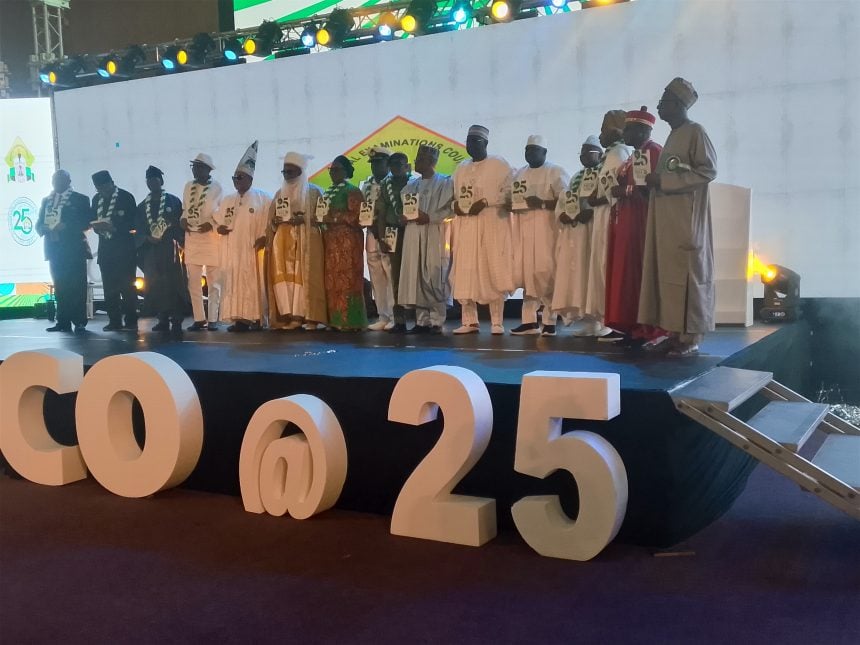
Minister of Education, Dr Olatunji Alausa, disclosed this on Thursday in Abuja during activities marking NECO’s 25th anniversary at the Bola Ahmed Tinubu Conference Centre.
The minister explained that the move forms part of broader reforms aimed at curbing examination malpractice and improving the credibility of Nigeria’s assessment system.
According to him, NECO is already leading the transition process with the rollout of Computer-Based Examinations expected to begin this year.
He noted that the adoption of technology-driven examinations would enhance transparency, improve efficiency, and enable authorities to monitor examinations in real time while digitally tracking candidates.
“We are at the threshold of a very important reform, which NECO is spearheading, and that is the Computer-Based Examination, which is to commence this year. Hopefully, by 2027, both NECO and its sister examination body, WAEC, will be conducting all senior secondary school examinations via Computer-Based Testing,” the minister stated.
Alausa maintained that the initiative would drastically reduce examination fraud, adding that the Federal Government remained committed to eliminating malpractice in public examinations nationwide.
The minister also commended NECO for its contributions to Nigeria’s education sector over the last 25 years, describing the council as a vital institution that has continued to provide credible and accessible examinations.
The event celebrated NECO’s Silver Jubilee and highlighted the council’s growth, achievements, and role in improving educational assessment standards across the country.
Vice President Kashim Shettima, who was represented by Barrister Bashir Maidugu, Senior Special Assistant to the President on Legal and Compliance Matters, urged NECO to sustain innovation and uphold global standards in examination administration.
He described NECO as one of Africa’s leading examination bodies, noting that its establishment was inspired by the need for a credible and nationally owned assessment institution capable of evaluating students fairly and transparently.
Shettima said the council had grown from a single examination agency into a major national assessment institution serving both public and private schools.
He added that investments in staff training, capacity building, and modern assessment techniques had improved the reliability and efficiency of NECO’s services.
“Today, as we commemorate this remarkable 25-year journey, we are proud to say that NECO stands proudly as one of Africa’s foremost examination bodies, continually refining its processes, expanding strategic partnerships, and upholding the highest standards of integrity in the conduct of examinations,” he said.
The Vice President further called for stronger measures to safeguard examination integrity, faster release of results, improved professional development for educators and examiners, and greater deployment of technology and strategic collaborations in the age of Artificial Intelligence.
He also stressed the importance of keeping examination fees affordable for Nigerian students.
Earlier in his address, NECO Registrar and Chief Executive, Professor Dantani Ibrahim Wushishi, described the anniversary as a significant milestone in the country’s educational history.
He recalled that the council faced challenges in its early years, including low public confidence, infrastructural limitations, and concerns over credibility, but said consistent reforms and transparent operations helped it gain public trust.
Wushishi noted that innovations such as online registration and internet-based result checking had improved service delivery and operational efficiency.
He revealed that NECO now conducts examinations in eight countries, which he said reflected the council’s increasing international recognition.
The registrar also acknowledged the contributions of former Nigerian leaders, including General Ibrahim Babangida, General Abdulsalami Abubakar, and former President Olusegun Obasanjo, to the growth of the examination body.
He listed achievements recorded under the current management to include the construction of offices in 10 states, acquisition of operational vehicles, introduction of the NECO e-Verify application, establishment of an e-library, and expansion of zonal directorates.
As part of activities commemorating the Silver Jubilee, NECO unveiled a book titled, “Twenty-Five Years of NECO: Evolution, Challenges and Contributions to Nigeria’s Educational Assessment System.”