By Felix Khanoba
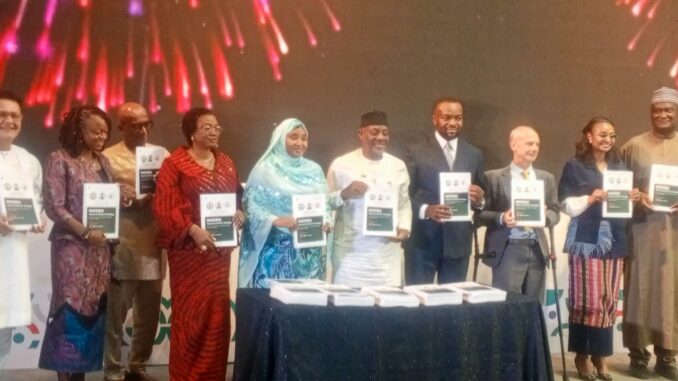
The Federal Government has unveiled Nigeria’s first National Education Technology (EdTech) Strategy, setting out a coordinated framework to integrate digital technology into teaching, learning and educational administration across the country.
The initiative, launched in Abuja on Tuesday by the Federal Ministry of Education in partnership with the Federal Ministry of Communications, Innovation and Digital Economy, is designed to improve learning outcomes, expand access to educational resources and strengthen teachers’ capacity to deliver quality education.
Minister of Education, Dr Maruf Tunji Alausa, said the strategy would provide a common national direction for coordinating investments in digital infrastructure, learning platforms and teacher development across basic, secondary, tertiary and non-formal education.
He explained that the framework was necessary to consolidate the Federal Government’s various investments in educational technology and ensure that interventions across the sector delivered measurable results.
According to him, Nigeria had made considerable progress in developing its digital education infrastructure and was moving from the conceptualisation and implementation stages towards expanding technology-driven learning nationwide.
Alausa said: “Today, it’s not just about unveiling. It’s a national framework, a common framework to improve teaching, expand learning opportunities, and strengthen educational management across all tiers of our education system: basic education, secondary school education, tertiary education, and non-formal education,” he said.
He stressed that technology must go beyond providing access to education to improving the quality of teaching and learning.
“We need to use technology to improve education, deliver education, and not just deliver education, but to ensure that the quality of education is significantly improved,” he said.
The minister also identified poor internet connectivity in underserved communities as a major challenge that must be addressed to achieve the objectives of the strategy.
He particularly highlighted schools in riverine communities of the Niger Delta, noting that expanding internet access would help bridge geographical barriers and give pupils in remote locations opportunities to benefit from digital learning resources.
Alausa recalled an engagement with the Minister of Communications, Innovation and Digital Economy, Dr Bosun Tijani, who had recently returned from the Niger Delta, where efforts were being made to extend internet connectivity to schools.
He maintained that nationwide connectivity would be critical to ensuring that no learner was excluded from the benefits of technology-driven education because of geographical location.
In his goodwill message, the World Bank Country Director, Matthew Verghis, described artificial intelligence and other emerging technologies as major forces reshaping the global economy, workplace and education system.
He said Nigeria must prepare its learners for the changing demands of the global economy by equipping them with relevant digital skills while maintaining strong foundations in literacy and numeracy.
Verghis noted that digital literacy, critical thinking, creativity and continuous learning would be essential for Nigerian students to adapt to technological changes, innovate and contribute meaningfully to economic development.
He added that artificial intelligence and digital learning platforms could help teachers address the different learning needs of students, provide timely feedback and improve access to educational materials.
However, he cautioned against viewing technology as a substitute for teachers, insisting that its primary role should be to enhance their effectiveness.
“Their promise is not to replace teaching, but to strengthen teaching and human relationships at the heart of education,” he said.
The World Bank official further argued that the effectiveness of educational technology should be assessed based on its impact on learning outcomes rather than the mere availability of digital devices and platforms.
He said: “The question is not simply what technology can do, but how it can help more learners learn better,” he said.
Verghis also emphasised the need for appropriate safeguards to ensure that the deployment of emerging technologies protects learners, promotes inclusion and preserves human judgment in educational decisions.
He warned that without deliberate efforts to address access gaps, digital transformation could worsen existing inequalities by leaving disadvantaged children and communities further behind.
Verghis reaffirmed the World Bank’s commitment to supporting Nigeria’s education and human capital development agenda, describing the new strategy as an important framework for aligning technological innovation with national educational priorities.
He said a unified national approach would help establish clear priorities for technology deployment while ensuring that digital advancement contributes to the country’s long-term development objectives.
The National EdTech Strategy was developed in partnership with the World Bank and the Mastercard Foundation.
The framework is expected to guide the deployment of digital solutions across Nigeria’s education system, with particular emphasis on improving teaching effectiveness, expanding access to learning resources and building the capacity of teachers and educational institutions.