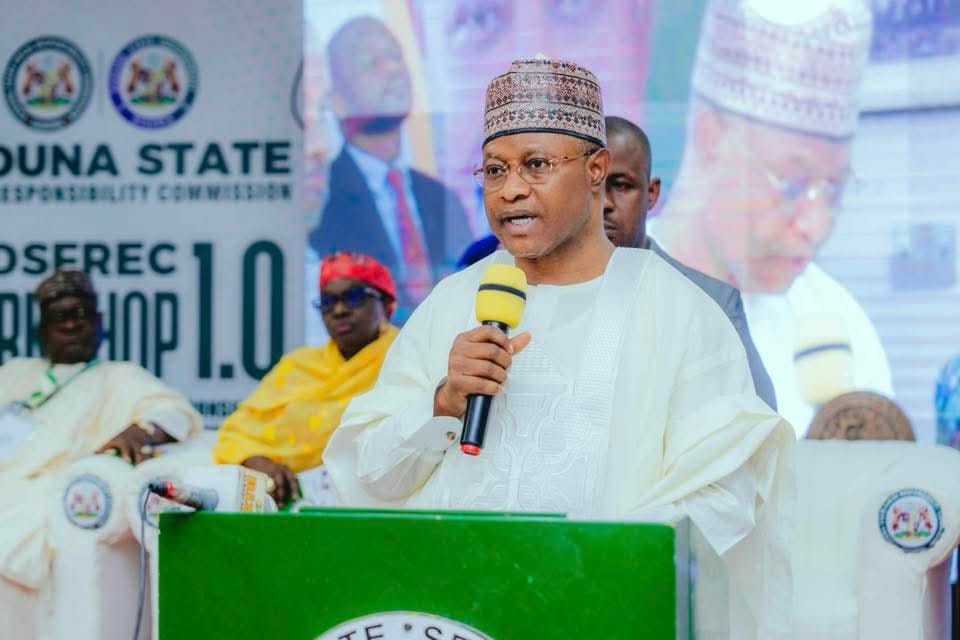
Governor Uba Sani has taken another decisive step in his governance reform drive, declaring open a high-level Capacity Building Workshop on Strengthening Fiscal Responsibility and Public Financial Management for the 23 Local Government Areas of Kaduna State, signalling an uncompromising push to entrench transparency and discipline at the grassroots.
The workshop, organised by the Kaduna State Fiscal Responsibility Commission in collaboration with the Ministry of Local Government and Chieftaincy Affairs, and backed by key national oversight institutions, underscores what insiders describe as the Governor’s quiet but firm war against fiscal indiscipline at the local level.

Declaring the workshop open, Governor Uba Sani said the intervention was both timely and unavoidable, noting that citizens now demand greater value for every naira spent and more responsive service delivery from governments closest to them.
He stressed that local governments, as the first point of contact between government and the people, must operate with the highest standards of integrity, professional competence and strict adherence to fiscal rules, warning that inefficiency and leakages at that level directly undermine development outcomes.
The Governor used the occasion to spotlight the far-reaching reforms his administration has pursued since assuming office—reforms aimed at strengthening institutions, enforcing compliance with financial regulations, and building a culture of accountability across all tiers of government.
Those reforms, he noted, are already yielding measurable dividends, with Kaduna State ranked Nigeria’s most transparent and accountable state for two consecutive years on the Transparency and Integrity Index, a feat that has positioned the state as a national reference point for public sector accountability.
According to him, the workshop is structured to deepen understanding of fiscal responsibility laws, strengthen budgetary discipline, improve procurement integrity, and enhance oversight mechanisms within local governments—areas long identified as pressure points in grassroots governance.
He reaffirmed that his administration’s commitment to prudent, transparent and accountable management of public resources remains constant, stressing that sustainable development is determined not just by how much government spends, but by how faithfully public trust is managed.
Observers say the move sends a clear message: under Uba Sani, fiscal recklessness at the local government level will no longer find safe harbour, as Kaduna tightens governance standards from the top down—starting where governance matters most to the people.