By Stella Odueme
The Federal Government has rolled out 2,000 tractors, implements and over 9,000 spare parts to enhance food production, improve the income of Nigerian farmers and achieve food sovereignty as well as revolutionize the agricultural ecosystem.
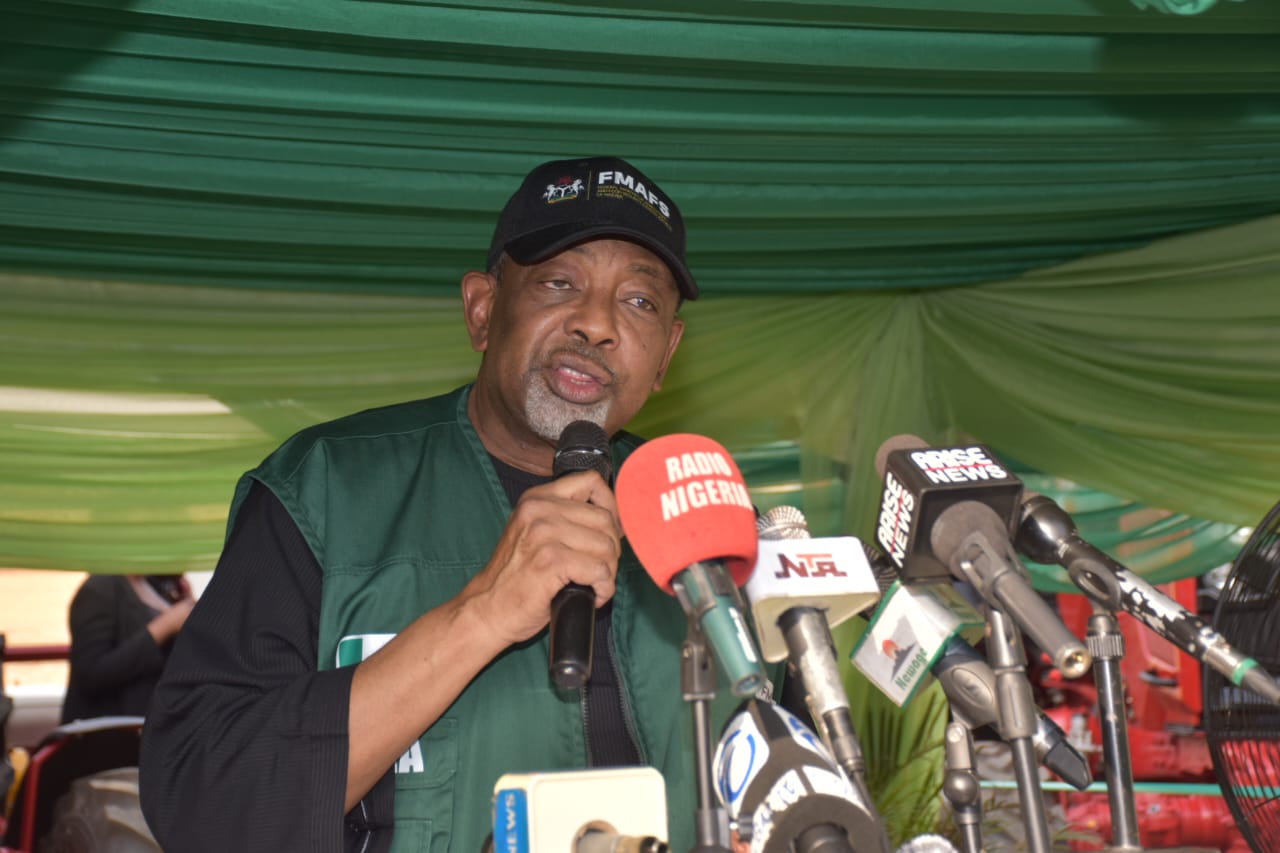
Speaking during the Official Flag-off of the Deployment of 2000 Tractors, Implement and over 9000 spare parts under the Renewed Hope National Agricultural Mechanization Programme, in held Sheda, Abuja, the Minister of Agriculture and Food Security, Sen. Abubakar Kyari revealed that the Initiative was the largest single agricultural mechanization programme ever undertaken on the African continent.
“’This is not merely an equipment rollout. It is the ignition of a national agricultural productivity revolution, ending the long era of low tractor density in Nigeria.
‘’Through the Renewed Hope National Agricultural Mechanization Program, we are deploying 2,000 heavy-capacity tractors and over 9,000 precision implements under a rigorously engineered national framework. This first tranche of 600 tractors marks the beginning of a phased acceleration.
“This will be followed by 750 tractors and 650 tractors, culminating in a nationwide force of 2,000 mechanization assets. In line with Mr. President’s vision that scale must drive impact, these tractors are not distributed for private ownership.
“They are entrusted to Mechanization Service Providers (MSPs) where each tractor, with the capacity to service approximately 600 hectares per year, becomes not just a machine but a multiplier of productivity. Many of these MSPs are youth-and-women-led enterprises operating under a lease-to-own model.
‘This is not just about 2,000 beneficiaries. It is about 1.2 million farmers across over 1.5 million hectares annually. It is about national food sovereignty,” he said in a statement by the Head, Department of Information, Ezeaja Ikemefuna, on Tuesday.
The Minister pointed out that ‘’the Ministry stands as the sovereign steward, providing policy authority, standards governance, configuration control, lifecycle asset management, quality assurance, performance monitoring, strategic feedback systems, and national capacity building. This is not just equipment distribution. It is a governed transformation as mechanization provides the horsepower, finance provides the liquidity and policy provides the stability. Together, they deliver food security, job creation, and economic resilience’’.
He further said that ‘’ each tractor deployed today comes with two years of free service support. We are institutionalizing maintenance culture, genuine parts replacement, asset longevity, and disciplined performance management. Because mechanization without maintenance is expenditure. Mechanization with maintenance is investment’’.
He stressed that ‘’ we are deploying 36 mobile service trucks for rapid first-line technical response. We are constructing seven mega mechanization service centers strategically across the nation. And we are catalyzing the establishment of one mega tractor assembly plant capable of producing between 2,000 and 4,000 tractors annually. We are not importing dependency. We are building industrial capability’’.
He further revealed that ‘’Beyond procurement and sustainability lies the structure. The Bank of Agriculture (BOA), in collaboration with Heifer International, is strategically positioned to deploy structured financing models, leasing, hire-purchase, service aggregation, and performance-based access systems that guarantee equitable access, financial discipline, asset sustainability, and measurable developmental impact. These tractors will not sit idle. They will work and multiply productivity. They will generate value across the agricultural value chain.
According to him, ‘’this intervention is part of a comprehensive agricultural financing ecosystem envisioned by Mr. President.
“Through a ₦50 billion catalytic seed fund with the Bank of Industry (BOI), we are unlocking agro-industrial investment at scale. This wet season alone, ₦250 billion has been mobilized to finance one million smallholder farmers, each cultivating an average of one hectare in 2026 in partnership with state governments.
“On this note, to our Mechanization Service Providers: you are the operators of national assets. Let discipline, professionalism, and integrity define your stewardship. To our young entrepreneurs and women-led enterprises: this is your industrial frontier. Lead it with excellence.
“To our farmers: prepare for higher yields, faster turnaround cycles, reduced drudgery, and expanded acreage. To our partners and investors: Nigeria is mechanizing at scale. You are encouraged to join the momentum, ‘’ the minister appealed.
In his remarks, the Minister of State for Agriculture and Food Security, Sen. Dr. Aliyu Sabi Abdullahi said that the programme would operate through mechanization service centers, allowing farmers to access equipment without the burden of purchasing tractors.
He assured farmers that the programme would be implemented fairly and inclusively, particularly for women who account for a significant portion of agricultural production.
During his welcome address, Managing Director, Bank of Agriculture, BOA, Mr Ayo Sotinrin, said the programme was designed to create a sustainable mechanization ecosystem and avoid past failures.
Sotinrin, revealed that the programme has already attracted strong demand from agribusiness operators and mechanization providers, with over 10,000 applications received in the first phase alone.
He explained that each tractor must service at least 600 hectares annually to remain economically viable, ensuring sustained revenue generation and long-term operational sustainability.
He added that the initiative would operate through structured financing models, including leasing arrangements, service-based repayment, and partnerships with state governments, private operators, and development partners.