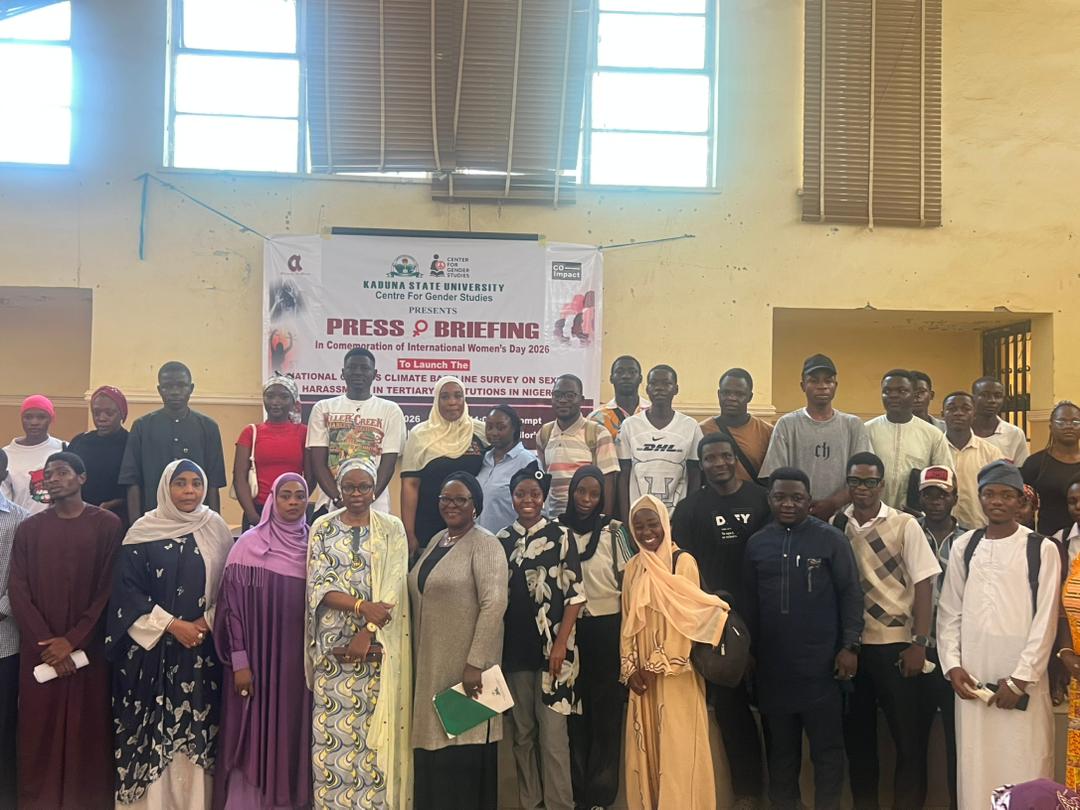
From Maryam Ahmadu-Suka, Kaduna
Findings from a baseline survey on sexual harassment in Nigerian public tertiary institutions conducted across six state and six federal public universities, covering the six geopolitical zones of Nigeria has shown that 70% of female students and 30% of male students have experienced at least one form of Gender Based Violence (GBV) on campus and 63% of female staff and 37% of male staff have the same experience.

The survey also showed that sexual misconduct, including unwanted touching, inappropriate comments, verbal abuse, and stalking was identified as the most common form of harassment by 42.2% of all respondents.
Presenting the findings of the surgery conducted by the Alliances for Africa (AfA) in collaboration with Center for Gender Studies (CGS), Kaduna State University (KASU), as part of activities to mark the 2026 International Women’s Day, a Professor of Criminology and Gender Studies, KASU, Professor Hauwa Evelyn Yusuf said the report documents a systemic crisis that has persisted under institutional silence for a long time.
Represented by Dr. Bilkisu Yusuf from the center, she noted that, “The survey, conducted across six state and six federal public universities, covering the six geopolitical zones of Nigeria, shows the most comprehensive empirical evidence on the nature and scale of gender-based violence (GBV) in Nigerian higher education.
“The findings show that 70% of female students and 30% of male students have experienced at least one form of GBV on campus and 63% of female staff and 37% of male staff have the same experience. Sexual misconduct, including unwanted touching, inappropriate comments, verbal abuse, and stalking was identified as the most common form of harassment by 42.2% of all respondents.”
She noted that the numbers were not abstract, but represent thousands of students who walked through the gates of the universities seeking knowledge and a future, but instead encountered harassment, coercion, and silence.
“This data makes one thing undeniable; Nigeria’s universities are not safe, and that needs to change. The survey shows that students on Nigerian campuses are being coerced into sexual exchanges for academic grades and privileges, threatened for refusing advances, and in some cases transferring universities to escape harassment. Despite this, many survivors do not report their experiences, due a lack of trust in institutional processes, fear of retaliation, and the absence of accessible, confidential reporting channels.
“These are not incidental failures. They are the consequences of institutions that have not prioritised the safety and dignity of their communities. AfA in Collaboration with Center for Gender studies KASU, is calling on Vice-Chancellors to act urgently by establishing independent sexual harassment response units, publish and enforce robust institutional policies, create safe and confidential reporting mechanisms, and mandate training for all staff.”
Equally, she said, AfA urges the National Universities Commission, the Federal Ministry of Education, and state governments to introduce policies that protect everyone on campus and funding for survivor support and prevention programmes pointing out that systemic change requires systemic accountability.
She further stated that Vice-Chancellors must take concrete steps to end sexual harassment on campuses across the country adding, “Every institution that received our researchers, that contributed to this data, and others, now holds a mirror to itself. The question is no longer whether sexual harassment exists on Nigerian campuses. The question is whether those with the power to end it have the courage to act.”
In her welcome address, the Director, CGS, Deborah J. Bijimi PhD said AFA in collaboration with Co-Impact, AfA launched a five-year programme (January 2023 – December 2028) to address sexual harassment in Nigeria’s public tertiary institutions.
She noted that the National Campus Climate Baseline Survey was conducted across twelve (12) participating universities, in partnership with each institution’s Centre for Gender Studies.
She disclosed that the project aims to gather essential data that will help better understand the prevalence and impact of Sexual harassment on students and staff adding, “Our goal is to create safer educational environments by informing policies and interventions that protect and empower our students.”
“As we reflect on the challenges faced by women and girls in our society, let us also celebrate the progress we have made and the resilience of those who continue to fight for justice and equality. This event not only raises awareness about the grave issue of sexual and Gender Based Violence but also serves as a call to action for actively creating systemic change.,” she said.
The Vice Chancellor, KASU, Professor Abdullahi Musa who was represented by the Deputy Vice Chancellor Strategy, Innovation and Service Delivery, Professor Helen Andow assured that the institution will look into ways of collaboration with key stakeholders so that policy indicators will be implemented in the university.
She thanked the centre and AFA for conducting the survey, describing it as an eye opener not just for KASU but public universities across the country.