By Chuks Oyema-Aziken
The International Centre for Energy, Environment and Development (ICEED) has called for stronger coordination and improved data systems to accelerate Nigeria’s clean cooking transition, as stakeholders gathered in Abuja on Tuesday for a high-level engagement on Measurement, Reporting and Verification (MRV) frameworks.
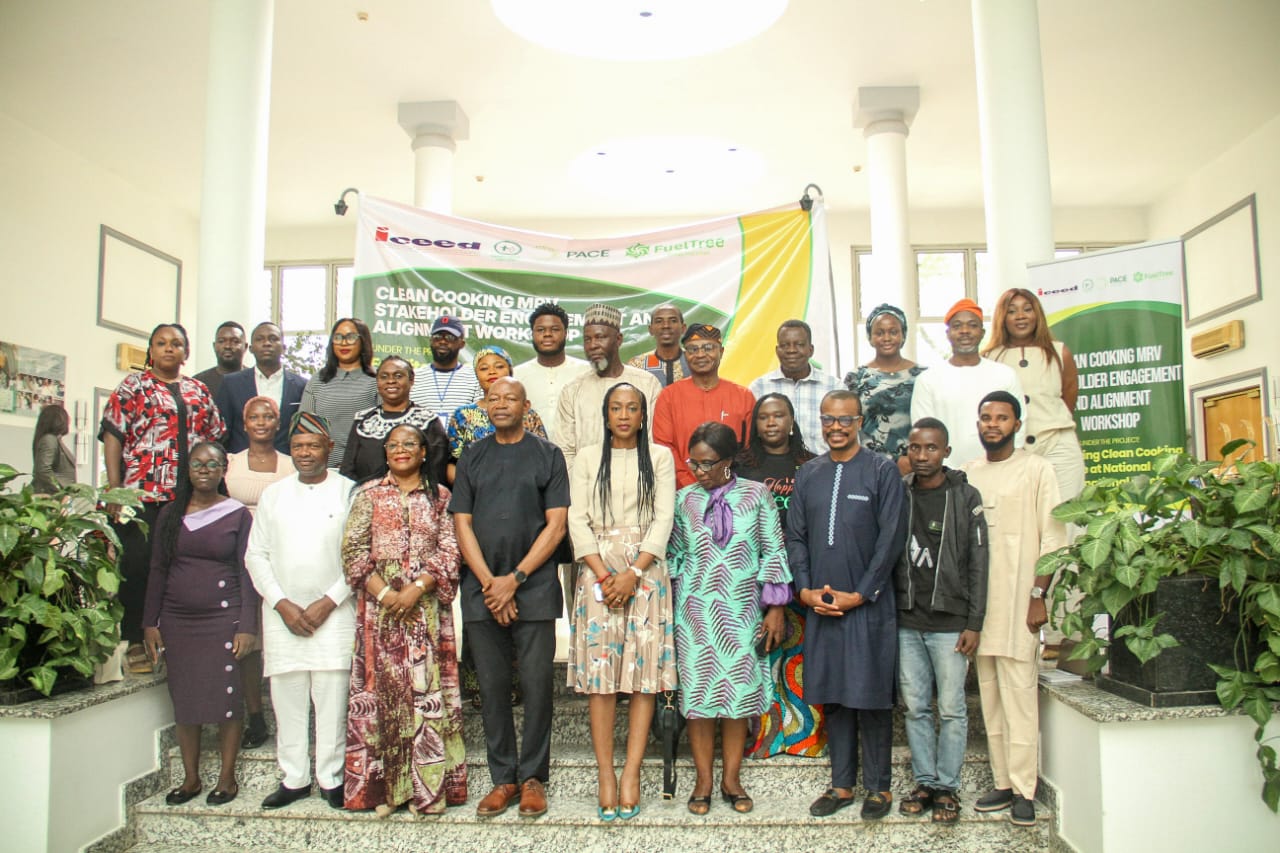
The Executive Director of ICEED, Ewah Otu Eleri, made the call at the Clean Cooking MRV Stakeholder Engagement and Alignment Workshop themed “Facilitating Clean Cooking Finance at National and Sub-national Levels,”
He noted that Nigeria’s clean cooking transition remains an urgent national priority due to the country’s continued dependence on solid biomass for cooking, with significant consequences for public health, gender equality, deforestation, household energy access, and climate change.
According to him, while carbon finance has emerged as a promising pathway for mobilising investment into clean cooking interventions, many projects continue to struggle with financing and validation challenges.
He attributed these challenges to weak data systems, inconsistent monitoring approaches, and fragmented institutional coordination across the sector.
Eleri explained that MRV systems have now become central to improving the credibility of clean cooking projects and unlocking access to carbon markets and climate finance.
In her goodwill message, the Director of Climate Change at the Federal Ministry of Environment, Dr. Iniobong Awe, commended ICEED and its partners for convening the workshop, describing it as both timely and strategic.
She noted that the engagement comes at a critical moment when Nigeria is intensifying efforts to accelerate the implementation of its National Clean Cooking Policy.
According to her, the workshop aligns strongly with the country’s broader development priorities as Nigeria joins the global community in addressing pressing challenges such as household air pollution, public health risks, and gender inequality linked to traditional cooking practices.
Dr. Awe further emphasized that the continued reliance on biomass for cooking has significant environmental consequences, particularly in accelerating deforestation and contributing to climate change impacts across the country
The workshop, convened by ICEED in partnership with FuelTree and supported by PACE, brought together key stakeholders across the clean cooking and carbon ecosystem.
Participants include federal regulators, project developers, carbon market actors, MRV technology providers, development partners, civil society organisations, investors, and sector coordination platforms.
The engagement aims to map the current MRV landscape in Nigeria, identify existing gaps and overlaps, and highlight bottlenecks affecting project validation, verification, and carbon credit issuance.
It will also focus on improving alignment between regulators, standards bodies, project developers, and technology providers in order to strengthen coordination within the sector.
Stakeholders explored practical digital MRV solutions, including kMRV systems and other technology-driven models designed to improve transparency, efficiency, and reliability in data reporting.
Participants at the workshop examined priority actions that will guide the establishment of a more coordinated and effective MRV framework for Nigeria’s clean cooking sector.
ICEED said the overall goal is to strengthen institutional readiness and build investor confidence, while accelerating the scale-up of clean cooking interventions across the country.