
By Mercy Aikoye
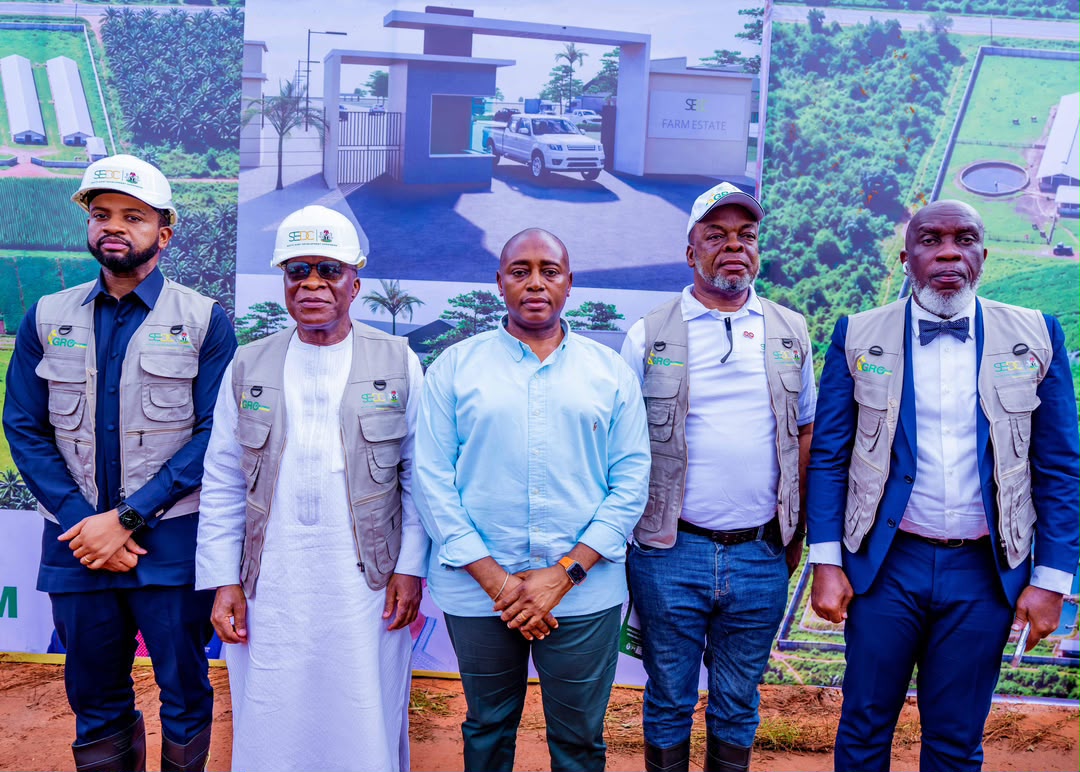
Enugu State has taken the lead in a new regional agricultural development initiative with the flag-off of a 200-hectare integrated farm by the South East Development Commission (SEDC) in Nomeh Unataeze, Nkanu East Local Government Area.
The project, launched on Wednesday under the South East Agro-Development Programme, is expected to create more than 1,000 direct jobs when fully operational.
The integrated farm is designed to go beyond food production by combining mechanised farming, livestock production, processing, skills development and market access in one agricultural hub.
Governor Peter Mbah, represented by his Deputy, Barrister Ifeanyi Ossai, described the project as an example of what could be achieved through collaboration among government institutions.
“This demonstrates what is possible when government institutions work together around a clear development objective,” Ossai said.
He said the state government was committed to creating an enabling environment for productive investments and initiatives capable of generating employment and improving the livelihoods of residents.
The Minister of Regional Development, Engr. Abubakar Momoh, attended the flag-off ceremony, alongside the Chairman of SEDC, Dr. Emeka Wogu, and the Commission’s Managing Director and Chief Executive Officer, Mr. Mark Okoye.
Traditional rulers, community leaders and other stakeholders also attended the event.
The facility will accommodate a 200-head dairy herd and a poultry unit with a production capacity of up to 20,000 birds per cycle. It will also feature fisheries, greenhouse farming, fodder production, silage and agro-processing facilities.
The project is designed around an integrated waste-to-wealth system, with different components supporting one another. Fodder produced on the farm will be used to feed livestock, while manure and poultry litter will be utilised for energy generation and soil improvement.
Surplus fodder will also be converted into silage for use during periods of scarcity, while some will be supplied to participating farmers.
The shared facilities are expected to provide farmers with access to water, animal feed, machinery, processing equipment and other agricultural services.
Speaking on the project, Okoye said the Commission’s objective was to move agriculture from fragmented subsistence activities to a coordinated and commercially viable enterprise.
“We want to demonstrate what agriculture can look like when land, technology and markets are brought together,” he said.
He added that the project would also serve as a skills development centre for young people in the region, with between 100 and 120 trainees expected to be accommodated per session.
According to him, about 300 households located within a 10-kilometre radius of the project will initially be enrolled as out-growers, with the number expected to increase as the project expands.
Participating farmers will receive inputs and mechanisation support, while the programme will provide access to guaranteed markets for their produce.
The SEDC said the Nomeh project was conceived as a pilot that could be adapted and replicated across the five South East states.
Okoye said the success of the initiative would not be measured only by the output of the farm, but also by the number of people trained and empowered to establish agricultural enterprises elsewhere.
“The real impact is the young person who learns here and starts a farm elsewhere,” he said.


