By Felix Khanoba
The Universal Basic Education Commission (UBEC) will in October commence the implementation of its 10-year roadmap aimed at transforming the delivery, planning and monitoring of basic education across the country.
The 2026–2035 Universal Basic Education Roadmap is expected to mark a shift from the implementation of isolated projects to a comprehensive approach that addresses the multiple needs of individual schools.
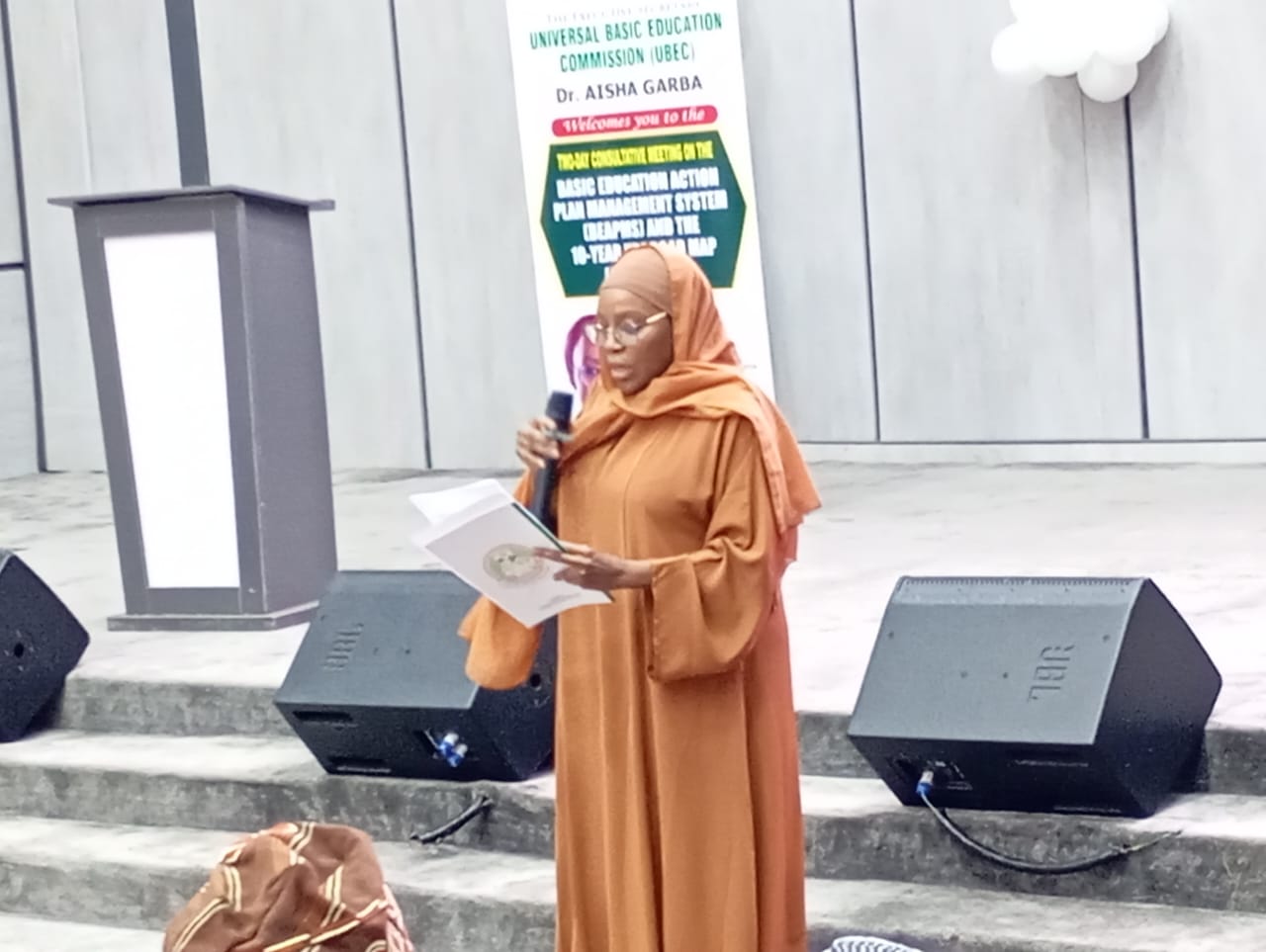
The Executive Secretary of UBEC, Dr. Aisha Garba, disclosed this in Abuja on Monday at a two-day consultative workshop involving chairmen of the 36 State Universal Basic Education Boards (SUBEBs) and directors of the commission.
Garba said the new framework was designed to ensure that interventions were driven by the actual needs of schools rather than decisions to execute individual projects without considering other gaps.
She said UBEC had adopted a “whole school approach”, under which states would be required to identify and address the critical deficiencies in a school before their intervention plans could be approved.
“For any state to do renovation, you have to do a whole school approach. A whole school approach means, you take a school and you look at all the gaps,” she said.
According to her, the new system would discourage situations where classrooms or furniture were provided while other basic facilities necessary for effective learning remained unavailable.
“You don’t just put in a furniture or you drop two blocks of classrooms and you leave because you want to give out awards. No, you have to take in all the comprehensive needs of that particular school,” she said.
Garba explained that a school requiring fencing, toilets, furniture or other facilities would have such deficiencies incorporated into its intervention plan.
She added that the provision of additional classrooms would also take into account the corresponding need for facilities such as toilets, based on the projected enrolment of pupils.
The UBEC chief also announced changes to the matching grant framework, saying the revised arrangement would give states greater flexibility to direct UBEC funds towards their most pressing basic education needs.
She said the previous funding formula had placed considerable emphasis on new infrastructure, even though some states had moved beyond the need for constructing new schools and required resources to rehabilitate and improve existing ones.
“The new formula allows each state to look at their own needs. If their needs on the ground is furniture, if their needs on the ground is renovating all schools to ensure that our schools now have fencing, have computers, have furniture, then they are allowed to do that,” she said.
She said states would also be able to identify other priorities, including materials to support enrolment and additional teachers where rising pupil numbers had created such needs.
A major component of the new roadmap is the Basic Education Action Plan Management System (BEAPMS), a digital platform unveiled by the commission to strengthen planning, transparency and monitoring of basic education interventions.
Garba said the platform would extend project monitoring beyond government officials by providing communities with access to information on projects being implemented in their schools.
“This will also allow us to bring in the community to be part of the monitoring of the projects that we do on the ground,” she said.
She said information on the funds accessed by individual states, as well as the projects being executed with the resources, would be published on UBEC’s website.
“With that, community can hold us accountable to the money we have accessed from UBEC, and then also the projects we’re doing on the ground, as well as the quality of projects we’re doing,” she said.
The commission said development of BEAPMS had been ongoing for more than a month, with SUBEB chairmen already onboarded ahead of the full commencement of the roadmap in October.
Speaking on the significance of the consultation, the Dean of SUBEB Chairmen, Prof. Shehu Adaramaja, said the meeting would provide stakeholders with an opportunity to agree on strategies for improving access, quality and institutional capacity in basic education over the next decade.
“In the next two days, we’ll pay attention to all the strategies and the initiatives toward the development of a roadmap for the next 10 years on how to provide access, provide quality service, and of course, strengthen our systems in line with our new basic education management system,” he said.
Adaramaja, who is also the Chairman of the Kwara State SUBEB, said the workshop was structured as a practical exercise, with directors of research and statistics expected to contribute to the development of the framework that would guide state-level basic education action plans.
He noted that UBEC’s intervention mandate had expanded beyond physical infrastructure to include other components considered essential to improving the delivery of basic education.
Earlier, UBEC Director of Physical Planning, Arc. Nura Ibrahim, said the consultation would allow stakeholders to examine and validate the proposed roadmap while drawing on their technical knowledge and experience in implementing basic education programmes across the states.