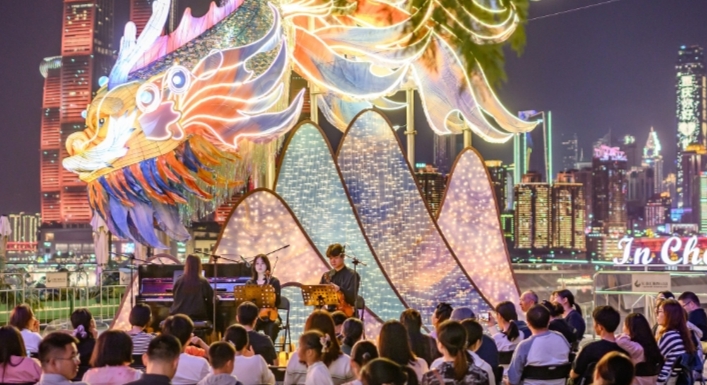
Visitors enjoy a concert at a park in Nan’an District, Chongqing Municipality, southwest China, October 6, 2026. /VCG
China’s service consumption market grew steadily during the National Day holiday, with average daily sales revenue in related sectors rising 19.5% year on year, according to the State Taxation Administration.
Tourism remained a major driver of holiday spending, with sales revenue from sightseeing and entertainment services rising 23.6% year on year.
Bookings at tourist attractions across China increased significantly, with provinces rich in natural scenery emerging as popular destinations.
Data from Trip.com showed that bookings in Xizang Autonomous Region surged nearly 50% year on year during the holiday, while Qinghai Province, Guizhou Province and the Xinjiang Uygur Autonomous Region each recorded growth of around 25%, ranking among the country’s four fastest-growing destinations.
International visitors showed growing interest in China’s cultural heritage and natural attractions. During the holiday, cultural sites accounted for about 43% of inbound tourist bookings for scenic attractions, up from approximately 32% in 2024, according to Trip.com.
Bookings by inbound visitors to the Mutianyu Great Wall nearly quadrupled, while those for the Palace Museum in Beijing and Emperor Qinshihuang’s Mausoleum Site Museum in Xi’an both increased by more than 130%.
Among the top six tourist attractions visited by tourists from the United Kingdom, France, Spain and Italy, Zhangjiajie National Forest Park, the Mutianyu Great Wall, Emperor Qinshihuang’s Mausoleum Site Museum, the Chengdu Research Base of Giant Panda Breeding and the Temple of Heaven all made the list.
Tickets and experience-based activities also gained popularity, accounting for about 14% of inbound travel bookings, double the share recorded during the same period last year.
Strong demand for cultural and sports entertainment
A wider range of cultural, sports and entertainment offerings, alongside diverse consumer experiences, has helped boost holiday spending.
Concerts, cultural performances and traditional folk activities held across China during the holiday drove a 20.9% year-on-year increase in sales revenue from cultural and artistic services.
In Beijing, 368 commercial performance programs featuring 2,329 shows were staged over the seven-day holiday, attracting approximately 690,000 visits and generating around 230 million yuan ($32 million) in box office revenue.
Combining tourism with sporting events also helped turn visitor traffic into additional consumer spending.
Major competitions held during the holiday, including the World Table Tennis (WTT) China Smash 2026 and the China Open tennis tournament, contributed to a 29.4% year-on-year increase in sales revenue from sports services.
Meanwhile, family gatherings and wedding banquets supported robust dining demand, with sales revenue from catering services rising 9% year on year during the holiday. The tourism boom also fueled business at local food streets and night markets, driving a 15.5% increase in sales revenue from snack services.