From Everest Ezihe
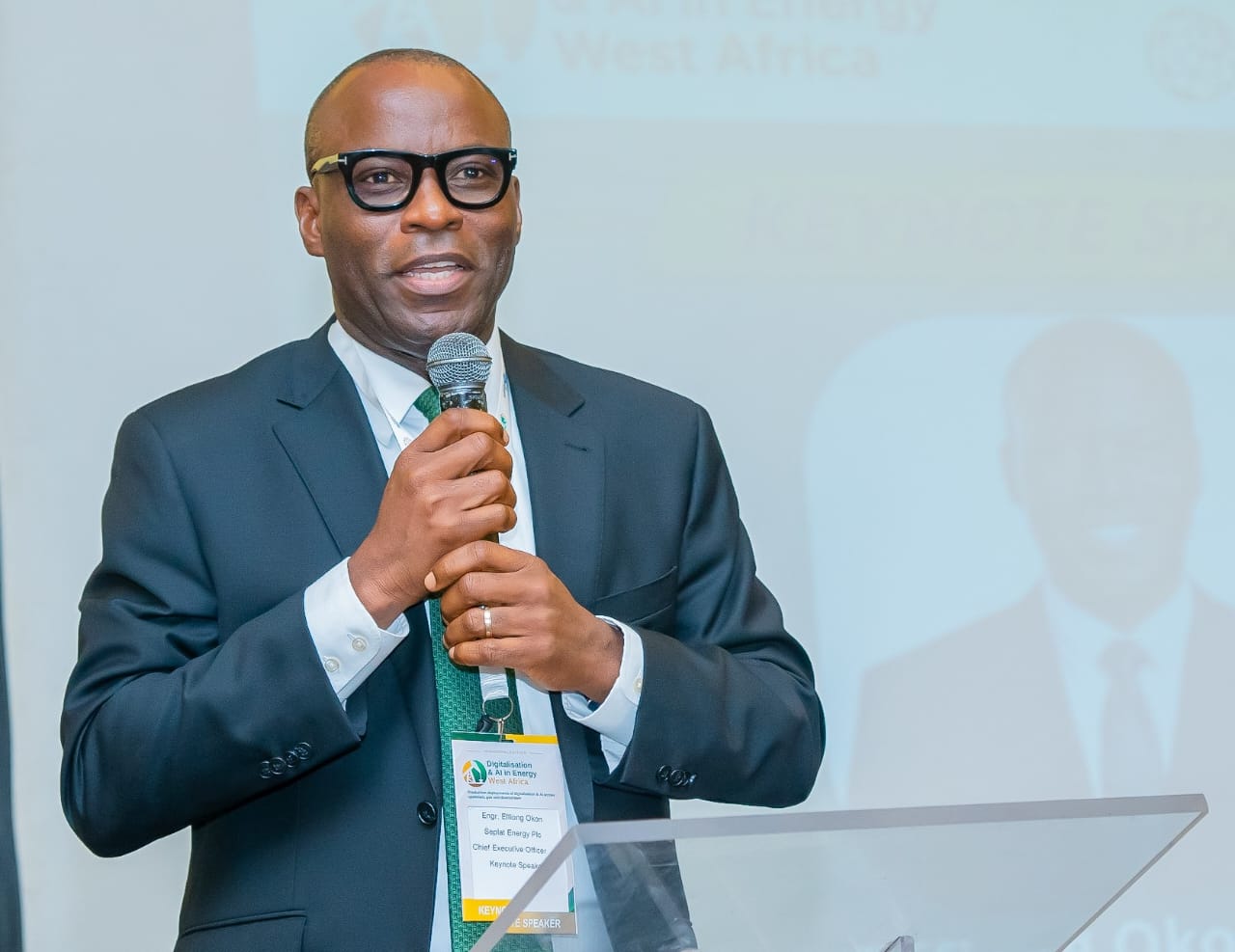
The Chief Executive Officer of Seplat Energy Plc, Engr. Effiong Okon, has called on African energy operators to accelerate the adoption of artificial intelligence (AI) and other digital technologies to enhance operational efficiency, strengthen asset performance and facilitate faster, data-driven decision-making.
Okon made the call while delivering the keynote address at the inaugural Digitalisation and AI in Energy West Africa Conference in Lagos, where he highlighted the growing interdependence between the energy sector and artificial intelligence.
He noted that the rapid expansion of AI was driving increased demand for reliable energy while simultaneously creating opportunities for oil and gas companies to improve exploration, development and production processes.
The Seplat Energy CEO explained that the growing demand for data centres and other digital infrastructure presented significant opportunities for Nigeria’s natural gas industry, considering the country’s abundant gas resources.
He further highlighted the potential of AI to help energy operators improve reservoir understanding, anticipate equipment failures, strengthen production surveillance and reduce uncertainty in operational decisions.
”The relationship between energy and AI is a two-way relationship. There is no AI without energy, and as data centres and other digital infrastructure expand, the demand for reliable power will continue to grow. At the same time, AI gives the energy industry an opportunity to find more, decide faster and deliver sooner. For Nigeria, our gas resources will be important to powering that digital future,” he said.
Okon stressed that successful digital transformation required the industry to move beyond merely acquiring technology and concentrate on identifying specific operational challenges and deploying solutions capable of delivering measurable results.
He outlined three critical priorities for effective AI adoption: identifying clearly defined business problems, establishing strong data foundations and ensuring that employees were actively involved in the transformation process.
Citing Seplat Energy’s experience, he disclosed that the company had deployed machine learning to improve permeability prediction at Sapele, increasing prediction accuracy from approximately 50–60 per cent to 80 per cent or higher.
He also highlighted the use of seismic reprocessing to enhance subsurface imaging and reservoir understanding, as well as plans for ocean bottom node seismic acquisition to support more informed exploration and development decisions.
The CEO further disclosed that Seplat Energy had rolled out Microsoft 365 Copilot to improve individual and team productivity, while its AI Ethics, Risk and Compliance Committee provides oversight to ensure responsible AI deployment.
”The point is never the tool. It is the decision it changes. Digital is not a destination. Better uptime, safer operations, sharper reservoir decisions and faster production decisions are the destination.
”We must start with the problem we are trying to solve, build the right data foundations and bring our people along. AI should support engineers and strengthen their judgement, not replace the engineering discipline required to operate our assets safely and efficiently,” he said.
In a related development, Seplat Energy’s General Manager, Information Technology, David Osemwegie, provided further insights into the practical demands of digital transformation during a dialogue session titled, Operator Address: What It Actually Took to Put AI into Production.
Drawing from the company’s experience in integrating the former ExxonMobil shallow-water asset, Osemwegie underscored the importance of effective data governance, business continuity and organisational alignment.
He explained that the integration required a deliberate strategy for consolidating business data, managing different technical systems and addressing legacy inefficiencies, while ensuring that employees and business owners remained actively involved throughout the process.
On AI deployment, he emphasised that business ownership was essential to ensuring that digital solutions delivered measurable value.
According to him, asset leaders must be accountable for AI-driven outcomes, with every use case assigned a business product owner responsible for its roadmap, performance, development and adoption.
He explained that while business teams remained accountable for operational outcomes, the IT department managed the technical performance and development of the solutions, with technology vendors serving as implementation partners.
Osemwegie also highlighted Seplat’s strategy for promoting employee adoption of enterprise AI tools, disclosing that employees were required to complete basic activation training before receiving Microsoft Copilot licences.
He added that the approach had resulted in a consistent adoption rate of more than 90 per cent.
He further disclosed that Seplat had established an AI Ethics, Risk and Compliance Governance Committee comprising representatives from its legal, human resources, finance and risk functions to promote responsible AI adoption and strengthen organisation-wide ownership of the transformation process.
Other industry leaders at the conference stressed the need to connect digital investments with measurable commercial outcomes, particularly as operators seek to maximise the performance of existing and brownfield assets.
They also examined the potential of digital twins, predictive maintenance and condition monitoring in improving equipment reliability, reducing downtime, strengthening asset integrity and extending the operational lifespan of energy infrastructure.
Through its contributions to the conference, Seplat Energy demonstrated the importance of practical AI applications, clearly defined business ownership and responsible governance in accelerating digital transformation and translating technology investments into measurable operational and commercial benefits.
It’s pertinent to state that Seplat Energy Plc is one of Nigeria’s leading indigenous energy companies, listed on the Premium Board of the Nigerian Exchange Limited (NGX: SEPLAT) and the Main Market of the London Stock Exchange (LSE: SEPL).
Public opinion commentators have disclosed that the company has continued to pursue a strategy aimed at building a sustainable business, supporting the energy transition and delivering affordable, reliable and sustainable energy to promote social and economic prosperity.
Its portfolio comprises 11 Petroleum Mining Leases (PMLs), 17 Petroleum Prospecting Licences (PPLs) and five Oil Mining Leases (OMLs), located in onshore and shallow-water areas of Nigeria’s prolific Niger Delta region.
The company observers revealed that majority of these assets are operated by Seplat in partnership with other stakeholders, including the Nigerian Government and other industry operators.
The company also has operated interests in three export terminals: the Qua Iboe Terminal (QIT), Yoho Floating Storage and Offloading (FSO) facility and Bonny River Terminal (BRT). Additionally, it operates two major offshore natural gas liquids (NGL) recovery plants at Oso and East Area Project (EAP).
In the gas sector, Seplat they said, operates three onshore gas processing facilities at Oben and Sapele in its Western Assets, as well as the 300 million standard cubic feet per day (MMscfd) ANOH Gas Processing Plant in its Eastern Assets.
The ANOH facility, developed as an integrated joint venture with the Nigerian Gas Infrastructure Company (NGIC), further strengthens Seplat Energy’s position as a major supplier of natural gas to Nigeria’s domestic power generation market.
The company’s expanding gas infrastructure and commitment to responsible technology adoption underscore its strategic role in supporting Nigeria’s energy security, industrial development and transition towards a more sustainable energy future.
Seplat Energy Champions Responsible AI Adoption for Sustainable Industry Growth