By Felix Khanoba
Election observer group, Yiaga Africa, has urged the National Assembly to make the signed 2026 Electoral Act publicly available, as former senior officials of the Independent National Electoral Commission (INEC) renewed calls for full electronic transmission of election results and clearer legal guidelines.
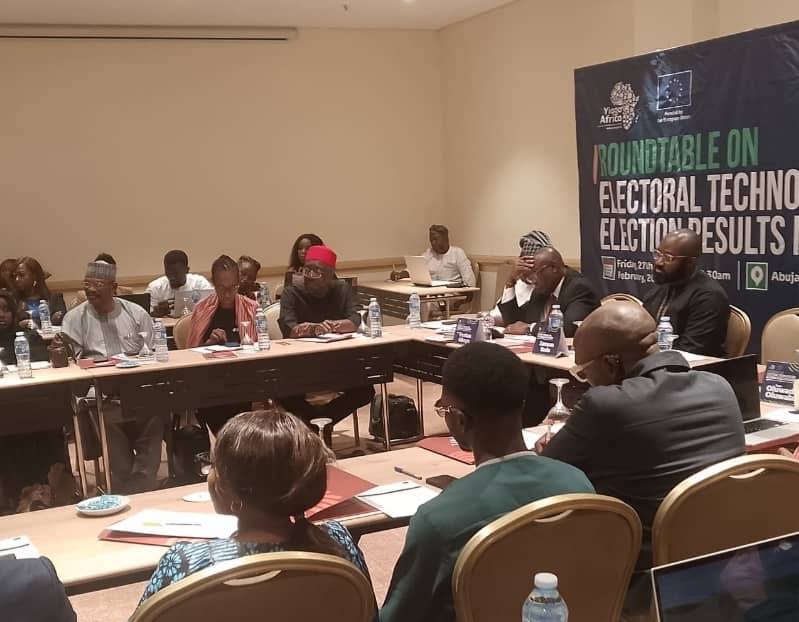
The appeal was made by the Executive Director of Yiaga Africa, Samson Itodo, at a Policy Roundtable on Electoral Technology and Election Results Management organised by the group in Abuja on Friday.
Itodo stressed that public access to the new law would help clarify provisions relating to electronic transmission of results.
“We want to use this opportunity to call on the National Assembly and those who are responsible to release the 2026 Electoral Act. It’s one thing to pass the Act, but it is another thing for the law to be available, you know, for citizens,” Itodo said.
He described the INEC Result Viewing Portal (IReV), as captured in the Act, as a transformative innovation in Nigeria’s electoral process, while warning that its deployment could also fuel distrust if not properly used, as seen in previous elections.
“The accountability and integrity that we use in these technologies have great impact on how citizens perceive that their votes will count in elections, but also on the legitimacy of electoral outcomes,” he said, noting that the roundtable would contribute significantly to ongoing conversations about safeguarding the integrity of the 2027 elections.
Delivering a keynote address titled ‘Electronic Transmission and Electoral Integrity: Safeguarding the Vote under the Electoral Act 2026,’ former INEC Resident Electoral Commissioner, Mr Mike Igini, raised concerns about resistance from political actors to the comprehensive deployment of technology in elections.
“Today, people are fighting technology that has saved so much money for our country,” Igini said, as he criticised the Supreme Court’s verdict on the 2023 election which described IReV as merely a viewing portal.
He urged Nigerians to embrace electronic transmission of election results as a vital safeguard for electoral credibility and democratic accountability.
According to him, democracy flourishes through citizens’ participation and accountability, adding that credible and periodic elections remain central to peaceful power transitions and citizens’ ability to determine their collective future.
Igini reaffirmed INEC’s constitutional independence, referencing provisions of the 1999 Constitution that empower the commission to regulate its procedures without external interference.
He noted that INEC’s gradual adoption of technology — including the Smart Card Reader and the Bimodal Voter Accreditation System (BVAS) — has marked important progress in curbing electoral manipulation and enhancing transparency.
Recalling that pilot electronic transmission of results was successfully conducted in Cross River State, Igini described BVAS and IReV as milestones that elevated public confidence and expectations for transparent polls.
However, he expressed reservations about Section 60(3) of the Electoral Act 2026, which retains the manually signed Form EC8A as the primary basis for result collation despite electronic transmission. He warned that the provision could undermine the gains achieved through technological reforms.
Igini also faulted the Supreme Court’s characterisation of IReV as only a viewing portal, arguing that such an interpretation contradicts INEC’s constitutional authority to determine its procedures.
He cautioned that conditional electronic transmission may weaken transparency, heighten voter apathy and erode public trust in the electoral system.
Highlighting the advantages of electronic transmission, Igini said real-time uploading of results would boost transparency, minimise human error and reinforce the credibility of election outcomes.
Nonetheless, he acknowledged persistent challenges such as infrastructure deficits, cybersecurity risks and political resistance. He called for strategic investment in technology, improved security architecture and sustained stakeholder engagement, urging INEC to communicate more transparently with citizens on contentious electoral matters.
Igini further appealed to the judiciary to defend the rule of law, emphasising that democracy depends on a courageous and independent bench willing to uphold justice.
“Sensitivity of the law is key to the practice of democracy. Justice Ademola once said judges should not be seen to blow muted trumpets. They must stand tall and mighty in defence of democracy and the rule of law.
“Democracy without the rule of law is the coming together of vicious men to take what they want; when the court fails to hold political elites accountable, it fails,” Igini said.
During a panel session titled ‘BVAS, IReV, and the Electoral Act 2026 – What the Law Now Says’, former INEC National Commissioner, Festus Okoye, observed that while BVAS remains an innovative accreditation tool, inconsistencies in the drafting of the 2026 Act could complicate its implementation.
He recalled that the Smart Card Reader was initially introduced through INEC guidelines and only formally recognised in the Electoral Act following the 2022 amendment.
Okoye pointed out that although the National Assembly replaced references to the Smart Card Reader with BVAS in certain sections of the 2026 Act, the substitution was not consistently effected throughout the legislation.
He said: “Where BVAS appears in the principal section, Smart Card Reader is still retained in other parts of the Act. The National Assembly needs to clean up the drafting to avoid ambiguity.
“Don’t write a particular technology into the law. Allow the electoral body discretion to adopt appropriate technology at any given time. Each time technology changes, you cannot keep amending the Act”.
Okoye explained that BVAS was designed as a multifunctional platform capable of handling voter registration, biometric accreditation, result upload and even potential future electronic voting. However, he noted that although the device supports full electronic transmission of results, the feature has yet to be fully operationalised.
Also speaking, former INEC ICT Director, Engr. Chidi Nwafor, said the new Electoral Act fell short of expectations but can be improved upon.
He called on the electoral commission to come up with strong guidelines that would discourage the preference for manual collation of results, and follow it up with robust training of staff to achieve the desired goal.