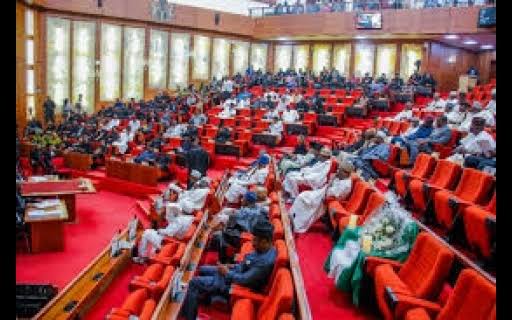
- NASS passes ₦68.3trn 2026 budget
The Senate on Tuesday approved a loan request by President Bola Ahmed Tinubu to secure new foreign loans totalling $6 billion for infrastructure development, debt servicing, and port rehabilitation.
The approval followed the consideration of two separate letters read during plenary by Senate President Godswill Akpabio.
In the first letter, President Tinubu sought approval for a $5 billion loan from First Abu Dhabi Bank in the United Arab Emirates (UAE). If fully drawn, the facility would raise Nigeria’s total public debt from $110.3 billion to $115.3 billion.
The President, who requested “urgent approval,” stated that the loan would be backed by naira-denominated securities.
In a second request, the President asked the Senate to approve a $1 billion loan for the rehabilitation of the Lagos Port Complex and Tin Can Island Port. The facility is being arranged by Citibank London and is backed by UK Export Finance (UKEF).
According to the President, the funding is intended to modernise the two Lagos ports, improve operational efficiency, enhance safety standards, and align port infrastructure with global best practices.
He noted that the rehabilitation would address longstanding structural deficiencies and support economic growth by boosting trade and logistics capacity.
The President added that the loan, if approved, has a repayment tenure of 14 years, including a 48-month availability period. He further stated that the terms include a 1.1 percent availability fee and a 1.07 percent UKEF premium.
Earlier, Chairman of the Senate Committee on Foreign and Local Loans, Senator Aliyu Wamakko, said the committee had conducted extensive deliberations on the requests before presenting its report to the Senate for approval.
Same Tuesday, the Senate and the House of Representatives passed 2026 budget following a report presented by the Joint Committee on Appropriations.
In the Senate, the lawmakers passed the budget after reviewing a report presented by the chairman of the Senate Committee on Appropriations, Adeola Olamilekan.
The upper chamber increased the total budget from N67.7 trillion, as requested by the president, to N68.323 trillion.
The budget was approved after most senators endorsed it through voice votes. The Senate President, Godswill Akpabio, subsequently announced the budget’s passage.
The lawmakers supported the passage of the budget after they reviewed a report presented by Adeola Olamilekan, chairman of the Senate Committee on Appropriations.
Olamilekan, while presenting the report, recommended the allocation of N4.799 trillion for statutory transfers, N15.809 trillion for debt servicing, N16.427 trillion for recurrent (non-debt) expenditure, and N32.287 trillion for capital expenditure.
The Joint Committee on Appropriations presented the report on the 2026 Appropriation Bill to the National Assembly, recommending approval of a ₦68.3 trillion budget.
The budget, themed “Budget of Consolidation, Renewed Resilience and Shared Prosperity”, aims to consolidate macroeconomic stability, improve the business environment, promote job-rich growth, and reduce poverty.
The Committee approved adjustments to the budget, including the inclusion of ₦5.71 trillion in outstanding capital obligations and ₦2 trillion for priority projects. The budget also includes provisions for strategic national interventions, such as the Presidential Legacy Light Rail Projects and the Tinubu National Beltway Initiative.
The adjustments will be funded through an increase in the oil benchmark by $10/b, generating ₦2.592 trillion, and an increase in external borrowings by ₦6.163 trillion. The telecommunications sector is expected to contribute ₦874 billion in revenue.
The budget allocates ₦4.8 trillion for statutory transfers, ₦15.8 trillion for debt service, ₦15.4 trillion for recurrent expenditure, and ₦32.3 trillion for capital expenditure.
The Committee observed that the capital expenditure component is higher than previous years, reflecting the government’s determination to prioritize key sectors such as security, health, education, and infrastructure.
It recommended approval of the budget and urged the Senate to work with the Executive to implement the budget effectively. It also recommended extending the Appropriation (Repeal and Enactment) Act, 2025 to June 30, 2026.