As presidential candidates commence strategic engagements and campaigns across the country, our correspondent, MYKE UZENDU examines some of the issues and key messages that will be on the front burner.
Nigeria is heading into what promises to be one of the most consequential presidential contests since the return to democratic rule in 1999.
Consequently, campaign messages are expected to revolve around the economy, security, corruption, jobs, food prices, energy and institutional reform.
While the incumbent president and his political party are expected to present a scorecard of three years of stewardship, the other candidates will question his eligibility to recontest, following controversies surrounding his certificate and also the alleged drug case that is before Judge Beryl Howell of the District of Columbia, in the United States.
The opposition candidates are expected to feast on the present economic, multiple taxation, national debt, increasing insecurity and general hardship associated with the reforms embarked upon by the present administration.
But beneath all these issues lies one overriding question: who can convince Nigerians that the country can be governed differently and, more importantly, that their lives will actually improve if entrusted with the keys of the presidential villa in 2027?
Tinubu: Socio-economic reforms and continuity argument
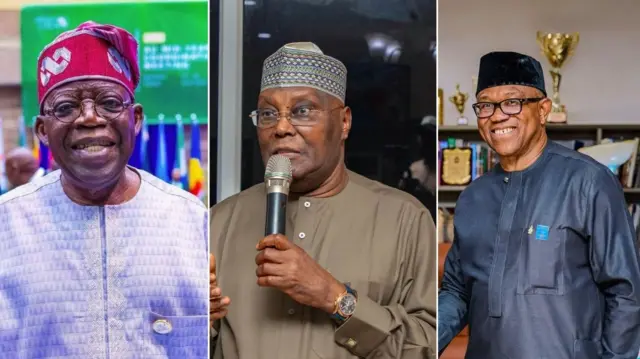
The incumbent President, Bola Tinubu and the All Progressives Congress (APC) will seek to convince Nigerians that the difficult reforms introduced since 2023 will produce better results after the election.
The President is expected to highlight initiatives such as the Nigerian Education Loan Fund (NELFUND), infrastructure projects including the Lagos-Calabar Coastal Highway, local government financial autonomy, tax reform and increased revenues accruing to state governments.
The administration will also point to increased investment in security, the creation of additional Army divisions and the renewed debate over state police.
Tinubu’s campaign will likely argue that the reforms were necessary to correct structural weaknesses inherited by his administration.
Justifying his strangulating economic decisions, The President through his Special Adviser on Media, Bayo Onanuga said, “In the past three years, we tried to do the hard part by implementing the necessary reforms to stabilise the economy. Now the economy is stabilized, and we have laid the foundation for a prosperous nation.
“Because of those tough decisions, today Nigeria has trade surpluses. Our foreign reserves are at their highest in 17 years. Our credit rating has moved up several notches. We are building roads, railways and superhighways that will last for a long time.
“Under our watch, the economy is on the irreversible path to experience even more growth that all homes will feel at the dining table and in their pockets,” he said.
The challenge for the APC, however, will be convincing voters that the benefits of these reforms have sufficiently outweighed their immediate costs.
The opposition will almost certainly ask Nigerians a simple question: Are you better off today than you were in 2022?
Atiku: Subsidy Return and economic wellbeing.
Former Vice President Atiku Abubakar, who is campaigning on the platform of the African Democratic Congress (ADC), has proposed a return of targeted petrol subsidy.
Atiku, in a post on his X account reiterated, “On the question of subsidy, my position has not changed and will not change: I will restore it! A nation as blessed as ours has no business abandoning its citizens to hardship. Nigeria is rich enough to look after her own.
“I believe the wealth of a nation is not measured by how much government collects, but by how much the money in the pockets of its people can buy.
“I want wages to have value again. I want farmers to move produce without transport swallowing their profits. I want families to fill their baskets without emptying their pockets. I want businesses to produce, employ and prosper.
“That is why I will restore targeted subsidy and put purchasing power back in the hands of Nigerians.
“When fuel rises, transport rises. When transport rises, food rises. When food rises, families suffer. I will break that wretched chain that has defined our national life in the nearly four years of Tinubu’s presidency.
“I will support Nigerian production, reduce energy costs and restore purchasing power. I will not restore the import racket; I will restore relief” he promised.
The proposal has triggered a counterattack from the Presidency, which has estimated that achieving a pump price of about ₦600 per litre could cost the country ₦19.1 trillion annually. The ADC has rejected the figure as a “phantom” estimate.
Beyond fuel, Atiku is expected to campaign on fighting corruption and reducing bureaucratic bottlenecks in governance.
Obi: From consumption to production and prudence in economic management.
Peter Obi, the presidential candidate of the Nigeria Democratic Congress (NDC), is expected to make competence, productivity and prudent management of public resources the centerpiece of his campaign.
Obi’s proposed transformation of Nigeria from a consumption-driven economy into a production economy is likely to be one of his strongest campaign messages.
He argues that Nigeria cannot achieve sustainable prosperity by relying heavily on imports, borrowing and distributing scarce resources. Instead, the country must produce more of what it consumes and create industries capable of generating employment and exports, as well as transform the vast arable land in the north into a food hub that will stimulate rural economies.
He is also expected to campaign for electoral reform, stronger institutions and tighter control of public expenditure.
He repeatedly argued that Nigeria’s leadership must demonstrate personal sacrifice before asking citizens to endure economic hardship, just as he promised to cut the cost of governance and eliminate what he considers unnecessary privileges and waste in government.
Speaking during his campaign flag-off, Obi said, “We will cut wasteful spending while protecting investments that create jobs and expand productive capacity. We will raise public revenue without stifling businesses and invest in education, healthcare, security, and infrastructure because they are foundations for future prosperity, not costs to defer.
“We will also build institutions that endure beyond any single administration. That is the standard by which every government should be judged.”
Makinde: A national reset
Engr. Makinde of the Allied Peoples Movement (APM) is expected to frame his campaign around “national reset.”
His message is likely to center on correcting what he describes as governance failures and rebuilding institutions capable of delivering results.
Makinde has already urged Nigerians to judge presidential candidates by records rather than rhetoric, arguing that voters should demand workable ideas and evidence of implementation capacity.
In his Presidential declaration speech Makinde said, “Our nation is hurting. Millions of Nigerians are weighed down by hunger, insecurity, rising transportation costs, and uncertainty about tomorrow. Across the country, people are asking the same question: when will leadership truly begin to work for the ordinary citizen? When will we fulfil the Nigerian Dream.
“I believe the answer is simple… Nigeria must reset.
“We cannot continue recycling the same leadership approaches while expecting different results. A new direction must emerge; one built on competence, courage, accountability and compassion for the people.
“As President of Nigeria, I will work to reform our national security architecture so that States are no longer left helpless in moments of crisis. The decentralization that we need for a more effective security will be prioritised. The safety of Nigerians will not be treated as a political talking point. It will be a national duty.
“I believe we have the capacity to rebuild our economy with honesty and practical reforms”.
Sowore: The revolutionary change
Omoleye Sowore and his African Action Congress (AAC), argues that Nigeria’s current political structure has continuously produced poor leaders.
His campaign would focus on revolutionary change, anti-corruption, social justice, democratic freedom, unemployment and a complete overhaul of what he termed a “broken system.”
Writing on his X, Sowore said, “Hunger is not an accident; Nigerian leaders made it a policy. Nigerians are hungry not because Nigeria lacks fertile land, farmers, water, labour, or the capacity to feed itself. Nigerians are hungry because successive governments have treated food security as an afterthought.
“Nigeria deserves a new direction. Nigeria deserves leaders who will put the people first. Nigeria deserves equal rights and justice for all!”
Adebayo: Reversing Nigeria’s misfortune
Adebayo Adewole and his Social Democratic Party (SDP) outlined five campaign pillars: “(1) Establish a clean, accountable government by appointing ethical ministers and advisors; (2) Boost productivity to eradicate poverty; (3) Institute transparent market rules to attract investors; (4) Ensure an independent judiciary for social, economic and legal justice; and (5) Achieve full employment as a non-negotiable goal”.
His priority is single-digit unemployment via targeted programmes, emphasising that “once you have full employment, the rest of your problems can be dealt with.”
Key to his turnaround is building a “medium-sized economy” blending China’s industrialisation, India’s urban vibrancy and the US’s market sophistication.
“Nigeria would export contributions, not problems – talent, goods and capital – while embracing global integration,” Adebayo explains.