By Maxwell Bako Dogara
Between 2015 and 2023, Kaduna State was plunged into one of the darkest chapters of its history, recording over 1,160 major security incidents that claimed an estimated 4,800 lives, with thousands more abducted across rural communities stretching from Southern Kaduna to the forests of Birnin Gwari, Giwa, Igabi and Chikun.
In 2021 alone, more than 1,190 people were killed and over 3,300 kidnapped, while the 15-month period between 2022 and early 2023 saw at least 1,266 murders and nearly 5,000 abductions, accompanied by widespread arson, school closures and mass displacement. These figures captured a state gripped by fear—where banditry had become routine commerce and insecurity a daily reality.
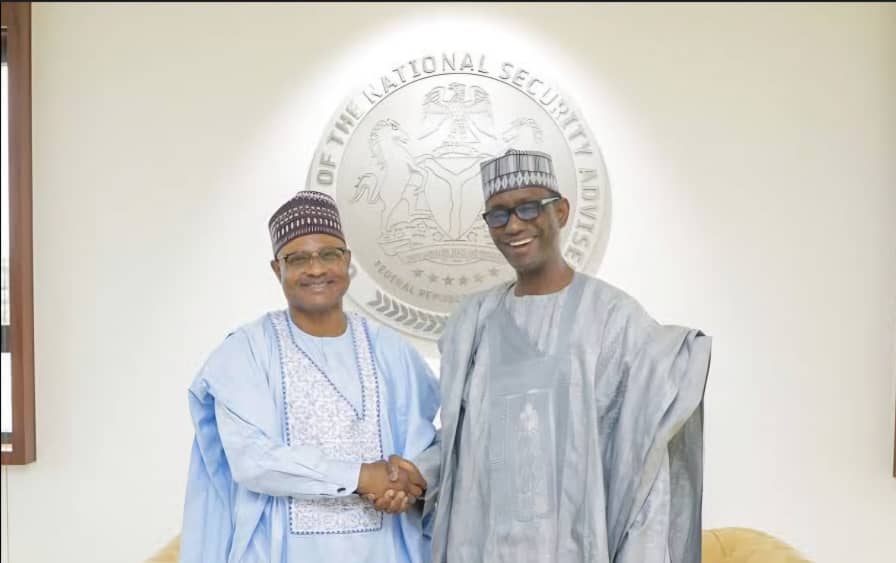
It was into this fractured and bleeding landscape that Governor Uba Sani emerged in May 2023, inheriting not just a crisis but a broken security response system. What followed was not rhetoric or denial, but a fundamental reset anchored on cooperation—most critically, a close, functional and trust-driven partnership between the Kaduna State Government and the Office of the National Security Adviser (ONSA) under Malam Nuhu Ribadu.
At the heart of Kaduna’s turnaround lies a decisive shift: security ceased to be siloed. Intelligence generated at community and state levels now feeds directly into the national security architecture, where it is fused, verified and acted upon with speed. What once took days now takes hours. What once stalled now triggers response. This intelligence-to-operation pipeline—enabled by ONSA and driven locally by Uba Sani’s hands-on leadership—has redefined how security operations are conceived and executed in Kaduna.
The Kuriga schoolchildren rescue became the first major signal that the old order had collapsed. Rather than reckless assaults that historically escalated casualties, the operation relied on layered intelligence, patient surveillance and coordinated deployment. Every child was rescued alive—an outcome that shattered the narrative of inevitability around mass abductions.
That model matured in Birnin Gwari, long regarded as Nigeria’s most stubborn bandit stronghold. Sustained intelligence sharing and synchronized operations dismantled criminal enclaves, restricted movement and cut supply routes. Communities that had normalised displacement began gradual returns, while criminal networks lost the advantage of chaos and delay.
In the Giwa axis, rapid-response deployments—triggered by real-time intelligence relay between Kaduna and ONSA—neutralised several kidnap attempts before they metastasised into prolonged crises. Speed, not spectacle, became the defining advantage.
The Kurmin Wali operation, culminating in the rescue of all 183 abducted residents alive, represented the full expression of this synergy. It showcased a security architecture where local knowledge met national capability, where political leadership removed bottlenecks, and where federal coordination delivered air support, operational discipline and decisive timing. In a country accustomed to tragic tallies, the absence of casualties was itself historic.
What makes the Uba Sani–Ribadu partnership exceptional is clarity of roles and mutual trust. Governor Uba Sani facilitates—investing in logistics, strengthening community intelligence and providing political cover for security agencies. Malam Ribadu brings coherence—marshalling federal intelligence assets, enforcing inter-agency discipline and ensuring swift national backing. Together, they have replaced blame-shifting with shared responsibility.
This alignment has restored confidence within the security services and rebuilt trust with communities. Commanders act knowing intelligence will not be ignored. Citizens engage knowing their information will matter. Bandits, deprived of confusion and delay, are steadily losing ground.
Kaduna’s experience delivers a clear national lesson: insecurity thrives on disconnection. But when state leadership and national security command move as one, criminals lose leverage, kidnappings lose profitability, and terror begins to retreat.
What Kaduna is witnessing today is not chance. It is the dividend of alignment. The Uba Sani–Ribadu synergy has redefined Kaduna’s security story—from fear and fragmentation to coordination, precision and growing confidence.
Dogara, a public commentator wrote from Kaduna