By Mercy Aikoye
The Executive arm of government and the National Assembly have pledged to strengthen collaboration to bridge gaps between budgeting, implementation, and Nigeria’s national development plans.
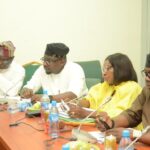
The disclosure was made on Wednesday at the ongoing Two-Day National Policy Dialogue in Abuja by the Minister of Budget and Economic Planning, Senator Atiku Bagudu.
Also speaking at the event were the Chairman of the House Committee on National Planning and Economic Development, as well as his Senate counterpart, Senator Musa Mustapha, who gave their remarks on the second day of the dialogue.
The commitment was made as both sides emphasised that effective coordination and proper alignment of policies are essential to achieving the country’s development objectives.
Minister of Budget and Economic Planning, Senator Atiku Bagudu, said national planning remains a constitutional responsibility for those in authority.
“National planning in Nigeria is mandated and obligated by the Constitution,” he said.
Bagudu commended the National Assembly for its support of ongoing economic reforms, describing the measures as bold and necessary despite their difficulty. He noted that lawmakers play a crucial role in communicating and defending such policies to the public.
Citing Section 13 of the Constitution, the minister stressed the need for synergy among all arms of government.
“All those in authority, legislative, judicial, and executive, must work together,” he added.
Chairman of the House Committee, Hon. Gboyega Isiaka, reaffirmed the readiness of the 10th National Assembly to deepen cooperation with the Executive beyond routine oversight functions.
“We need to collaborate more, beyond oversight and working sessions,” he said.
Similarly, Chairman of the Senate Committee, Senator Musa Mustapha, urged a shift in how budgets are perceived and utilised. He argued that budgets should serve as instruments for development rather than mere records of expenditure.
“We must stop treating the budget as simply a document of expenses, but as the primary engine for implementing our national development agenda,” he said.
Mustapha added that Nigeria’s planning framework is now guided by a long-term vision of building a $1 trillion economy by 2030, noting a departure from short-term political considerations.
He also credited the administration of President Bola Tinubu with initiating reforms aimed at stabilising the economy and restoring investor confidence. According to him, the policies are addressing longstanding structural challenges while laying the foundation for inclusive and sustainable growth.