By Chuks Oyema-Aziken
Africa is emerging as a critical driver of the global transition to a circular economy, with innovations in waste management, climate action, and inclusive entrepreneurship placing the continent at the forefront of sustainable development.
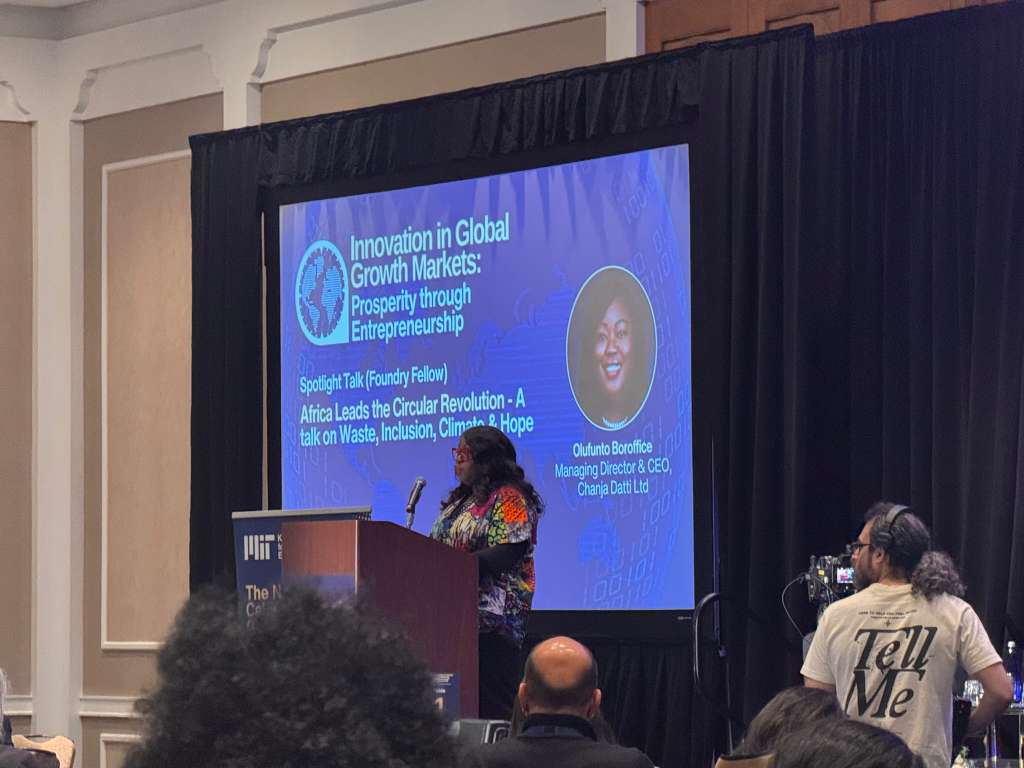
A press release by Waste Management firm, Chanja Datti said the founder, Olufunto Boroffice made this known during a TED-style presentation at the annual conference hosted by the Massachusetts Institute of Technology Kuo Sharper Center, held from April 22 to 23 in Cambridge, Massachusetts, under the theme “Innovation in Global Growth Markets: Prosperity through Entrepreneurship.”
In her address, Boroffice challenged conventional perceptions of waste, describing it as a resource capable of driving economic transformation across African cities such as Lagos, Nairobi, Cairo, and Johannesburg.
She highlighted a growing ecosystem of entrepreneurs who are converting plastic, organic waste, and other materials into valuable products, creating jobs while addressing environmental challenges. According to her, these efforts reflect a broader shift toward a circular economy—one that prioritizes reuse, repair, and regeneration over the traditional “take, make, dispose” model.
Boroffice stressed that Africa contributes less than 4 percent of global greenhouse gas emissions but is among the regions most affected by climate change, citing droughts, flooding, and rising sea levels across the continent. She noted that nearly half of global emissions are linked to how goods are produced and consumed, arguing that circular systems offer a major opportunity to reduce environmental impact. “The climate crisis is not a future threat. It is a present emergency,”she said.
The speaker drew attention to the role of informal workers, including waste pickers and recyclers, whom she described as central to Africa’s circular economy. She said these workers recover between 50 and 80 percent of recyclable materials in some cities, often without formal support or recognition. “Inclusion is not charity. Inclusion is strategy,” she emphasized, calling for policies that integrate and empower these groups.
Boroffice also highlighted the contributions of women entrepreneurs and young people, noting that Africa’s youthful population presents a unique advantage in designing long-term sustainable solutions. She pointed to emerging enterprises that transform waste into construction materials, fertilizers, and renewable energy solutions.
Citing examples across the continent, Boroffice referenced initiatives such as Rwanda’s ban on single-use plastics, Kenya’s mobile money systems, Ethiopia’s mass tree-planting efforts, and Morocco’s large-scale solar investments. She said these developments demonstrate Africa’s capacity not only to solve local problems but also to provide models for other regions facing similar challenges.
Boroffice urged governments, investors, and entrepreneurs to embed circular principles into business models, formalize informal sector contributions, and prioritize climate action. She also called for increased global support for African-led solutions, emphasizing that the continent’s innovations are essential to addressing global environmental challenges.
Rejecting the notion of Africa as a passive recipient of development aid, Boroffice argued that the continent is actively shaping the future of sustainable systems. “The world needs Africa’s solutions,”she said, urging stakeholders to recognize and invest in the continent’s growing role in global innovation.