By Chuks Oyema-Aziken
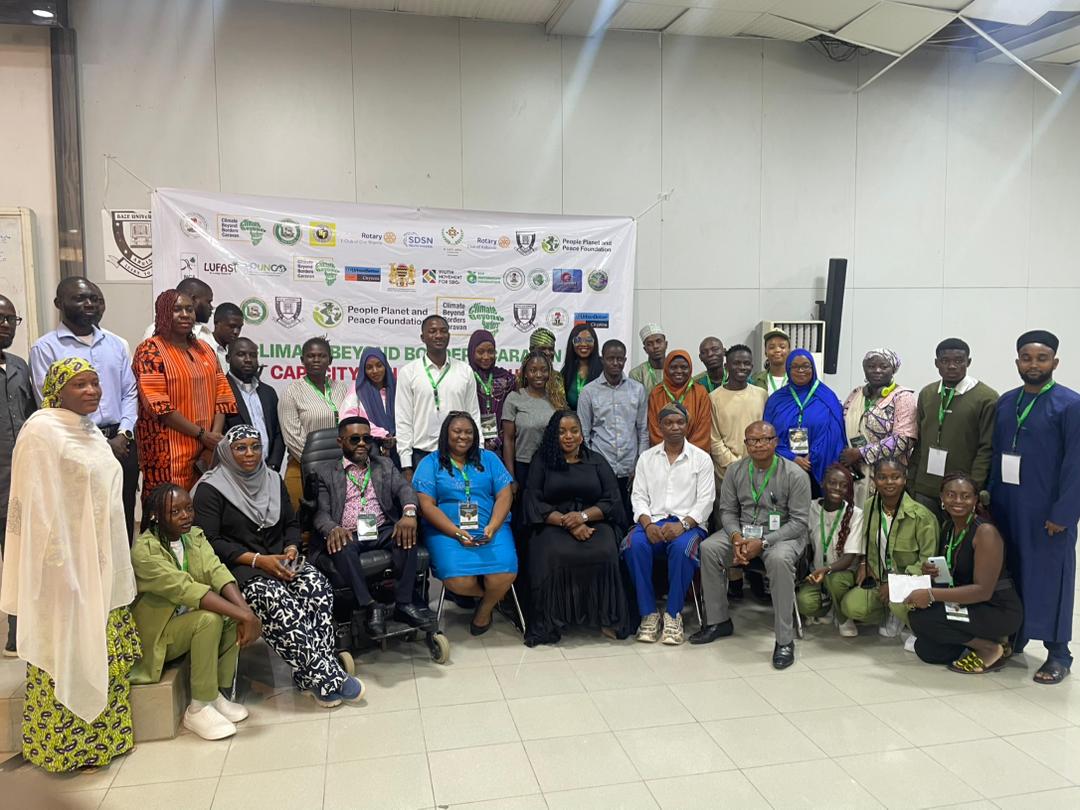
The Federal Government has reiterated its commitment to youth participation in climate action as the Climate Beyond Borders Caravan officially commenced in Abuja, drawing stakeholders from across Africa to advance grassroots environmental solutions.
The initiative, organised by the People, Planet and Peace Foundation, was commended by the Federal Ministry of Youth Development as a timely and bold intervention aimed at strengthening climate advocacy, eco-tourism, and community-driven climate action across the continent.
Delivering a goodwill message on behalf of the Honourable Minister of Youth Development, Comrade Ayodele Olawande, the Ministry said Nigeria was proud to host the opening of the caravan, which will traverse 17 African countries across West, East, Central, and Southern Africa.
The Minister represented by his Senior Special Assistant, Mrs Leah Akinfiresoye described the theme, “From Awareness to Action: Mobilizing Resourceful Nigerian Youth for Grassroots Climate Solutions,” as both powerful and urgent, noting that Nigerian youth are “not under-resourced but under-utilised,” with immense potential to drive climate innovation.
He stressed that young people possess the creativity and resilience needed to lead in green entrepreneurship, renewable energy, sustainable agriculture, waste management, and climate-smart innovation if adequately supported.
According to him, climate change is no longer a distant threat but a present reality, evident in desertification in the North, flooding and coastal erosion in the South, and rising food insecurity across the country.
The Ministry warned that these environmental challenges are already impacting households, markets, and communities, adding that urgent collective action is required to mitigate further damage.
However, it noted that the climate crisis also presents economic opportunities, particularly for youth engagement in green jobs and sustainable enterprises that can simultaneously address unemployment and environmental degradation.
It highlighted ongoing government interventions such as the Youth Migration and Climate Action Resilience Department and the Circular Economy Youth Empowerment Initiative, which seeks to create jobs by converting waste into valuable eco-friendly products.
The Ministry further emphasized that small-scale community actions, including tree planting, recycling, drainage clearing, and environmental awareness campaigns, remain critical to achieving long-term sustainability goals.
Speaking at the event, Dr. Joseph Omoniyi of the Federal Ministry of Innovation, Science and Technology described the caravan as a “continental technology discovery mission” aimed at identifying indigenous climate solutions across African countries.
He explained that the project would help build a database of locally applicable technologies that can be adopted by youth in different nations to address climate-related challenges effectively.
Dr. Omoniyi added that the outcomes of the caravan are expected to contribute to a broader African climate solutions framework and strengthen contributions to global climate negotiations.
Also speaking, Kenyan climate advocate Mariam Abdirashid of Roots of Hope Organisation stressed the disproportionate impact of climate change on women and rural communities across Africa, calling for stronger youth and women collaboration in climate action.
Caravan leader and co-organiser, Olatunji Olaitan-Francisco of the Triple P Foundation, said the initiative is designed as a people with the skills to champion climate advocacy in their respective communities.
He noted that the caravan will proceed from Nigeria to Benin Republic, Togo, and several other African countries, engaging climate champions along the route.
Olaitan-Francisco expressed optimism that the initiative would go beyond awareness creation to produce tangible outcomes that promote environmental protection and sustainable development across the continent.
The Climate Beyond Borders Caravan is expected to strengthen regional cooperation, enhance youth participation in climate governance, and promote scalable local solutions to Africa’s growing environmental challenges.