By Stella Odueme
Nigeria has unveiled its first harmonised fertiliser recommendation manual in over 14 years as part of efforts to boost crop yields, improve soil health and enhance fertiliser-use efficiency nationwide.
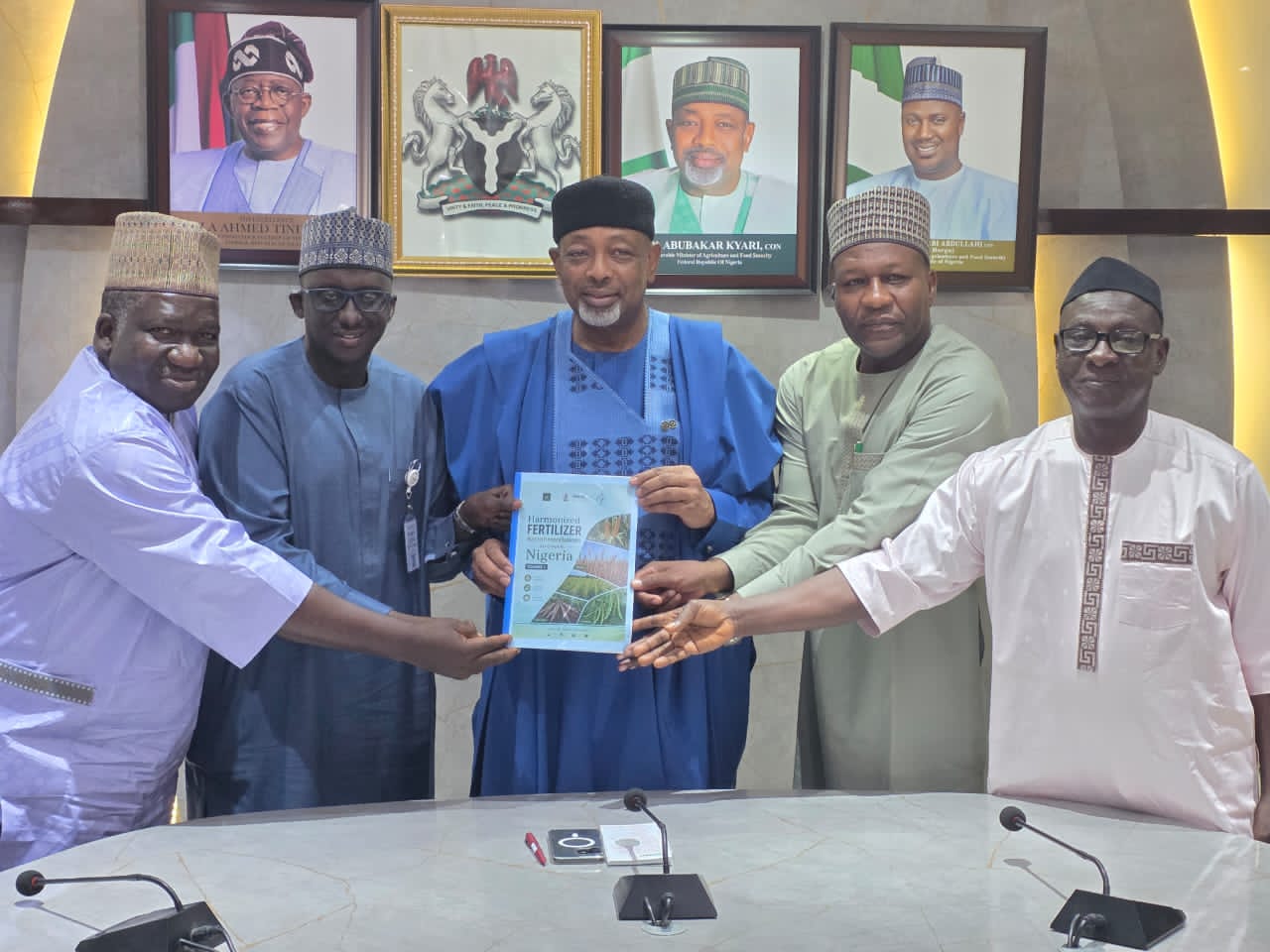
The National Agricultural Development Fund (NADF), in collaboration with the Farm Input Support Services (FISS), presented the Harmonised Fertiliser Recommendations for Nigeria – 2026 Edition to the Minister of Agriculture and Food Security, Abubakar Kyari.
Speaking during the presentation, NADF Executive Secretary, Mohammed Ibrahim, said the initiative was conceived in April 2025 following concerns among stakeholders over the absence of a unified fertiliser application framework for Nigerian farmers.
According to him, the project brought together key stakeholders, including the Farm Input Support Services, the Fertilizer Producers and Suppliers Association of Nigeria, OCP Group and the International Fertilizer Development Center to develop scientifically validated fertiliser recommendations tailored to Nigeria’s diverse farming conditions.
Ibrahim explained that fertiliser was prioritised because of its importance to agricultural productivity and the complexity surrounding its application across different ecological zones.
The manual, which is regarded as the first phase of a broader national input application guide, currently covers five major crops — maize, rice, wheat, cassava and cowpea — with plans underway to include more crops in future editions.
Chairman of the Editorial Committee, Christogonus Daudu, described the document as a major intervention to address the gap created since the last national fertiliser recommendation manual was issued in 2012.
Daudu noted that the absence of updated fertiliser guidance over the years contributed to poor crop yields, inefficient fertiliser usage and declining soil fertility across farming communities.
He said the new guide provides practical recommendations on fertiliser rates, application timing and nutrient management, while also incorporating sustainable soil management practices such as Integrated Soil Fertility Management and the “4Rs” of nutrient stewardship — right source, right rate, right time and right place.
According to him, the recommendations were developed using research data from institutions including the Institute for Agricultural Research, Institute of Agricultural Research and Training, National Root Crops Research Institute, National Cereals Research Institute and the Lake Chad Research Institute.
He added that the manual contains fertiliser recommendations for Nigeria’s six agroecological zones, all 36 states and the Federal Capital Territory.
To improve accessibility for farmers and extension workers, fertiliser recommendations were converted from kilogramme measurements into bag equivalents, while nutrient deficiency guides and simplified extension glossaries were also included.
The committee further recommended translating the document into major Nigerian languages and deploying digital extension tools such as interactive voice response systems to support farmers in remote areas.
Responding, Minister Kyari commended the initiative but stressed the need to ensure that increased agricultural productivity also translates into profitability for farmers.
He warned that higher yields would have little economic value if production costs outweighed farmers’ returns, adding that fertiliser recommendations must reflect local soil realities and cost-benefit considerations.
The minister also expressed concern over the decline of agricultural extension services across states, describing extension workers as critical to improving farm productivity and technology adoption.
Kyari further called for the integration of the manual with existing soil health programmes and climate adaptation strategies to address challenges such as flooding, drought and irregular rainfall patterns.
He noted that although Nigeria possesses about 70 million hectares of arable land, only about 30 million hectares are currently being cultivated, underscoring the importance of improving productivity on available farmland.
Stakeholders believe the harmonised fertiliser manual could play a major role in strengthening Nigeria’s food security strategy through improved nutrient management, soil restoration and increased yields for staple crops.