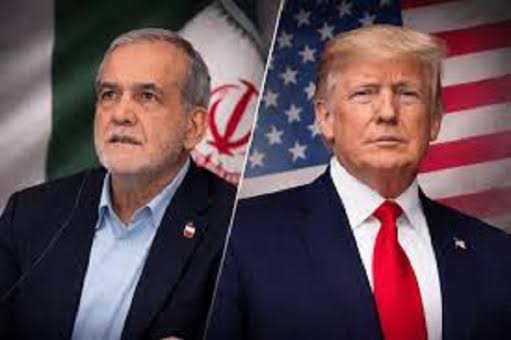
The United States and Iran digitally signed and released a memorandum of understanding (MoU) aimed at ending the conflict between the two countries on Wednesday, with US President Donald Trump threatening to resume attacks on Iran if it failed to honor its commitments.
The memorandum came as leaders gathered at the G7 summit in France, where the group welcomed the interim deal while calling for an immediate ceasefire in Lebanon and stressing that follow-up negotiations must ensure Iran never acquires a nuclear weapon.
Trump, attending the summit, said he hoped Iran would abide by the agreement and warned that if it did not Washington was prepared to launch new military action. “We’re going to bomb the hell out of them if they violate the agreement,” Trump cautioned at a press conference. “I don’t want them to. I want them to honor the agreement.”
Meanwhile, he appeared to soften one of the justifications he had previously offered for attacking Iran, saying it would be “unfair” for Tehran not to have ballistic missiles after earlier vowing to eliminate them.
He added negotiators from both countries worked toward a final agreement during the 60-day period, which would bring peace to the Middle East and ease pressure on global oil markets.
Tehran did not respond to Trump’s renewed military threats.
Iran, Pakistan say MoU takes immediate effect.
Both Trump and Iranian President Masoud Pezeshkian have digitally signed the memorandum, with Pakistan, which mediated months of indirect negotiations between Washington and Tehran, welcomed as a diplomatic breakthrough.
The country’s Prime Minister Shehbaz Sharif said the memorandum takes immediate effect, and congratulated both countries for choosing dialogue over confrontation. Iranian officials likewise described the agreement as already in force, while emphasizing that negotiations on a permanent settlement should begin without delay.
The US and Iran respectively released the full text of the digitally signed MoU through media outlets on Wednesday, which establishes an immediate ceasefire and a 60-day timetable for negotiating a final settlement. The agreement calls for an end to military operations on all fronts, including Lebanon, while both sides pledge to respect each other’s sovereignty and refrain from the use or threat of force.
“Everything we sought to achieve through military action, we obtained several times over through negotiation; it was not even comparable,” Iran’s lead negotiator Mohammad Bagher Ghalibaf told state television about the document.
Under the MoU, the United States commits, together with regional partners, to formulate a reconstruction and economic development plan worth at least $300 billion for Iran, with an implementation mechanism to be finalized during negotiations on a permanent agreement. An executive mechanism will oversee implementation before the final accord is submitted to the UN Security Council.
The MoU also seeks to restore maritime security in the Strait of Hormuz. Iran agrees to facilitate the safe passage of commercial shipping during the 60-day negotiation period and work toward restoring traffic to pre-war levels, while the United States will begin lifting its naval blockade and halt interference with Iranian shipping. The report also envisages discussions with Oman and other Gulf states on the future management of the strategic waterway.
G7 leaders welcome the MoU
According to the released MoU, Iran reaffirms that it will not develop or acquire nuclear weapons, while the two sides agree to resolve the issue of Iran’s enriched uranium stockpile through a mutually agreed mechanism under International Atomic Energy Agency (IAEA) supervision.
G7 leaders hailed the agreement at their summit.
Oil prices extended their decline on Wednesday as optimism over the reopening of the Strait of Hormuz eased concerns about global supply disruptions. Brent crude briefly fell below $80 a barrel, its lowest level since the latest round of conflicts starting in February. However, the market later reversed course, with prices recovering more than 1% after US President Donald Trump warned that Washington could resort to military action again if Iran failed to uphold the newly signed agreement.
Meanwhile, the leaders of France, Germany, Britain, Japan, Italy, Canada and the US demanded in a joint statement an immediate ceasefire in Lebanon, where the memorandum envisages an end to hostilities between Israel and the Hezbollah after months of fighting that has left thousands dead and displaced more than one million people.
Although strikes in Lebanon have eased since the memorandum was reached on Sunday, clashes in the region have not stopped entirely. Israel, which did not participate in the negotiations and continues to maintain troops in southern Lebanon, said it retains the right to use force.
Expert: MoU as roadmap for future negotiations but still vulnerable
Wang Jin, assistant director of the Institute of Middle East Studies at Northwest University of China, described the 14-point MoU between the United States and Iran as both a confirmation of the ceasefire and a roadmap for future negotiations.
The agreement formalizes the de facto ceasefire that has been in place since April while establishing a 60-day framework for talks on Iran’s nuclear program and sanctions relief, he said.
The newly signed document requires reciprocal concessions, with Iran accepting limits on its nuclear activities and greater international oversight, while the United States gradually eases sanctions and supports Iran’s post-war economic recovery.
Wang cautioned that the MoU still remains inherently fragile because it freezes the conflict rather than resolving it, noting differences still remain over the reopening of the Strait of Hormuz and Iran’s nuclear program. He added that Israel could become the biggest source of uncertainty for the agreement’s implementation.