From John Silas, Lagos
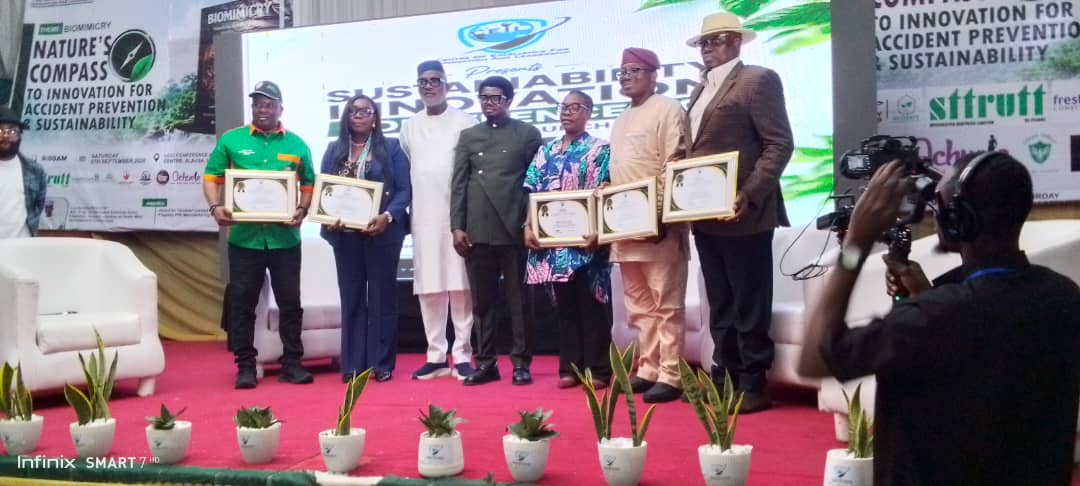
Safety experts, policymakers and industry leaders in Lagos have been urged to look to nature for answers to Nigeria’s rising workplace accident crisis, as the Center of Excellence for Innovation and Leadership, CEIL, held its Sustainability Innovation Conference 2.0 with the launch of a new book on biomimicry.
The event, convened by Dr. Julius Akpong of Azura Power West Africa Limited, had as its theme: “Biomimicry, Nature’s Compass to Innovation for Accident Prevention and Sustainability.”
The conference also unveiled Dr. Akpong’s book, _“Biomimicry, Nature’s Guide to Multi-Industry Accident Prevention.”
Speaking at the gathering, Dr. Akpong, who holds a PhD and founded CEIL in 2023 with other professionals, said the organization started as a CSIRO-inspired outfit working in correctional centers and communities to contribute to the United Nations’ 17 Sustainable Development Goals. “In 2024 and 2025 we decided to give it a formal framework through a conference,” he said. “Sustainability Innovation Conference 1.0 focused on using artificial intelligence to prevent greenwashing. That was a fabulous conversation. But something has been troubling me since my PhD.”
That concern, he said, is the global statistics on occupational accidents. According to the International Labour Organization, 2.6 to 2.7 million people die every year from work-related accidents and diseases. That translates to at least 7,600 deaths every single day.
“Technology is improving. AI is going up. Why can’t we make things better?” Dr. Akpong asked. “That was how I went back to my PhD research on biomimicry — learning from nature to solve human problems.”
Dr. Akpong explained that biomimicry involves studying how natural systems have survived for 380 billion years without failure, and applying those principles to human systems in healthcare, construction, oil and gas, energy, and other high-risk sectors.
He gave practical examples. “We have two kidneys, two eyes, two nostrils. That is redundancy built into the system. If one fails, the other takes over. Aircraft copied birds. That is why they have two engines. If one fails mid-air, the other takes over.”
He also cited termites and ants. “Termite mounds have natural flood protection systems. Ant hills don’t have ACs, yet they stay cool because of how air flows in and out. No matter how hot the sun is, inside remains cold. Who taught them? Nature did.”